


























1 / 4
0
Views
0
Downloads

0.0
0
0 Likes
Exploring Ecological Relationships
0 Views
0 Downloads
Paste this activity's link or code into your existing LMS (Google Classroom, Canvas, Teams, Schoology, Moodle, etc.).
Students can open and work on the activity right away, with no student login required.
You'll still be able to track student progress and results from your teacher account.
Information
Description
What It Is:
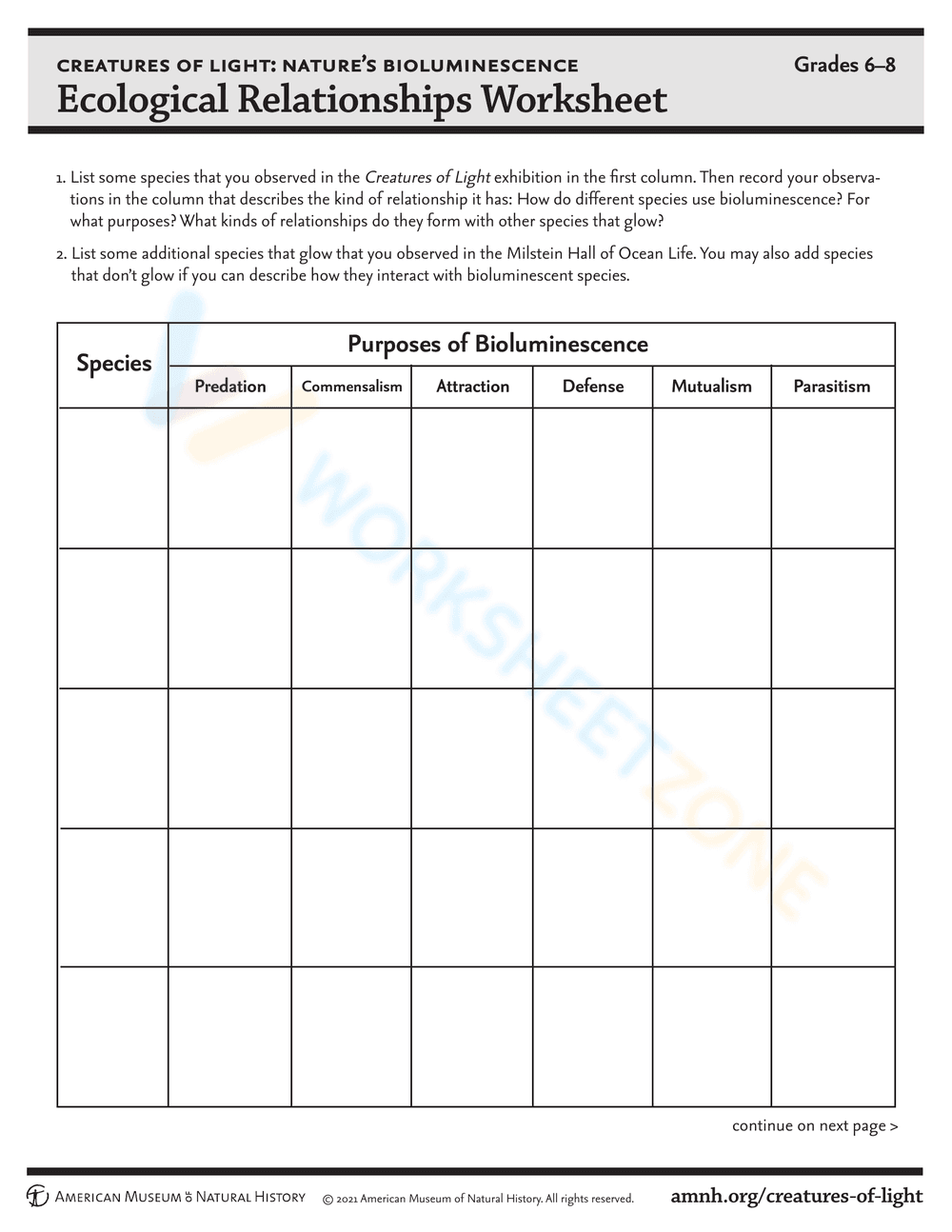
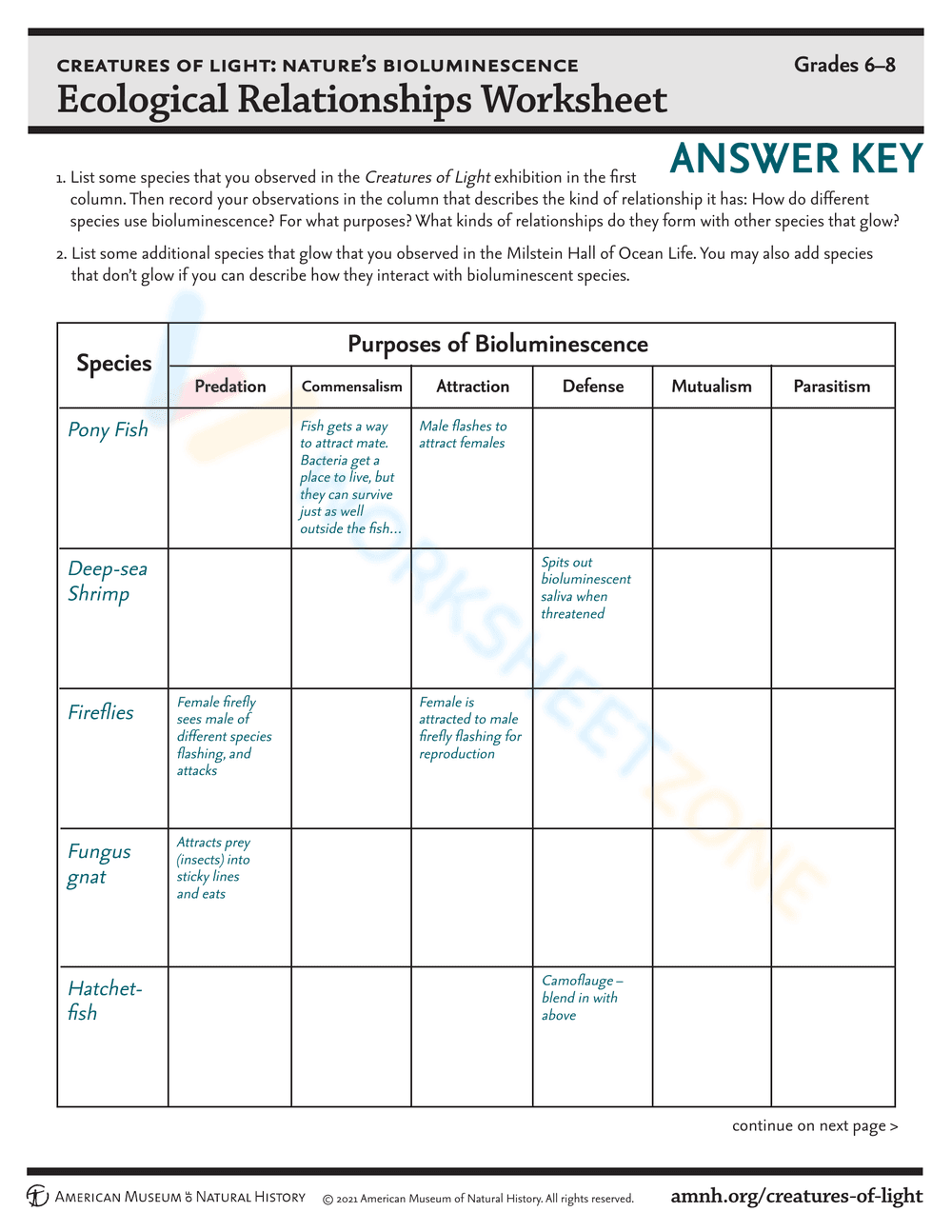
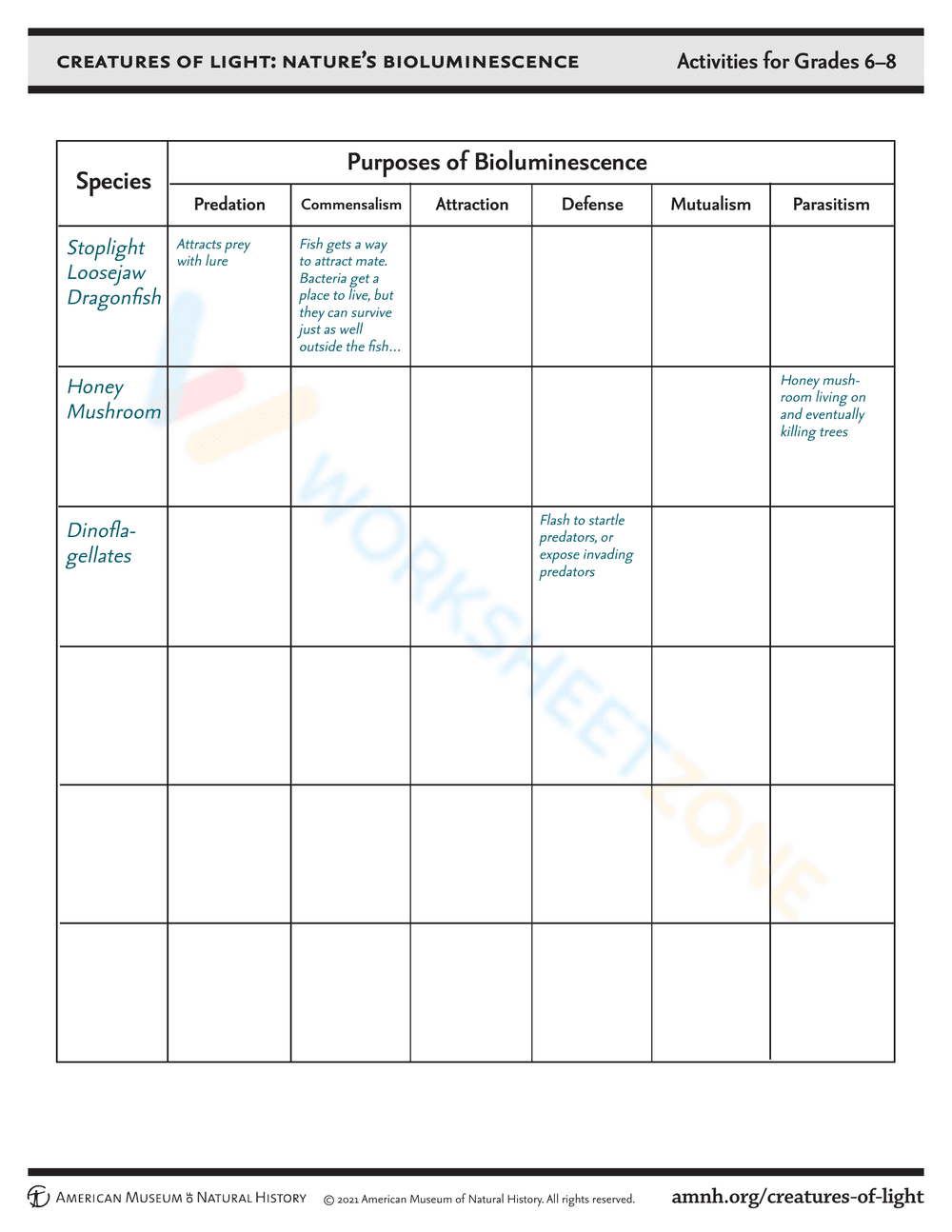
This is an ecological relationships worksheet focusing on bioluminescent creatures. It prompts students to list species they observed at the 'Creatures of Light' exhibition or the 'Milstein Hall of Ocean Life'. The worksheet provides a table with 'Species' as the first column and subsequent columns to record the 'Purposes of Bioluminescence' including Predation, Commensalism, Attraction, Defense, Mutualism, and Parasitism. Students are expected to identify and categorize the ecological relationships of these species.
Grade Level Suitability:
Grades 6-8. The worksheet requires an understanding of ecological relationships like predation, commensalism, and mutualism, along with the ability to analyze and categorize observations. The complexity of these concepts makes it suitable for middle school students.
Why Use It:
This worksheet reinforces understanding of ecological relationships and the role of bioluminescence in nature. It encourages observation skills, critical thinking, and the ability to categorize organisms based on their interactions. It connects classroom learning to real-world examples found in museum exhibits.
How to Use It:
Students first list observed species in the 'Species' column. Then, for each species, they identify and mark or describe the purpose of bioluminescence (Predation, Commensalism, Attraction, Defense, Mutualism, Parasitism) in the corresponding columns, based on their observations and understanding of ecological relationships.
Target Users:
Middle school students (grades 6-8) studying ecology, bioluminescence, or marine biology. This worksheet is designed for students who have visited the 'Creatures of Light' exhibition or the 'Milstein Hall of Ocean Life' at the American Museum of Natural History, or have researched bioluminescent species.
This is an ecological relationships worksheet focusing on bioluminescent creatures. It prompts students to list species they observed at the 'Creatures of Light' exhibition or the 'Milstein Hall of Ocean Life'. The worksheet provides a table with 'Species' as the first column and subsequent columns to record the 'Purposes of Bioluminescence' including Predation, Commensalism, Attraction, Defense, Mutualism, and Parasitism. Students are expected to identify and categorize the ecological relationships of these species.
Grade Level Suitability:
Grades 6-8. The worksheet requires an understanding of ecological relationships like predation, commensalism, and mutualism, along with the ability to analyze and categorize observations. The complexity of these concepts makes it suitable for middle school students.
Why Use It:
This worksheet reinforces understanding of ecological relationships and the role of bioluminescence in nature. It encourages observation skills, critical thinking, and the ability to categorize organisms based on their interactions. It connects classroom learning to real-world examples found in museum exhibits.
How to Use It:
Students first list observed species in the 'Species' column. Then, for each species, they identify and mark or describe the purpose of bioluminescence (Predation, Commensalism, Attraction, Defense, Mutualism, Parasitism) in the corresponding columns, based on their observations and understanding of ecological relationships.
Target Users:
Middle school students (grades 6-8) studying ecology, bioluminescence, or marine biology. This worksheet is designed for students who have visited the 'Creatures of Light' exhibition or the 'Milstein Hall of Ocean Life' at the American Museum of Natural History, or have researched bioluminescent species.


