


























1 / 2
0
Views
0
Downloads


0 Likes
Advanced Electronegativity Practice Problems
0 Views
0 Downloads
Paste this activity's link or code into your existing LMS (Google Classroom, Canvas, Teams, Schoology, Moodle, etc.).
Students can open and work on the activity right away, with no student login required.
You'll still be able to track student progress and results from your teacher account.
Information
Description
What It Is:
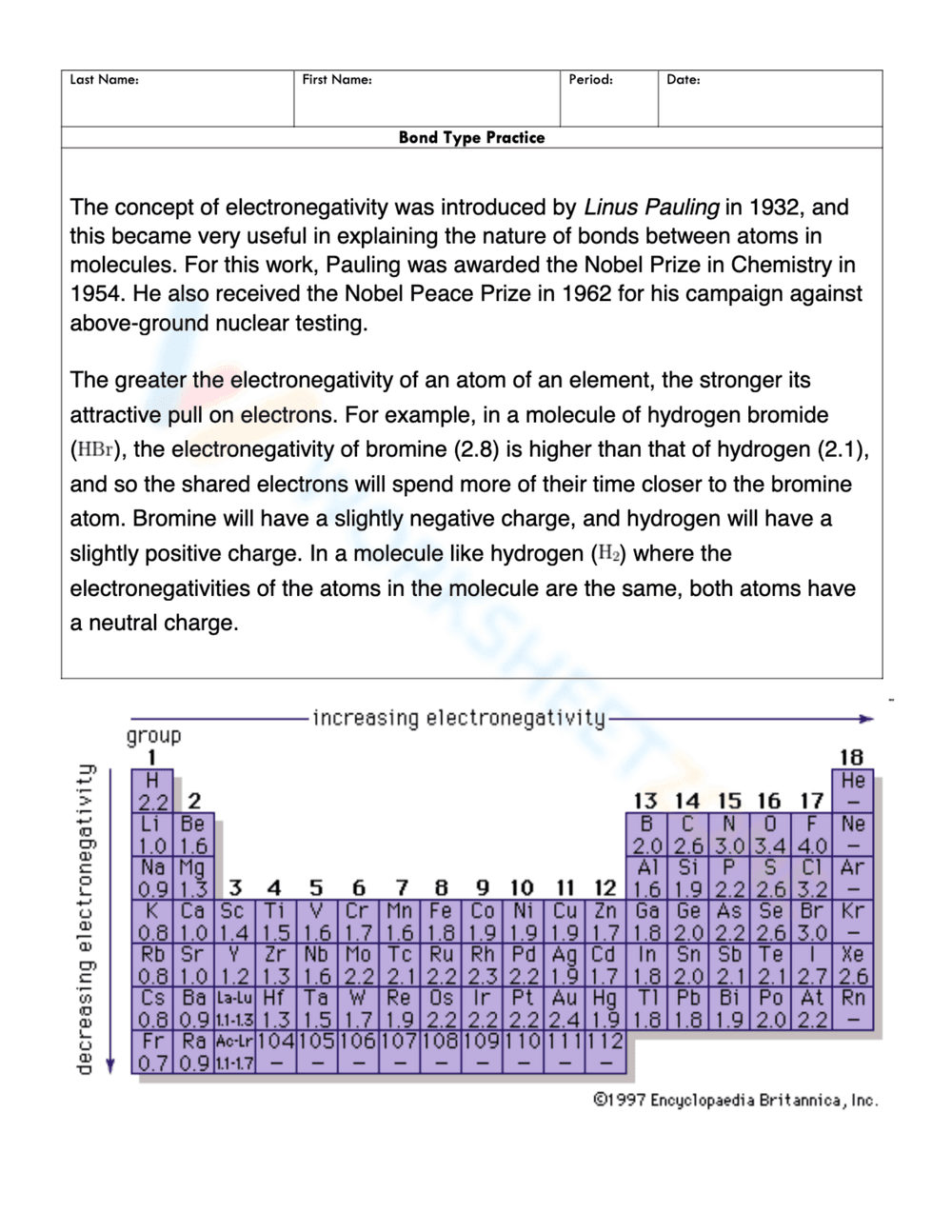
This is a chemistry worksheet focusing on electronegativity and bond types. It includes an introductory paragraph explaining the concept of electronegativity, its discovery by Linus Pauling, and how it relates to the nature of bonds in molecules. It provides an example using hydrogen bromide (HBr) and hydrogen (H₂) to illustrate how electronegativity differences affect the distribution of shared electrons and the resulting charges on atoms. The worksheet also features a periodic table highlighting electronegativity values for various elements and indicating the direction of increasing and decreasing electronegativity.
Grade Level Suitability:
This worksheet is suitable for high school chemistry students (Grades 9-12), particularly those studying chemical bonding and molecular structure. The concepts of electronegativity, polarity, and bond types are typically covered in high school chemistry curricula.
Why Use It:
This worksheet helps students understand the concept of electronegativity and its influence on chemical bonding. It explains how differences in electronegativity between atoms lead to polar bonds and partial charges. The included periodic table with electronegativity values provides a visual aid for comparing the electronegativity of different elements. It helps students visualize and understand the trends in electronegativity across the periodic table.
How to Use It:
Students can read the introductory text to understand the concept of electronegativity. They can then use the provided examples to analyze how electronegativity differences affect bond polarity. The periodic table can be used as a reference for determining the electronegativity of elements and predicting the type of bond that will form between them. The worksheet can be used as a study guide, a practice exercise, or a classroom activity.
Target Users:
The target users for this worksheet are high school chemistry students, teachers, and tutors. It can be used in a classroom setting, as a homework assignment, or as a supplemental resource for students who need extra help understanding electronegativity and chemical bonding.
This is a chemistry worksheet focusing on electronegativity and bond types. It includes an introductory paragraph explaining the concept of electronegativity, its discovery by Linus Pauling, and how it relates to the nature of bonds in molecules. It provides an example using hydrogen bromide (HBr) and hydrogen (H₂) to illustrate how electronegativity differences affect the distribution of shared electrons and the resulting charges on atoms. The worksheet also features a periodic table highlighting electronegativity values for various elements and indicating the direction of increasing and decreasing electronegativity.
Grade Level Suitability:
This worksheet is suitable for high school chemistry students (Grades 9-12), particularly those studying chemical bonding and molecular structure. The concepts of electronegativity, polarity, and bond types are typically covered in high school chemistry curricula.
Why Use It:
This worksheet helps students understand the concept of electronegativity and its influence on chemical bonding. It explains how differences in electronegativity between atoms lead to polar bonds and partial charges. The included periodic table with electronegativity values provides a visual aid for comparing the electronegativity of different elements. It helps students visualize and understand the trends in electronegativity across the periodic table.
How to Use It:
Students can read the introductory text to understand the concept of electronegativity. They can then use the provided examples to analyze how electronegativity differences affect bond polarity. The periodic table can be used as a reference for determining the electronegativity of elements and predicting the type of bond that will form between them. The worksheet can be used as a study guide, a practice exercise, or a classroom activity.
Target Users:
The target users for this worksheet are high school chemistry students, teachers, and tutors. It can be used in a classroom setting, as a homework assignment, or as a supplemental resource for students who need extra help understanding electronegativity and chemical bonding.


