


























1 / 2
0
Views
0
Downloads

10.0
0
0 Likes
Solve Empirical Molecular Formula with this Practice Sheet
0 Views
0 Downloads
Paste this activity's link or code into your existing LMS (Google Classroom, Canvas, Teams, Schoology, Moodle, etc.).
Students can open and work on the activity right away, with no student login required.
You'll still be able to track student progress and results from your teacher account.
Information
Description
What It Is:
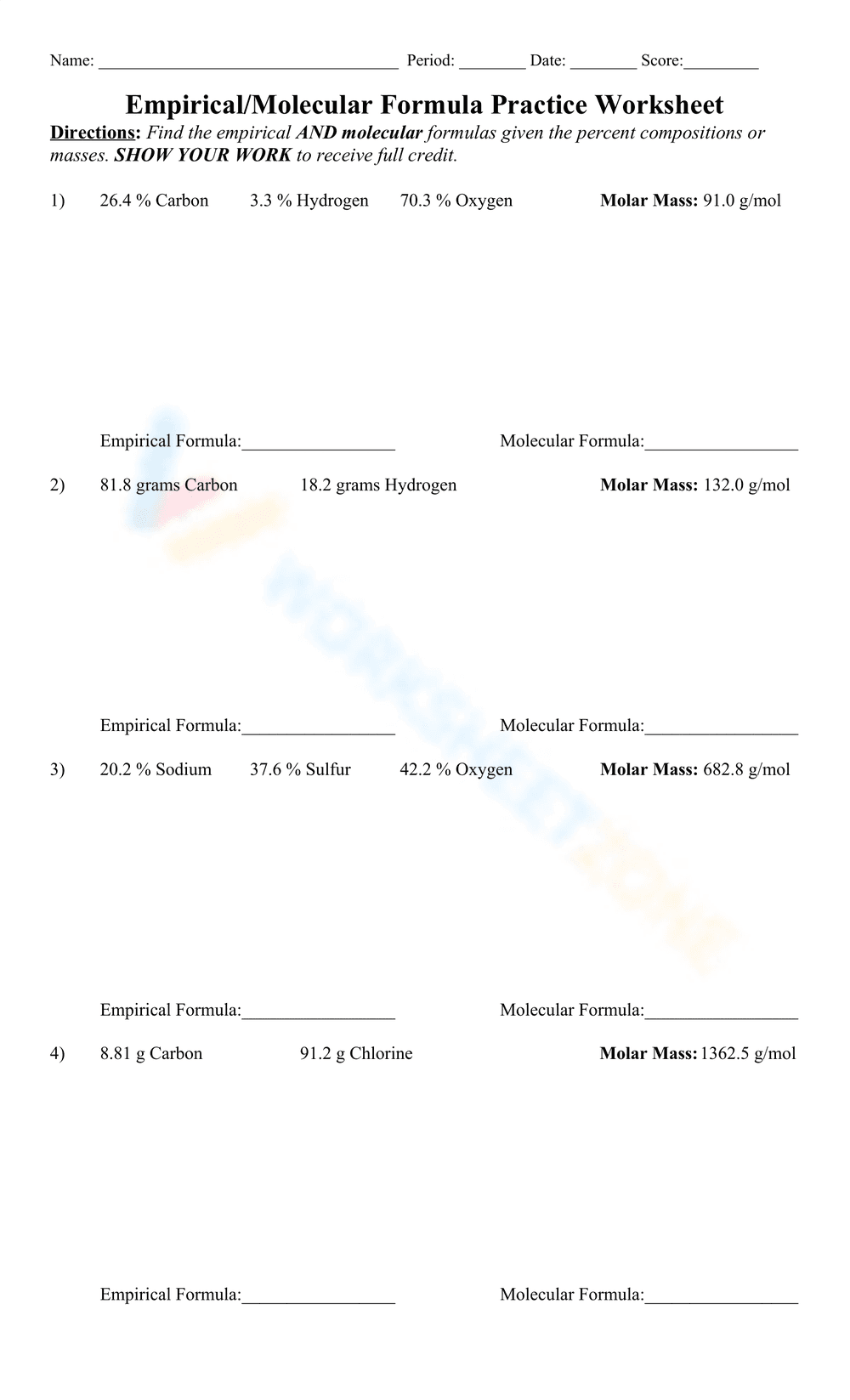
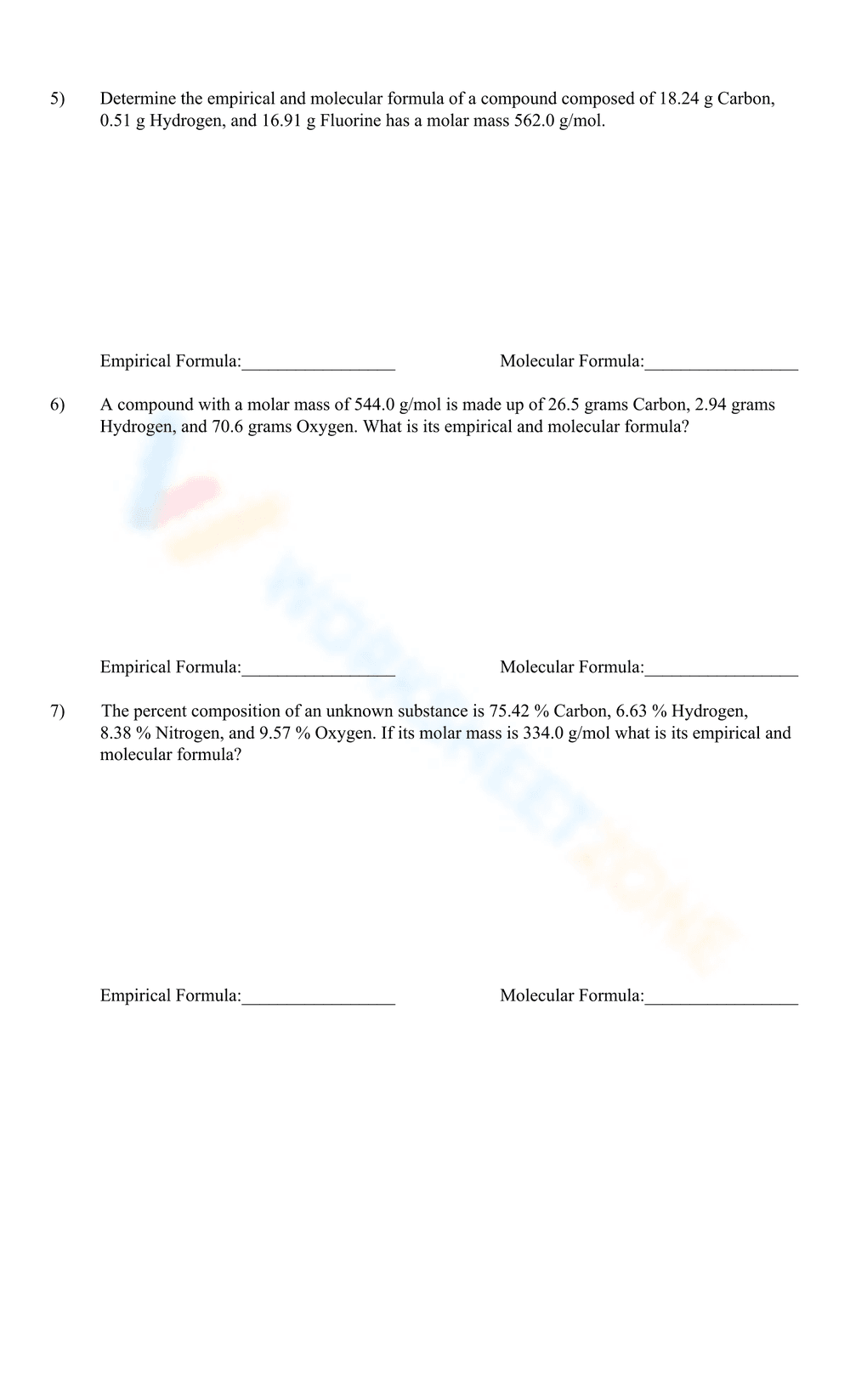
This is a chemistry worksheet focused on practicing the calculation of empirical and molecular formulas. The worksheet presents problems where students must determine both the empirical and molecular formulas of compounds. Each problem provides either the percent composition of elements in a compound or the mass of each element, along with the molar mass of the compound. Students are instructed to show their work to receive full credit. The worksheet contains four problems.
Grade Level Suitability:
This worksheet is suitable for grades 11-12, specifically for high school chemistry courses. The concepts of empirical and molecular formulas require a solid understanding of stoichiometry and molar mass, which are typically covered in high school chemistry.
Why Use It:
This worksheet provides valuable practice in applying the concepts of empirical and molecular formulas. It reinforces the ability to convert between percent composition/mass and moles, calculate empirical formulas from mole ratios, and determine molecular formulas using molar mass. It helps students develop problem-solving skills in stoichiometry.
How to Use It:
Students should first convert the given percentages or masses to moles. Then, they should determine the simplest whole number ratio of the elements to find the empirical formula. Finally, they should use the molar mass provided to calculate the molecular formula, showing all steps clearly.
Target Users:
The target users are high school chemistry students who are learning about empirical and molecular formulas. It is also useful for students who need additional practice with stoichiometry calculations.
This is a chemistry worksheet focused on practicing the calculation of empirical and molecular formulas. The worksheet presents problems where students must determine both the empirical and molecular formulas of compounds. Each problem provides either the percent composition of elements in a compound or the mass of each element, along with the molar mass of the compound. Students are instructed to show their work to receive full credit. The worksheet contains four problems.
Grade Level Suitability:
This worksheet is suitable for grades 11-12, specifically for high school chemistry courses. The concepts of empirical and molecular formulas require a solid understanding of stoichiometry and molar mass, which are typically covered in high school chemistry.
Why Use It:
This worksheet provides valuable practice in applying the concepts of empirical and molecular formulas. It reinforces the ability to convert between percent composition/mass and moles, calculate empirical formulas from mole ratios, and determine molecular formulas using molar mass. It helps students develop problem-solving skills in stoichiometry.
How to Use It:
Students should first convert the given percentages or masses to moles. Then, they should determine the simplest whole number ratio of the elements to find the empirical formula. Finally, they should use the molar mass provided to calculate the molecular formula, showing all steps clearly.
Target Users:
The target users are high school chemistry students who are learning about empirical and molecular formulas. It is also useful for students who need additional practice with stoichiometry calculations.


