


























1 / 6
0
Views
0
Downloads




0.0
0
0 Likes
Discovering Energy Resources
0 Views
0 Downloads
Paste this activity's link or code into your existing LMS (Google Classroom, Canvas, Teams, Schoology, Moodle, etc.).
Students can open and work on the activity right away, with no student login required.
You'll still be able to track student progress and results from your teacher account.
Information
Description
What It Is:
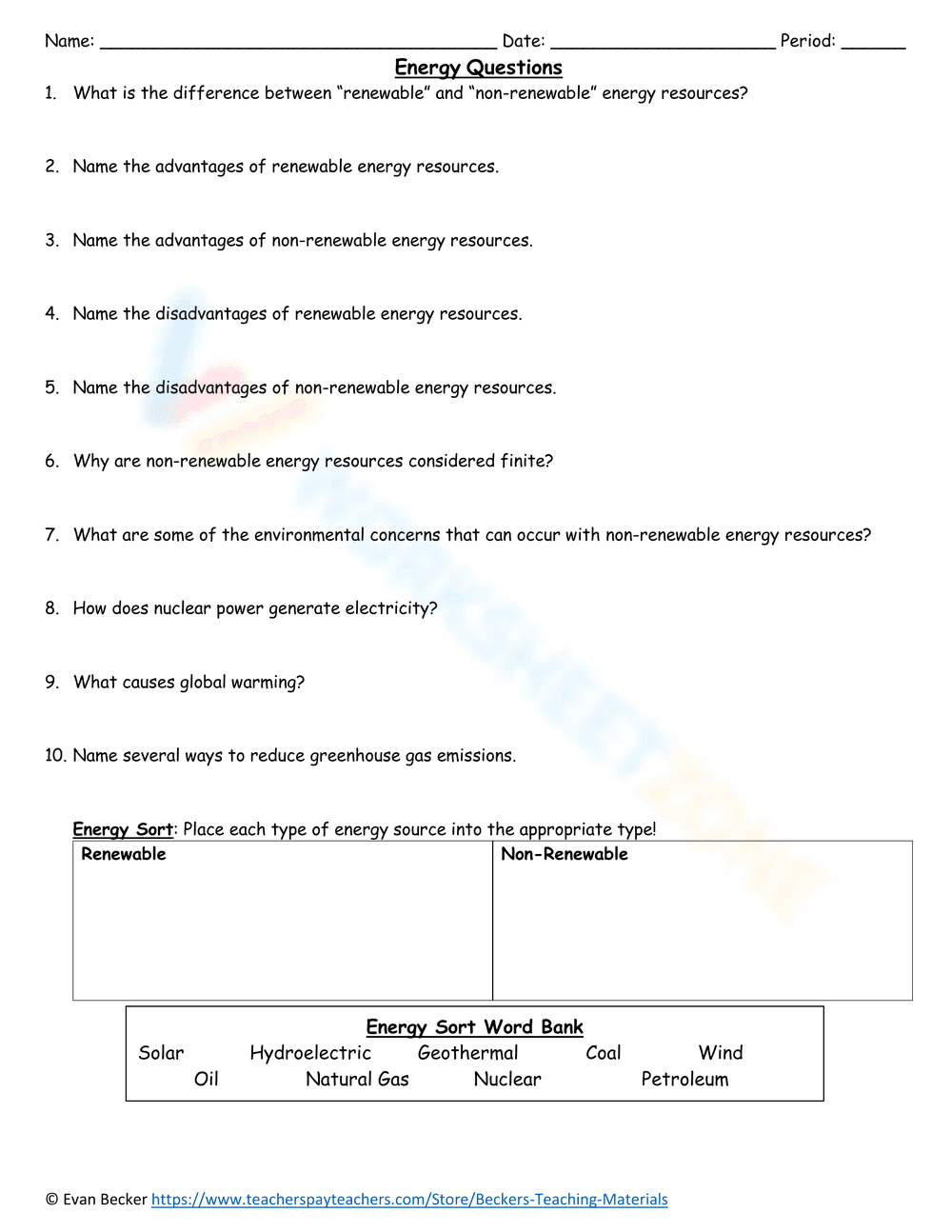
This is an educational worksheet about energy resources. It differentiates between renewable and non-renewable energy sources, providing examples of each with illustrative diagrams. It also explains the greenhouse effect with a diagram showing sunlight reflecting off the earth and being trapped by atmospheric gases. There's a picture of an open-pit coal mine.
Grade Level Suitability:
This worksheet is suitable for grades 5-8. The vocabulary and concepts, such as renewable energy, non-renewable energy, the greenhouse effect, and global warming, are appropriate for this age range. The diagrams are helpful for visual learners.
Why Use It:
This worksheet helps students understand the difference between renewable and non-renewable energy sources and their impact on the environment. It introduces the concept of the greenhouse effect and global warming, promoting awareness of environmental issues related to energy consumption.
How to Use It:
The worksheet can be used as an introduction to the topic of energy resources, as a review activity, or as a homework assignment. Students can read the text, study the diagrams, and discuss the concepts in class. It can also serve as a starting point for further research on energy-related topics.
Target Users:
This worksheet is designed for elementary and middle school students learning about energy resources, environmental science, and the impact of human activities on the planet. Teachers can use it as part of their science curriculum.
This is an educational worksheet about energy resources. It differentiates between renewable and non-renewable energy sources, providing examples of each with illustrative diagrams. It also explains the greenhouse effect with a diagram showing sunlight reflecting off the earth and being trapped by atmospheric gases. There's a picture of an open-pit coal mine.
Grade Level Suitability:
This worksheet is suitable for grades 5-8. The vocabulary and concepts, such as renewable energy, non-renewable energy, the greenhouse effect, and global warming, are appropriate for this age range. The diagrams are helpful for visual learners.
Why Use It:
This worksheet helps students understand the difference between renewable and non-renewable energy sources and their impact on the environment. It introduces the concept of the greenhouse effect and global warming, promoting awareness of environmental issues related to energy consumption.
How to Use It:
The worksheet can be used as an introduction to the topic of energy resources, as a review activity, or as a homework assignment. Students can read the text, study the diagrams, and discuss the concepts in class. It can also serve as a starting point for further research on energy-related topics.
Target Users:
This worksheet is designed for elementary and middle school students learning about energy resources, environmental science, and the impact of human activities on the planet. Teachers can use it as part of their science curriculum.


