


























1 / 7
0
Views
0
Downloads




0 Likes
Updated Escape Velocity Science Worksheet
0 Views
0 Downloads
Paste this activity's link or code into your existing LMS (Google Classroom, Canvas, Teams, Schoology, Moodle, etc.).
Students can open and work on the activity right away, with no student login required.
You'll still be able to track student progress and results from your teacher account.
Information
Description
What It Is:
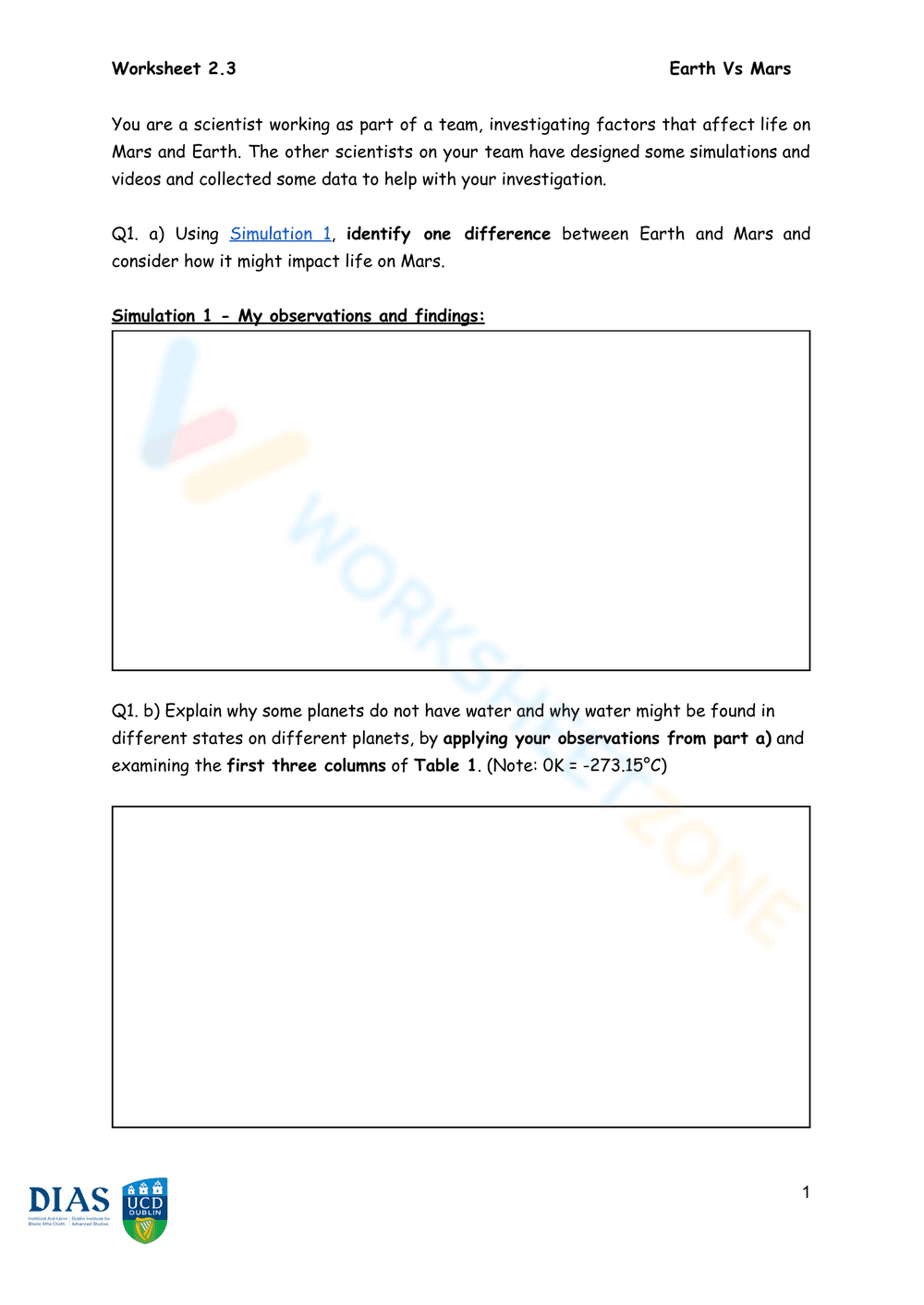
This is a science worksheet titled 'Earth Vs Mars.' It presents a scenario where students are scientists investigating factors affecting life on Mars and Earth. The worksheet prompts students to use a simulation to identify a difference between the two planets and consider its impact on life on Mars. It also asks students to explain why some planets lack water and the states in which water might exist on different planets, using observations and data from a table. Space is provided for observations and findings.
Grade Level Suitability:
This worksheet is suitable for grades 6-8. The concepts of planetary differences, the existence of water in different states, and the impact of environmental factors on life require a basic understanding of science concepts typically taught in middle school. The worksheet encourages analytical thinking and application of knowledge.
Why Use It:
This worksheet promotes critical thinking, observation skills, and data analysis. It encourages students to apply scientific knowledge to real-world scenarios, fostering a deeper understanding of the factors that make Earth habitable and the challenges of life on other planets. It integrates simulation-based learning with written analysis.
How to Use It:
Students should first read the introductory scenario. Then, they should access and use 'Simulation 1' to observe and identify differences between Earth and Mars. They should record their observations in the provided space. Next, they need to answer the questions, referencing their observations and the data from Table 1 (the first three columns) to explain the presence and states of water on different planets.
Target Users:
This worksheet is designed for middle school students studying Earth science, space science, or environmental science. It is particularly beneficial for students who learn best through hands-on activities and visual aids like simulations. The worksheet can be used as an individual assignment or as part of a group project.
This is a science worksheet titled 'Earth Vs Mars.' It presents a scenario where students are scientists investigating factors affecting life on Mars and Earth. The worksheet prompts students to use a simulation to identify a difference between the two planets and consider its impact on life on Mars. It also asks students to explain why some planets lack water and the states in which water might exist on different planets, using observations and data from a table. Space is provided for observations and findings.
Grade Level Suitability:
This worksheet is suitable for grades 6-8. The concepts of planetary differences, the existence of water in different states, and the impact of environmental factors on life require a basic understanding of science concepts typically taught in middle school. The worksheet encourages analytical thinking and application of knowledge.
Why Use It:
This worksheet promotes critical thinking, observation skills, and data analysis. It encourages students to apply scientific knowledge to real-world scenarios, fostering a deeper understanding of the factors that make Earth habitable and the challenges of life on other planets. It integrates simulation-based learning with written analysis.
How to Use It:
Students should first read the introductory scenario. Then, they should access and use 'Simulation 1' to observe and identify differences between Earth and Mars. They should record their observations in the provided space. Next, they need to answer the questions, referencing their observations and the data from Table 1 (the first three columns) to explain the presence and states of water on different planets.
Target Users:
This worksheet is designed for middle school students studying Earth science, space science, or environmental science. It is particularly beneficial for students who learn best through hands-on activities and visual aids like simulations. The worksheet can be used as an individual assignment or as part of a group project.


