


























1 / 2
0
Views
0
Downloads

0.0
0
0 Likes
Zero and Negative Exponents: Math Practice Match-Up
0 Views
0 Downloads
Paste this activity's link or code into your existing LMS (Google Classroom, Canvas, Teams, Schoology, Moodle, etc.).
Students can open and work on the activity right away, with no student login required.
You'll still be able to track student progress and results from your teacher account.
Information
Description
What It Is:
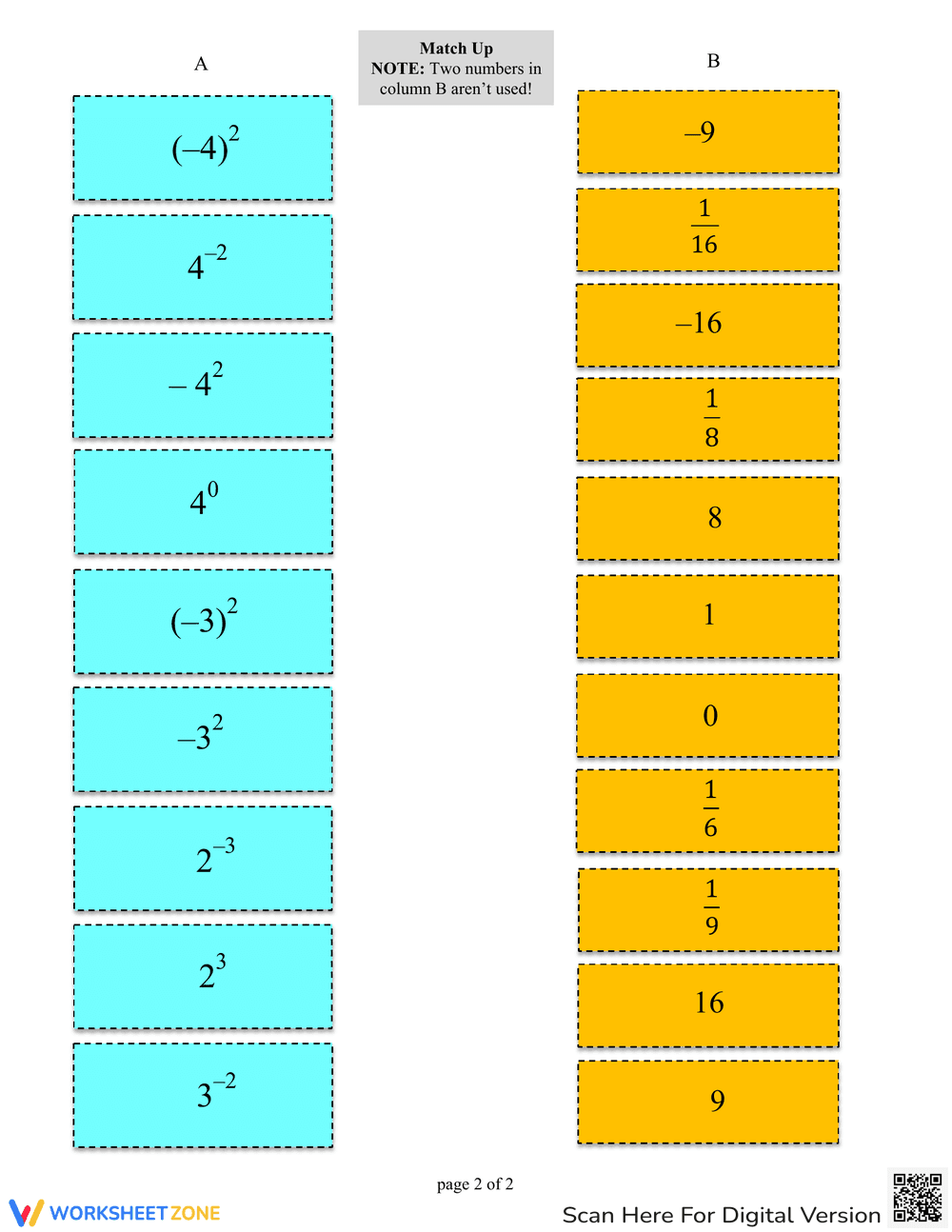
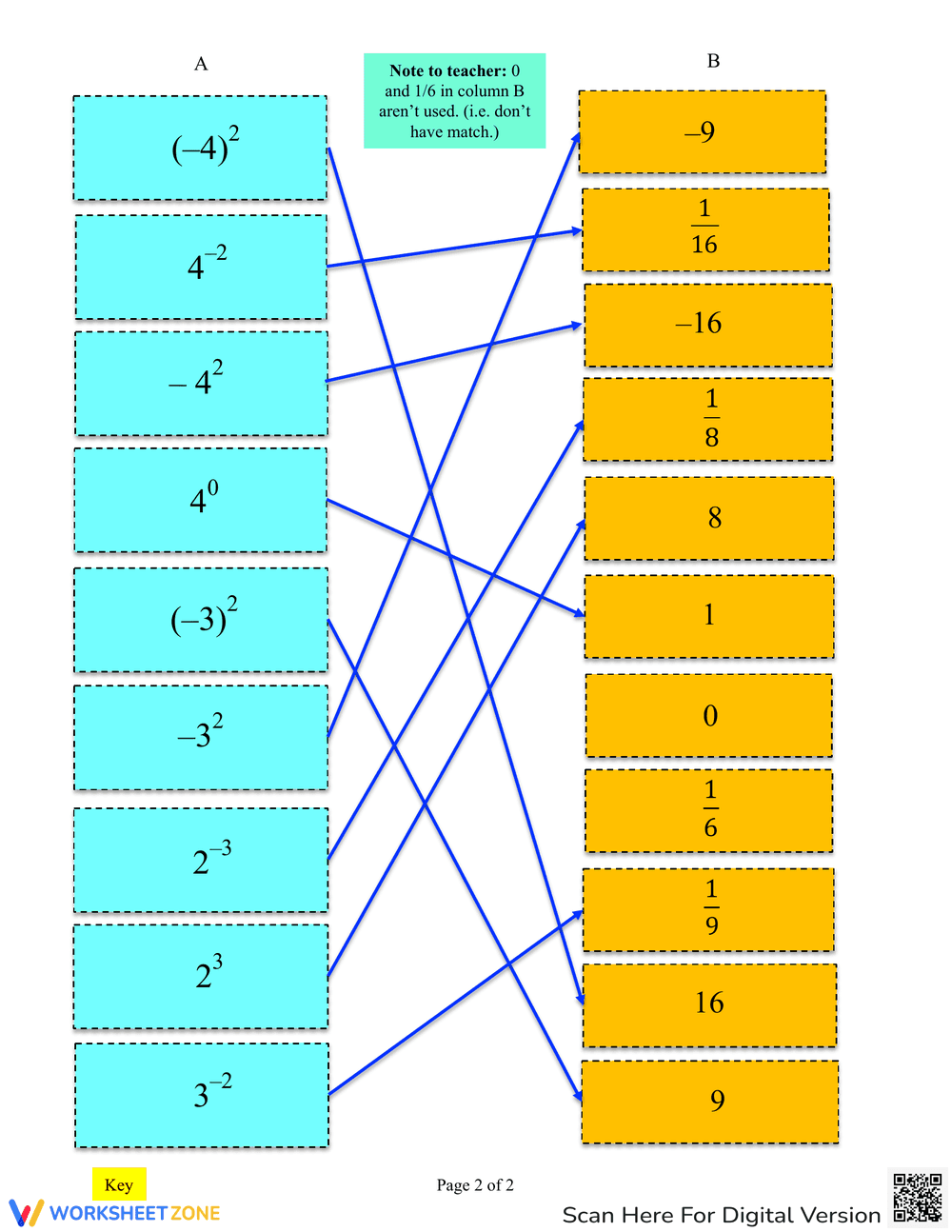
This is a math worksheet featuring a 'Match Up' activity. Column A contains expressions with exponents, such as (-4)², 4⁻², -4², 4⁰, (-3)², -3², 2⁻³, 2³, and 3⁻². Column B contains numerical values, including -9, 1/16, -16, 1/8, 8, 1, 0, 1/6, 1/9, 16, and 9. The worksheet instructs students to match the expressions in column A to their corresponding numerical values in column B, noting that two numbers in column B will not be used.
Grade Level Suitability:
This worksheet is suitable for grades 7-9. It requires students to understand and apply the rules of exponents, including negative exponents and the order of operations. The presence of negative bases and fractional exponents suggests a middle school or early high school level.
Why Use It:
This worksheet helps students practice evaluating expressions with exponents, including positive, negative, and zero exponents. It reinforces the concept of order of operations and provides a matching activity to make learning engaging. It also encourages critical thinking as students must identify the correct matches and recognize that not all options in column B are used.
How to Use It:
Students should first evaluate each expression in column A. Then, they should find the corresponding numerical value in column B and draw a line connecting the two. Students should be reminded to pay close attention to signs and the order of operations. After matching all the expressions, they should check to make sure that the answers are correct and that two numbers in column B are unused.
Target Users:
This worksheet is ideal for students who are learning about or reviewing exponents and the order of operations. It can be used as a classroom activity, homework assignment, or review tool for students in middle school or early high school. It is also beneficial for students who need extra practice with simplifying expressions.
This is a math worksheet featuring a 'Match Up' activity. Column A contains expressions with exponents, such as (-4)², 4⁻², -4², 4⁰, (-3)², -3², 2⁻³, 2³, and 3⁻². Column B contains numerical values, including -9, 1/16, -16, 1/8, 8, 1, 0, 1/6, 1/9, 16, and 9. The worksheet instructs students to match the expressions in column A to their corresponding numerical values in column B, noting that two numbers in column B will not be used.
Grade Level Suitability:
This worksheet is suitable for grades 7-9. It requires students to understand and apply the rules of exponents, including negative exponents and the order of operations. The presence of negative bases and fractional exponents suggests a middle school or early high school level.
Why Use It:
This worksheet helps students practice evaluating expressions with exponents, including positive, negative, and zero exponents. It reinforces the concept of order of operations and provides a matching activity to make learning engaging. It also encourages critical thinking as students must identify the correct matches and recognize that not all options in column B are used.
How to Use It:
Students should first evaluate each expression in column A. Then, they should find the corresponding numerical value in column B and draw a line connecting the two. Students should be reminded to pay close attention to signs and the order of operations. After matching all the expressions, they should check to make sure that the answers are correct and that two numbers in column B are unused.
Target Users:
This worksheet is ideal for students who are learning about or reviewing exponents and the order of operations. It can be used as a classroom activity, homework assignment, or review tool for students in middle school or early high school. It is also beneficial for students who need extra practice with simplifying expressions.


