


























0
Views
0
Downloads

0.0
0
0 Likes
Fact and Opinion Differentiation Worksheet
0 Views
0 Downloads
Paste this activity's link or code into your existing LMS (Google Classroom, Canvas, Teams, Schoology, Moodle, etc.).
Students can open and work on the activity right away, with no student login required.
You'll still be able to track student progress and results from your teacher account.
Information
Description
What It Is:
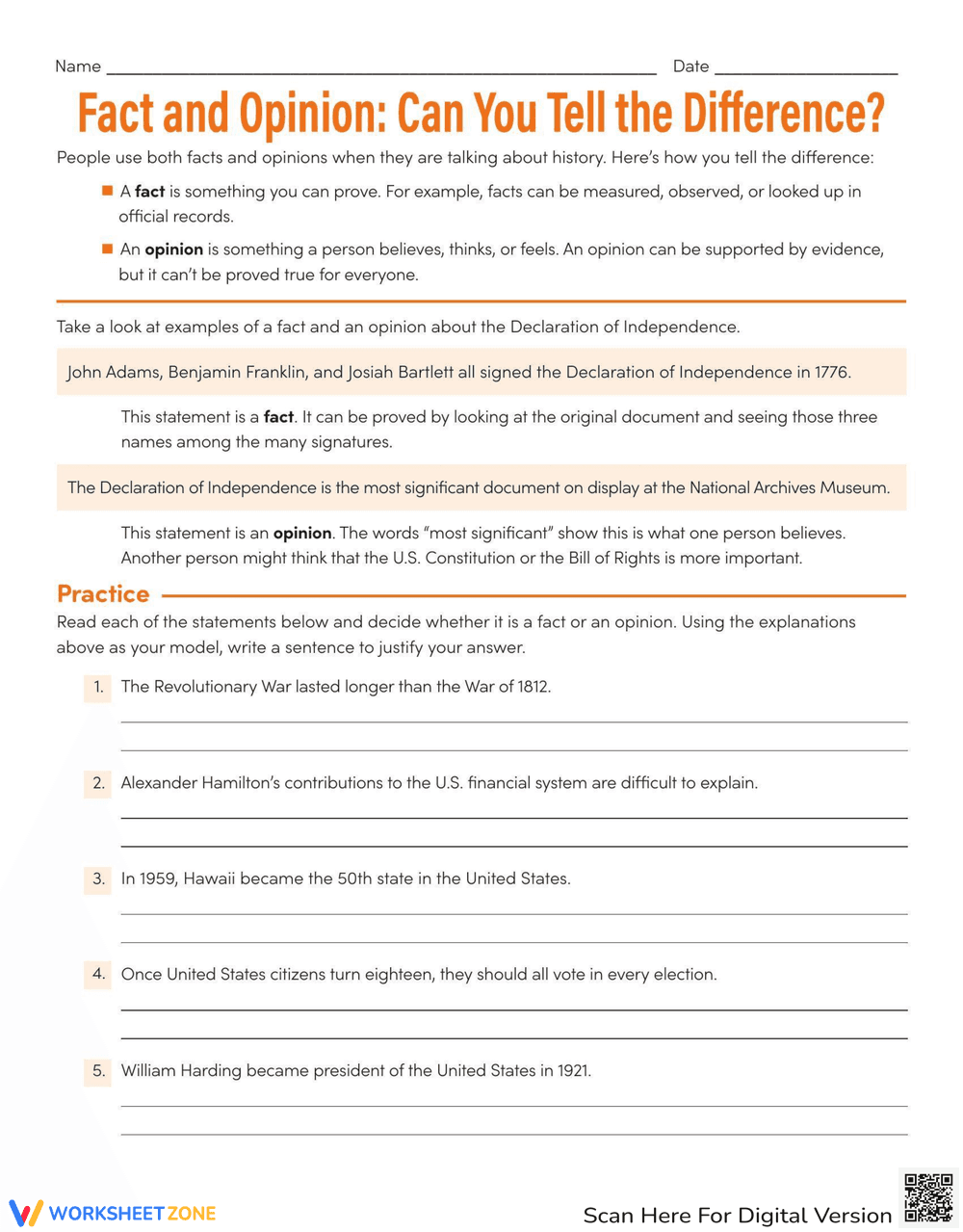
This is a worksheet focused on distinguishing between facts and opinions, specifically within the context of historical events. It provides definitions of facts and opinions, gives examples related to the Declaration of Independence, and then asks the student to identify statements as either fact or opinion and justify their answer. The statements cover topics like the Revolutionary War, Alexander Hamilton, Hawaii becoming a state, voting age, and William Harding's presidency.
Grade Level Suitability:
This worksheet is suitable for grades 4-6. The content requires understanding of historical concepts and the ability to analyze statements critically, making it appropriate for upper elementary and early middle school students. The reading level and sentence structure are also geared towards this age group.
Why Use It:
This worksheet helps students develop critical thinking skills by teaching them to differentiate between verifiable facts and subjective opinions. It reinforces understanding of historical topics and improves analytical writing abilities as students justify their answers. It also promotes careful reading and attention to detail.
How to Use It:
First, review the definitions of fact and opinion provided at the top of the worksheet. Then, read each statement carefully. Determine whether the statement is a fact that can be proven or an opinion that reflects a belief or feeling. Finally, write a sentence explaining why you classified the statement as either a fact or an opinion, referencing the definitions as a guide.
Target Users:
This worksheet is ideal for elementary and middle school students learning about fact vs. opinion, particularly in the context of history or social studies. It is also useful for students who need practice in critical thinking, reading comprehension, and analytical writing. Teachers and homeschool parents can use this as a classroom activity or homework assignment.
This is a worksheet focused on distinguishing between facts and opinions, specifically within the context of historical events. It provides definitions of facts and opinions, gives examples related to the Declaration of Independence, and then asks the student to identify statements as either fact or opinion and justify their answer. The statements cover topics like the Revolutionary War, Alexander Hamilton, Hawaii becoming a state, voting age, and William Harding's presidency.
Grade Level Suitability:
This worksheet is suitable for grades 4-6. The content requires understanding of historical concepts and the ability to analyze statements critically, making it appropriate for upper elementary and early middle school students. The reading level and sentence structure are also geared towards this age group.
Why Use It:
This worksheet helps students develop critical thinking skills by teaching them to differentiate between verifiable facts and subjective opinions. It reinforces understanding of historical topics and improves analytical writing abilities as students justify their answers. It also promotes careful reading and attention to detail.
How to Use It:
First, review the definitions of fact and opinion provided at the top of the worksheet. Then, read each statement carefully. Determine whether the statement is a fact that can be proven or an opinion that reflects a belief or feeling. Finally, write a sentence explaining why you classified the statement as either a fact or an opinion, referencing the definitions as a guide.
Target Users:
This worksheet is ideal for elementary and middle school students learning about fact vs. opinion, particularly in the context of history or social studies. It is also useful for students who need practice in critical thinking, reading comprehension, and analytical writing. Teachers and homeschool parents can use this as a classroom activity or homework assignment.


