


























0
Views
0
Downloads

0.0
0
0 Likes
Firsthand or Secondhand Account Worksheet
0 Views
0 Downloads
Paste this activity's link or code into your existing LMS (Google Classroom, Canvas, Teams, Schoology, Moodle, etc.).
Students can open and work on the activity right away, with no student login required.
You'll still be able to track student progress and results from your teacher account.
Information
Description
What It Is:
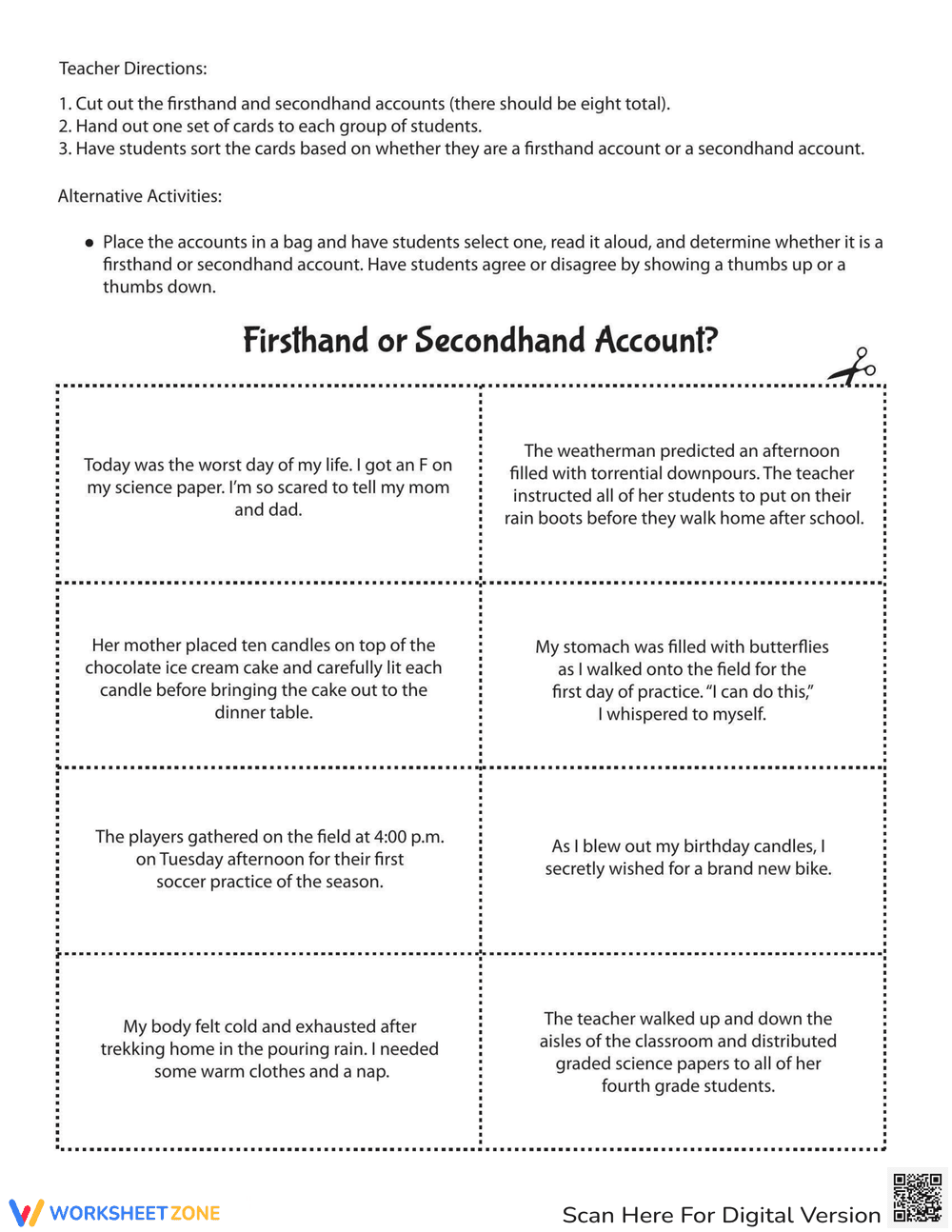
This is an educational worksheet designed to help students differentiate between firsthand and secondhand accounts. It features eight cards with short narratives. Students are instructed to cut out the cards and sort them based on whether each narrative is a firsthand or secondhand account. The worksheet includes teacher directions and alternative activity suggestions.
Grade Level Suitability:
This worksheet is suitable for grades 3-5. The language used in the narratives is relatively simple, and the concept of firsthand versus secondhand accounts is typically introduced in these grade levels. The narratives are also age-appropriate for this age range.
Why Use It:
This worksheet helps students develop critical thinking skills by analyzing text and determining the source of information. It reinforces reading comprehension and encourages discussion about perspective and point of view. It can be used to improve understanding of narrative structure and informational texts.
How to Use It:
First, cut out the individual cards. Then, read each card carefully. Decide whether the narrative is a firsthand account (told by someone who experienced the event) or a secondhand account (told by someone who heard about the event). Sort the cards into two piles: firsthand accounts and secondhand accounts. The teacher can have students work individually, in pairs, or in small groups.
Target Users:
This worksheet is ideal for elementary school teachers looking for a resource to teach or reinforce the concept of firsthand and secondhand accounts. It is also suitable for homeschooling parents or tutors working with students in grades 3-5. It would benefit students who need practice in reading comprehension, critical thinking, and identifying different perspectives.
This is an educational worksheet designed to help students differentiate between firsthand and secondhand accounts. It features eight cards with short narratives. Students are instructed to cut out the cards and sort them based on whether each narrative is a firsthand or secondhand account. The worksheet includes teacher directions and alternative activity suggestions.
Grade Level Suitability:
This worksheet is suitable for grades 3-5. The language used in the narratives is relatively simple, and the concept of firsthand versus secondhand accounts is typically introduced in these grade levels. The narratives are also age-appropriate for this age range.
Why Use It:
This worksheet helps students develop critical thinking skills by analyzing text and determining the source of information. It reinforces reading comprehension and encourages discussion about perspective and point of view. It can be used to improve understanding of narrative structure and informational texts.
How to Use It:
First, cut out the individual cards. Then, read each card carefully. Decide whether the narrative is a firsthand account (told by someone who experienced the event) or a secondhand account (told by someone who heard about the event). Sort the cards into two piles: firsthand accounts and secondhand accounts. The teacher can have students work individually, in pairs, or in small groups.
Target Users:
This worksheet is ideal for elementary school teachers looking for a resource to teach or reinforce the concept of firsthand and secondhand accounts. It is also suitable for homeschooling parents or tutors working with students in grades 3-5. It would benefit students who need practice in reading comprehension, critical thinking, and identifying different perspectives.


