


























0
Views
0
Downloads

0.0
0
0 Likes
Funny Riddles About Planets
0 Views
0 Downloads
Paste this activity's link or code into your existing LMS (Google Classroom, Canvas, Teams, Schoology, Moodle, etc.).
Students can open and work on the activity right away, with no student login required.
You'll still be able to track student progress and results from your teacher account.
Information
Description
What It Is:
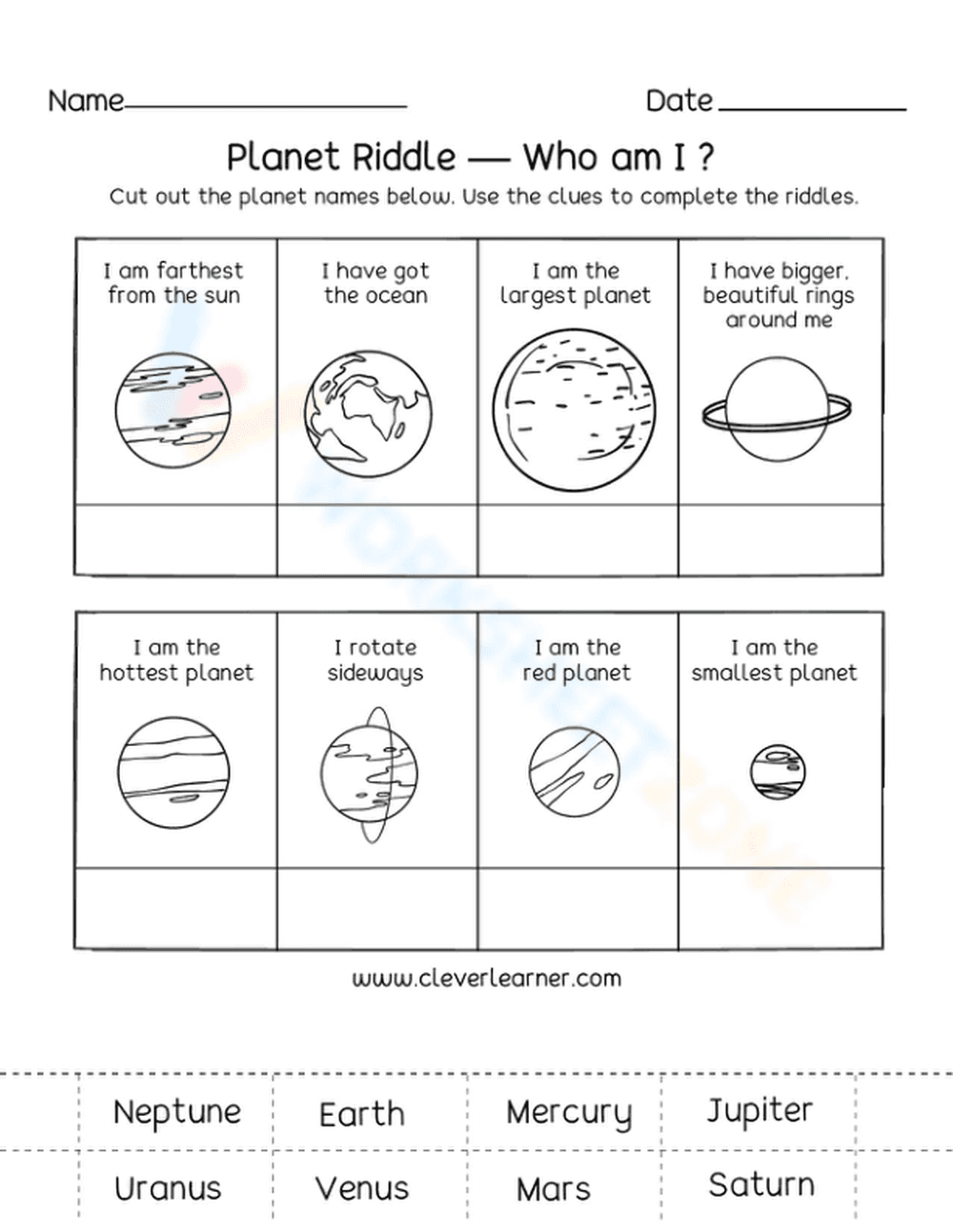
This is a printable worksheet titled 'Planet Riddle - Who am I?'. It features eight planet riddles with corresponding images of the planets. Each riddle provides a clue about a specific planet (e.g., 'I am farthest from the sun,' 'I have got the ocean'). Below the riddles are cut-out labels with the names of the eight planets: Neptune, Earth, Mercury, Jupiter, Uranus, Venus, Mars, and Saturn. The student is expected to cut out the planet names and paste them under the correct riddle based on the clues provided.
Grade Level Suitability:
This worksheet is suitable for grades 1-3. The riddles are simple and the planet facts are basic, making it accessible to young learners who are being introduced to the solar system. The cut-and-paste activity is also appropriate for this age group.
Why Use It:
This worksheet reinforces planet recognition and basic facts about each planet in a fun and engaging way. It helps students develop their reading comprehension skills, problem-solving abilities, and knowledge of the solar system. The riddle format encourages critical thinking and makes learning about planets more interactive.
How to Use It:
First, have the student read each riddle carefully. Then, cut out the planet name labels at the bottom of the page. Next, based on the clue in the riddle and the planet image, determine which planet the riddle is describing. Finally, glue the correct planet name label under the corresponding riddle and image.
Target Users:
This worksheet is ideal for elementary school students, particularly those in grades 1-3, who are learning about the solar system. It can be used in the classroom as a supplemental activity or at home for educational enrichment. Homeschooling families can also use it as part of their science curriculum.
This is a printable worksheet titled 'Planet Riddle - Who am I?'. It features eight planet riddles with corresponding images of the planets. Each riddle provides a clue about a specific planet (e.g., 'I am farthest from the sun,' 'I have got the ocean'). Below the riddles are cut-out labels with the names of the eight planets: Neptune, Earth, Mercury, Jupiter, Uranus, Venus, Mars, and Saturn. The student is expected to cut out the planet names and paste them under the correct riddle based on the clues provided.
Grade Level Suitability:
This worksheet is suitable for grades 1-3. The riddles are simple and the planet facts are basic, making it accessible to young learners who are being introduced to the solar system. The cut-and-paste activity is also appropriate for this age group.
Why Use It:
This worksheet reinforces planet recognition and basic facts about each planet in a fun and engaging way. It helps students develop their reading comprehension skills, problem-solving abilities, and knowledge of the solar system. The riddle format encourages critical thinking and makes learning about planets more interactive.
How to Use It:
First, have the student read each riddle carefully. Then, cut out the planet name labels at the bottom of the page. Next, based on the clue in the riddle and the planet image, determine which planet the riddle is describing. Finally, glue the correct planet name label under the corresponding riddle and image.
Target Users:
This worksheet is ideal for elementary school students, particularly those in grades 1-3, who are learning about the solar system. It can be used in the classroom as a supplemental activity or at home for educational enrichment. Homeschooling families can also use it as part of their science curriculum.


