


























1 / 6
0
Views
0
Downloads



0 Likes
Explore the Gas Laws Worksheet
0 Views
0 Downloads
Paste this activity's link or code into your existing LMS (Google Classroom, Canvas, Teams, Schoology, Moodle, etc.).
Students can open and work on the activity right away, with no student login required.
You'll still be able to track student progress and results from your teacher account.
Information
Description
What It Is:
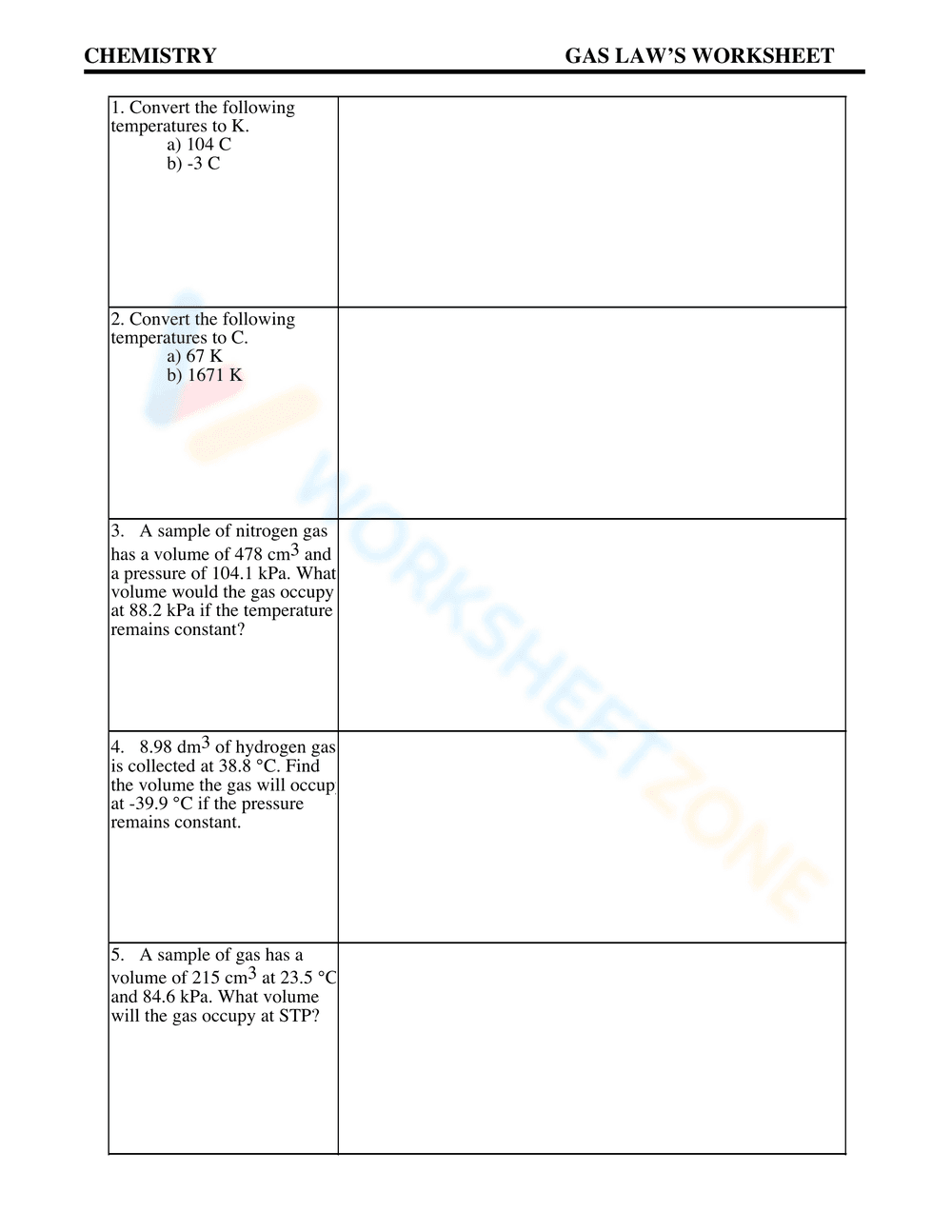
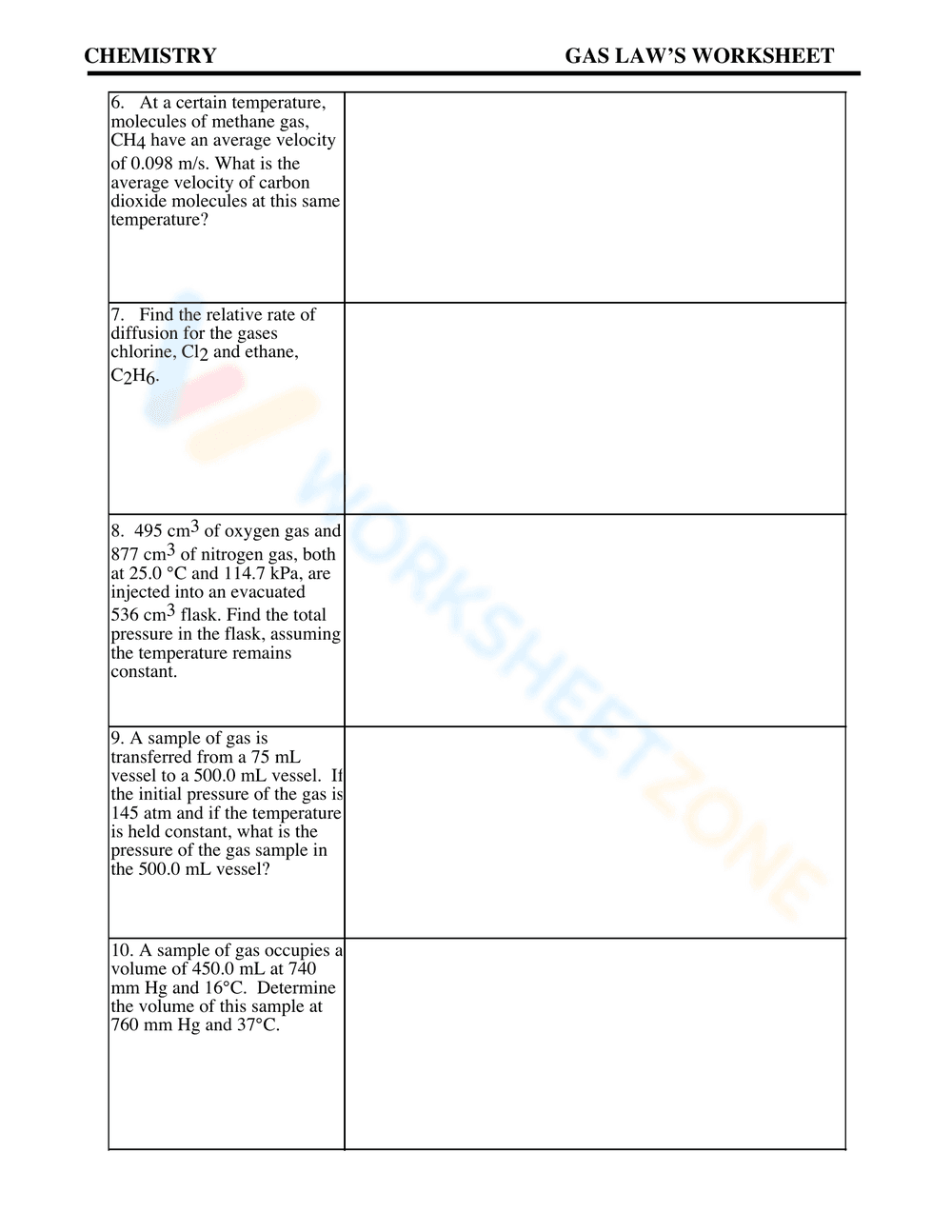
This is a chemistry worksheet summarizing various gas laws, including Boyle's Law, Charles' Law, Guy-Lussac's Law, Combined Gas Law, Dalton's Law, the Ideal Gas Law, and Graham's Law. It provides the formulas and brief descriptions of each law. The worksheet also includes a section on abbreviations, standard conditions, conversions between temperature scales, and definitions of the equation symbols used in gas law calculations.
Grade Level Suitability:
This worksheet is suitable for high school chemistry, specifically grades 11-12, and introductory college chemistry courses. The concepts and formulas require a solid understanding of algebra and basic chemistry principles.
Why Use It:
This worksheet serves as a quick reference guide for gas laws and their associated formulas. It helps students understand the relationships between pressure, volume, temperature, and the number of moles of a gas. It also provides essential information like standard conditions and unit conversions needed to solve gas law problems.
How to Use It:
Use this worksheet as a study guide or reference sheet when solving gas law problems. Students can use it to quickly identify the appropriate formula for a given problem and understand the meaning of each variable. Refer to the conversion tables and standard conditions when performing calculations.
Target Users:
The target users are high school and college students studying chemistry, particularly those learning about gas laws. Chemistry teachers can also use it as a handout or reference sheet for their students.
This is a chemistry worksheet summarizing various gas laws, including Boyle's Law, Charles' Law, Guy-Lussac's Law, Combined Gas Law, Dalton's Law, the Ideal Gas Law, and Graham's Law. It provides the formulas and brief descriptions of each law. The worksheet also includes a section on abbreviations, standard conditions, conversions between temperature scales, and definitions of the equation symbols used in gas law calculations.
Grade Level Suitability:
This worksheet is suitable for high school chemistry, specifically grades 11-12, and introductory college chemistry courses. The concepts and formulas require a solid understanding of algebra and basic chemistry principles.
Why Use It:
This worksheet serves as a quick reference guide for gas laws and their associated formulas. It helps students understand the relationships between pressure, volume, temperature, and the number of moles of a gas. It also provides essential information like standard conditions and unit conversions needed to solve gas law problems.
How to Use It:
Use this worksheet as a study guide or reference sheet when solving gas law problems. Students can use it to quickly identify the appropriate formula for a given problem and understand the meaning of each variable. Refer to the conversion tables and standard conditions when performing calculations.
Target Users:
The target users are high school and college students studying chemistry, particularly those learning about gas laws. Chemistry teachers can also use it as a handout or reference sheet for their students.


