


























Objectives
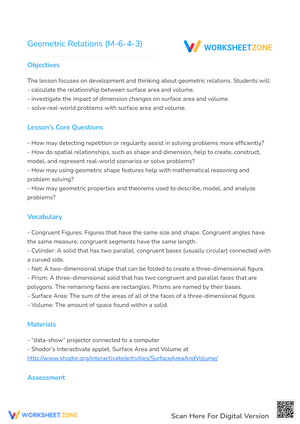
<p>The lesson focuses on development and thinking about geometric relations. Students will: <br>- calculate the relationship between surface area and volume. <br>- investigate the impact of dimension changes on surface area and volume. <br>- solve real-world problems with surface area and volume.</p>
Core Questions
<p>- How may detecting repetition or regularity assist in solving problems more efficiently? <br>- How do spatial relationships, such as shape and dimension, help to create, construct, model, and represent real-world scenarios or solve problems? <br>- How may using geometric shape features help with mathematical reasoning and problem solving? <br>- How may geometric properties and theorems used to describe, model, and analyze problems? </p>
Vocabulary
<p>- Congruent Figures: Figures that have the same size and shape. Congruent angles have the same measure; congruent segments have the same length. <br>- Cylinder: A solid that has two parallel, congruent bases (usually circular) connected with a curved side. <br>- Net: A two-dimensional shape that can be folded to create a three-dimensional figure. <br>- Prism: A three-dimensional solid that has two congruent and parallel faces that are polygons. The remaining faces are rectangles. Prisms are named by their bases. <br>- Surface Area: The sum of the areas of all of the faces of a three-dimensional figure. <br>- Volume: The amount of space found within a solid.</p>
Materials
<p>- “data-show” projector connected to a computer<br>- Shodor’s Interactivate applet, Surface Area and Volume at <a href="http://www.shodor.org/interactivate/activities/SurfaceAreaAndVolume/"><u>http://www.shodor.org/interactivate/activities/SurfaceAreaAndVolume/</u></a></p>
Assignment
<p>- Observations of students throughout Activity 3: Necessary Packaging will aid in determining whether they are learning the necessary skills. <br>- Observations and discussions during the Real-World Problem will help determine whether students have learned the concepts. </p>
Supports
<p>W: Emphasize the importance of understanding the connection between volume and surface area. <br>H: Students can use the interactive link to visualize how changing dimensions affects the volume and surface area of a prism. Create a table to display the differences that occur when a dimension is changed. <br>E: Refer to the table showing the side length of a cube. Discuss how volume and surface area change as side length increases. Similarly, examine how a prism's volume and surface area change as side lengths change. Calculate the possible dimensions of a prism given a specified volume and explain how surface area is affected. <br>R: Explore the differences between volume and surface area measurement units and their implications for comparison. Consider comparing the volume and surface area of various three-dimensional shapes. <br>E: Divide the class into groups and write real-world problems about volume and surface area. Ask groups to share their findings. <br>T: Apply students' knowledge of volume and surface area to real-world applications. Extend the process to three-dimensional solids besides cubes and prisms. <br>The lesson takes a methodical and exploratory approach to understanding the relationship between volume, surface area, and their practical applications. </p>
Procedures
<p>This lesson was designed to take a structured/exploratory approach to determining the relationships between volume and surface area and their real-world applications. The use of exploration and classroom discussion, followed by individual problem-solving, writing, and brainstorming activities, advances abstract thinking by constructing algorithmic procedures and then revisiting abstract ideas. <br><br>Students will make further connections between surface area and volume. Their involvement in the discovery-based lesson will improve their grasp of surface area and volume. The relationship between these two concepts is significant in mathematics because it frequently represents the start of a more general understanding of the differences between linear, quadratic, and exponential growth. Experience and practice with these types of activities will prepare students for the more abstract reasoning necessary in algebra and geometry. Students often learn these concepts in isolation, without making connections or understanding how those connections might be applied to real-life situations. Students will make connections by participating in classroom discussions, solving real-world problems, and creating similar real-world problems. <br><br>Using the "data-show" projector connected to a computer, begin the lesson by exploring one of Shodor's Interactive applets, Surface Area and Volume, at <a href="http://www.shodor.org/interactivate/activities/SurfaceAreaAndVolume/">http://www.shodor.org/interactivate/activities/SurfaceAreaAndVolume/</a>.<br><br>Students will investigate the impact of changes in one dimension (width, depth, or height) on surface area and volume. Ask them to investigate the effects of change in one dimension at a time. How do the changes compare? Is a change in dimension more likely to effect one measurement over another? How? Students will create a table comparing the various measurements and changes in surface area and volume in order to make conclusions. This task will be more thoroughly investigated in Activity 1.<br><br><strong>Activity 1: Changing Dimensions: Impact on Surface Area and Volume</strong><br><br>After students have visually explored the differences in surface area and volume based on the size of each dimension, provide a more structured method for investigating the effect of changing dimensions on surface area and volume.<br><br><strong>Activity 1A: Exploring with a Cube</strong><br><br><strong>"Let's look at the volume and surface area of different cube sizes, paying special attention to variations in volume and surface area, as well as the surface area to volume ratio. We will work together to complete the table below. To calculate the volume of a cube, use V = s³, which is equivalent to cubing the length of the side. If the volume is known, you can use the cube root to calculate the length of the side. If a cube has a volume of 125 cubic units, how long is its side?"</strong> (<i>5</i>)<br><br>Display the table with only side-length entries. Begin with the remaining cells blank. The completed table is for your reference.</p><figure class="image image_resized" style="width:53.7%;"><img style="aspect-ratio:559/218;" src="https://storage.googleapis.com/worksheetzone/images/Screenshot_19.png" width="559" height="218"></figure><p><strong>Cube: Change in Side Length</strong></p><figure class="image image_resized" style="width:60.95%;"><img style="aspect-ratio:545/648;" src="https://storage.googleapis.com/worksheetzone/images/Screenshot_20.png" width="545" height="648"></figure><p><strong>"What are your observations about the volume as the side length increases? What are your observations on the surface area as the side length increases? Which increases more quickly? How does the surface area to volume ratio change as side length increases? What does this fact actually tell us? Can you provide an example?"</strong> Students should notice that as side length increases, volume increases gradually at first, then rapidly. Students should also remark that the number of surface area units is larger than the number of volume units until the cube reaches a side length of 6. The volume then increases dramatically. Some may notice that this is the result of cubing the side length (volume calculation), but changing the number squared for each face and multiplying by 6 (surface-area calculation) results in a slower increase. <br><br>Students should be aware that the ratio of surface area to volume decreases as side length increases. In everyday terms, this simply means that as the side lengths of a cube increase (size 6 units and larger), the area of the outside of the cube becomes significantly smaller than the volume of the cube. (i.e., the area of the outside of the cube is much smaller than the amount that can be places inside the cube).<br><br><strong>Activity 1B: Exploring with a Rectangular Prism</strong><br><br><strong>"Let's take a short look at how changing the dimensions of various-sized rectangular prisms affects their volume and surface area. Let's check whether we get the same results as we did before. We'll work together to fill out a table."</strong> Display the table containing only the dimension entries. Begin with the remaining cells blank. The completed table is for your reference. <br><br>Remember that the volume of a rectangular prism is calculated in the same way as a cube: <br><br>Volume = length × width × height, or <i>V</i> = <i>lwh</i>. <br><br>As the prism's side length rises, so do its volume and surface area. The pattern will reveal something about the general relationship between length, area, and volume.<br><br><strong>Rectangular Prism: Change in Length</strong></p><figure class="image image_resized" style="width:63.9%;"><img style="aspect-ratio:578/784;" src="https://storage.googleapis.com/worksheetzone/images/Screenshot_21.png" width="578" height="784"></figure><p><strong>"Do you notice a similar pattern?"</strong> (<i>Volume increases more rapidly, and the surface area to volume ratio decreases as dimensions increase.</i>) <br><br><strong>"So, we can again conclude that as the dimensions increase (past a few iterations), the area around the outside of the prism is quite small compared to the amount the prism can hold."</strong><br><br><strong>Activity 2: Comparing Surface Area and Volume</strong><br><br><strong>"Before we begin this activity, let's consider an intriguing question: Do rectangular prisms with the same volume have the same surface area?" </strong><br><br><strong>"Can anyone think of how we can investigate this situation?"</strong> Students may suggest creating a table with a list of rectangular prisms of varied dimensions that yield the same volume calculations. Students would then describe how you would calculate and compare the surface areas of each. <br><br><strong>"Let's actually do it! We'll build a table , composed of dimensions, volume, and surface area. Let's set the volume of our rectangular prism at 36 in³. </strong><br><br><strong>"How do we determine the dimensions we can use?"</strong> (<i>The product of the dimensions must be 36.</i>). <strong>"Correct. For each rectangular prism, we will find three factors of 36."</strong><br><br><strong>Rectangular Prisms: Relationship Between Surface Area and Volume</strong></p><figure class="image image_resized" style="width:57.44%;"><img style="aspect-ratio:529/387;" src="https://storage.googleapis.com/worksheetzone/images/Screenshot_22.png" width="529" height="387"></figure><p><strong>"Now, let's revisit the question: Do rectangular prisms with the same volume have the same surface area? How do you know?"</strong> (<i>No. The volume of each rectangular prism is fixed, but the surface area changes.</i>) <strong>"Correct. Rectangular prisms with the same volume do not have the same surface area."</strong><br><br><strong>Activity 3: Necessary Packaging</strong><br><br><strong>"Now, apply your knowledge to a real-world problem."</strong> Explain the following problem to the students. <br><br><strong>"A company that manufactures chocolate-covered pretzels needs to create a new box that can store 18 pretzels, or 18 cubic units, and requires the least amount of packaging material. What dimensions should the company choose for the box?"</strong><br><br><strong>"How should we go about solving this problem?"</strong> (<i>Make a table.</i>) <strong>"Correct. Please construct and label a table, with all required values."</strong> Students should make their own table from scratch. The table below is an example.<br><br>Example Table: Dimensions of a Pretzel Box</p><figure class="image image_resized" style="width:51.06%;"><img style="aspect-ratio:408/324;" src="https://storage.googleapis.com/worksheetzone/images/Screenshot_23.png" width="408" height="324"></figure><p><strong>"To use the least amount of packaging material, what dimensions should the company use?" Why?"</strong> (<i>The box with dimensions of 2 by 3 by 3 because it has the smallest surface area.</i>) <br><br><strong>"That's correct. The box with the smallest surface area needs the smallest quantity of packaging material. We know we can hold 18 pretzels since the volume remains 18 cubic units."</strong><br><br>Lead a class discussion on the geometric relationship between surface area and volume. Students should reflect on these questions to improve their understanding of surface area and volume. <br><br><strong>"Since surface area is measured in square units and volume is measured in cubic units, what do those labels tell you about the differences between surface area and volume?"</strong> (<i>A surface area is a two-dimensional measurement, whereas volume is a three-dimensional measurement.</i>)<br><br><strong>"Do other three-dimensional shapes that you have not used in these lessons, such as spheres, cylinders, cones, and pyramids, have the same surface area-volume relationships as cubes and rectangular prisms? Why, or why not? Investigate other three-dimensional figures, such as a pyramid, and the concept that the formula for the volume of a pyramid is one-third the area of the base times the height."</strong> (<i>Surface area is always measured in 2 dimensions, whereas volume is always measured in 3 dimensions, regardless of shape. Surface area is always computed by summing the areas of each face of a figure. If the figure is a prism, volume is always computed by multiplying the area of the base and the height. If the figure is a pyramid or a cone, the volume is calculated in the same method but then multiplied by one-third. This is because the "layers" of the base in a pyramid or cone become "skinnier" as the height increases, whereas the layers of the base in a prism remain constant throughout.</i>) <br>In order to compare surface area and volume, ask students to come up with a list of real-world scenarios involving other shapes.<br><br><strong>Real-World Problem</strong><br><br>Divide the students into groups of four or five. Have the groups create a real-world challenge that relates surface area and volume and seeks the largest surface area. Groups will build a table of values and present their findings. <br><br><strong>Extension:</strong> <br><br>Use the following strategies to personalize the lesson to each student's specific needs and interests.<br><br><strong>Routine:</strong> During the school year, students may be divided into small groups or partnered and assigned a figure that has not yet been discussed in class. Students could, for example, fill in the table below for a cone, for example, or cylinder. Then, discuss the findings and draw some conclusions about the implications of dimension changes on surface area and volume.</p><figure class="image image_resized" style="width:50.71%;"><img style="aspect-ratio:434/346;" src="https://storage.googleapis.com/worksheetzone/images/Screenshot_24.png" width="434" height="346"></figure><p><strong>Small Groups:</strong> Students who might benefit from additional education or practice opportunities may find the following link helpful:<br><a href="http://teacherweb.com/TN/FCS/MiddleSchoolMath/Surface-Area-Volume-investigation.pdf">http://teacherweb.com/TN/FCS/MiddleSchoolMath/Surface-Area-Volume-investigation.pdf</a> <br><br>For more teaching ideas, visit the following link: <br><a href="http://library.thinkquest.org/20991/geo/solids.html">http://library.thinkquest.org/20991/geo/solids.html</a>.<br><br><strong>Expansion:</strong> Students who are ready for a harder challenge may hypothesize the relationship between surface area and volume in other three-dimensional solids, such as cylinders, and then conduct an organized study, recording observations and conclusions in a tabular format.</p><figure class="image image_resized" style="width:56.11%;"><img style="aspect-ratio:434/346;" src="https://storage.googleapis.com/worksheetzone/images/Screenshot_24.png" width="434" height="346"></figure><p><strong>Technology:</strong> A free Apple app can be used to further investigate this concept. <br><a href="https://itunes.apple.com/au/app/think-3d-free/id463364378?mt=8"><u>https://itunes.apple.com/au/app/think-3d-free/id463364378?mt=8</u></a></p>

0.0
0
0 Likes
Geometric Relations (M-6-4-3)
0 Views
0 Downloads
Information
Description
The lesson focuses on development and thinking about geometric relations. Students will:
- calculate the relationship between surface area and volume.
- investigate the impact of dimension changes on surface area and volume.
- solve real-world problems with surface area and volume.
Lesson’s Materials
Teaching Progress
Geometric Relations (M-6-4-3)
Geometric Relations (M-6-4-3)
Geometric Relations (M-6-4-3)
Geometric Relations (M-6-4-3)


