


























0
Views
0
Downloads

0.0
0
0 Likes
Distinguish Between Facts and Opinions Worksheet
0 Views
0 Downloads
Paste this activity's link or code into your existing LMS (Google Classroom, Canvas, Teams, Schoology, Moodle, etc.).
Students can open and work on the activity right away, with no student login required.
You'll still be able to track student progress and results from your teacher account.
Information
Description
What It Is:
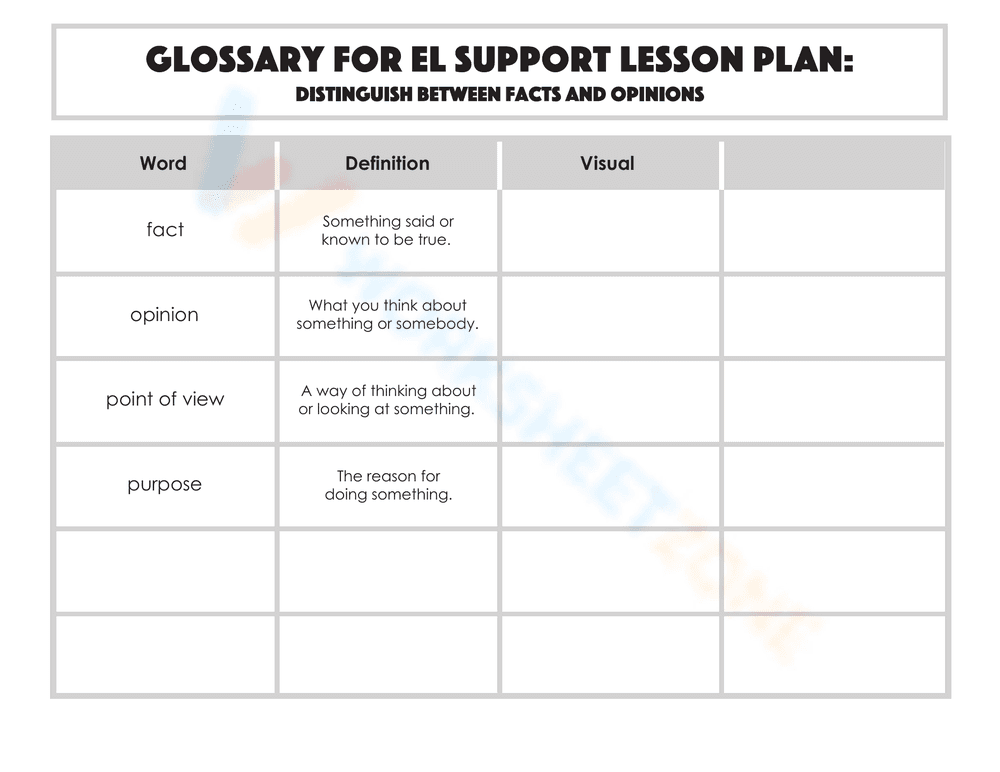
This is a glossary worksheet designed to support English Language (EL) learners in understanding the difference between facts and opinions. It includes a table with columns for 'Word,' 'Definition,' and 'Visual.' The worksheet lists the words 'fact,' 'opinion,' 'point of view,' and 'purpose,' along with their definitions. Students are expected to fill in the 'Visual' column, presumably with a drawing or image to represent each term.
Grade Level Suitability:
This worksheet is most suitable for grades 3-5. The vocabulary and concepts are appropriate for this age range, and the activity of creating visual representations helps solidify understanding for EL learners. It could also be used in higher grades for students who need additional support with vocabulary.
Why Use It:
This worksheet helps students develop their understanding of key vocabulary related to facts, opinions, and critical thinking. The visual component promotes deeper learning and retention, particularly for visual learners and EL students. It encourages students to actively engage with the definitions and make connections to their own understanding.
How to Use It:
First, review the definitions of 'fact,' 'opinion,' 'point of view,' and 'purpose' with the students. Then, instruct them to draw a picture or find an image that represents each word in the 'Visual' column. Encourage them to explain their choices and how the visual relates to the definition.
Target Users:
This worksheet is designed for English Language Learners (ELLs) who need support with vocabulary development and understanding the difference between facts and opinions. It is also beneficial for general education students in elementary grades who are learning these concepts. Teachers and tutors working with these students would find this worksheet useful.
This is a glossary worksheet designed to support English Language (EL) learners in understanding the difference between facts and opinions. It includes a table with columns for 'Word,' 'Definition,' and 'Visual.' The worksheet lists the words 'fact,' 'opinion,' 'point of view,' and 'purpose,' along with their definitions. Students are expected to fill in the 'Visual' column, presumably with a drawing or image to represent each term.
Grade Level Suitability:
This worksheet is most suitable for grades 3-5. The vocabulary and concepts are appropriate for this age range, and the activity of creating visual representations helps solidify understanding for EL learners. It could also be used in higher grades for students who need additional support with vocabulary.
Why Use It:
This worksheet helps students develop their understanding of key vocabulary related to facts, opinions, and critical thinking. The visual component promotes deeper learning and retention, particularly for visual learners and EL students. It encourages students to actively engage with the definitions and make connections to their own understanding.
How to Use It:
First, review the definitions of 'fact,' 'opinion,' 'point of view,' and 'purpose' with the students. Then, instruct them to draw a picture or find an image that represents each word in the 'Visual' column. Encourage them to explain their choices and how the visual relates to the definition.
Target Users:
This worksheet is designed for English Language Learners (ELLs) who need support with vocabulary development and understanding the difference between facts and opinions. It is also beneficial for general education students in elementary grades who are learning these concepts. Teachers and tutors working with these students would find this worksheet useful.


