


























1 / 2
0
Views
0
Downloads


0.0
0
0 Likes
Glossary of Measurement Tools Worksheet
0 Views
0 Downloads
Paste this activity's link or code into your existing LMS (Google Classroom, Canvas, Teams, Schoology, Moodle, etc.).
Students can open and work on the activity right away, with no student login required.
You'll still be able to track student progress and results from your teacher account.
Information
Description
What It Is:
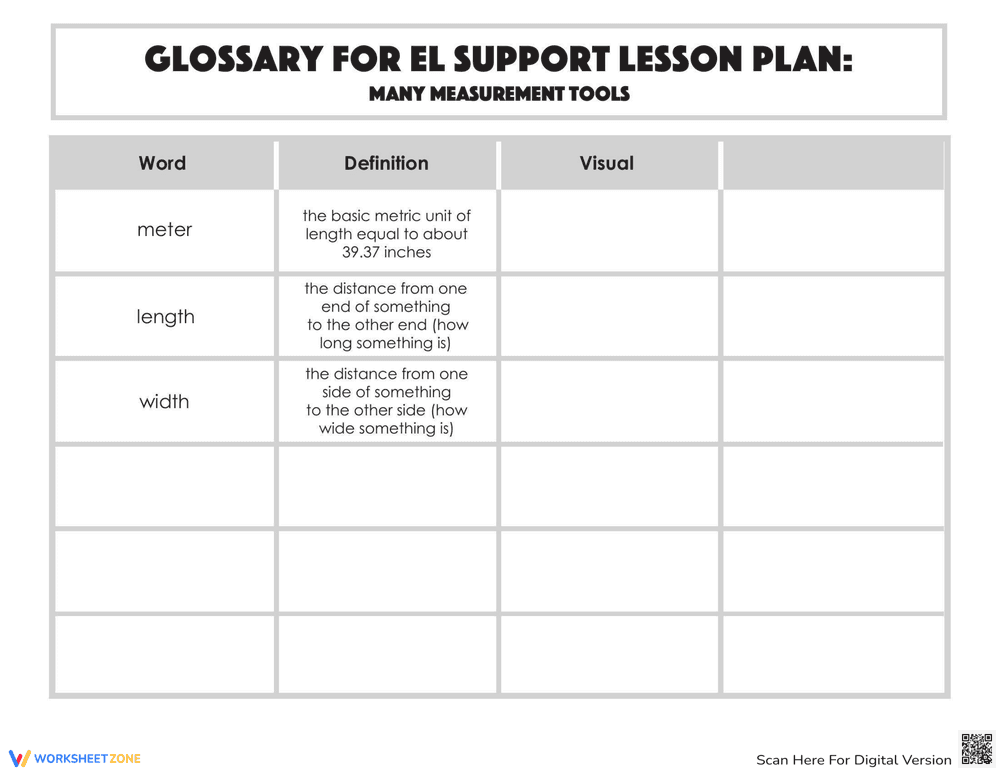
This is a glossary worksheet designed to support English Language (EL) learners in understanding measurement tools. It includes a table with three columns: 'Word,' 'Definition,' and 'Visual.' The 'Word' column lists measurement terms such as 'measure,' 'measuring tape,' 'ruler,' 'yardstick,' 'inch,' and 'foot.' The 'Definition' column provides a simple explanation of each term. The 'Visual' column is empty, presumably for students to draw or paste a picture representing the word.
Grade Level Suitability:
This worksheet is suitable for grades 1-3, potentially also for kindergarten depending on the student's level. The vocabulary and definitions are relatively simple and straightforward, making it accessible for younger students learning about measurement for the first time. The visual component also aids understanding for visual learners.
Why Use It:
This worksheet helps build vocabulary related to measurement. It supports EL learners by providing clear definitions and encouraging visual associations, which aids in comprehension. It also introduces fundamental measurement concepts.
How to Use It:
Students can read the word and its definition. Then, they can draw a picture of the measurement tool in the 'Visual' column. Alternatively, the teacher can provide pre-cut images for students to glue into the visual column. The worksheet can be used in conjunction with hands-on activities involving actual measurement tools.
Target Users:
The primary target users are English Language Learners (ELLs) in elementary school, specifically those in grades 1-3 who are learning about measurement. It can also be used as a general vocabulary builder for all students in those grade levels who are new to measurement concepts.
This is a glossary worksheet designed to support English Language (EL) learners in understanding measurement tools. It includes a table with three columns: 'Word,' 'Definition,' and 'Visual.' The 'Word' column lists measurement terms such as 'measure,' 'measuring tape,' 'ruler,' 'yardstick,' 'inch,' and 'foot.' The 'Definition' column provides a simple explanation of each term. The 'Visual' column is empty, presumably for students to draw or paste a picture representing the word.
Grade Level Suitability:
This worksheet is suitable for grades 1-3, potentially also for kindergarten depending on the student's level. The vocabulary and definitions are relatively simple and straightforward, making it accessible for younger students learning about measurement for the first time. The visual component also aids understanding for visual learners.
Why Use It:
This worksheet helps build vocabulary related to measurement. It supports EL learners by providing clear definitions and encouraging visual associations, which aids in comprehension. It also introduces fundamental measurement concepts.
How to Use It:
Students can read the word and its definition. Then, they can draw a picture of the measurement tool in the 'Visual' column. Alternatively, the teacher can provide pre-cut images for students to glue into the visual column. The worksheet can be used in conjunction with hands-on activities involving actual measurement tools.
Target Users:
The primary target users are English Language Learners (ELLs) in elementary school, specifically those in grades 1-3 who are learning about measurement. It can also be used as a general vocabulary builder for all students in those grade levels who are new to measurement concepts.


