


























0
Views
0
Downloads

0.0
0
0 Likes
Good Choices vs Bad Choices: Critical Analysis
0 Views
0 Downloads
Paste this activity's link or code into your existing LMS (Google Classroom, Canvas, Teams, Schoology, Moodle, etc.).
Students can open and work on the activity right away, with no student login required.
You'll still be able to track student progress and results from your teacher account.
Information
Description
What It Is:
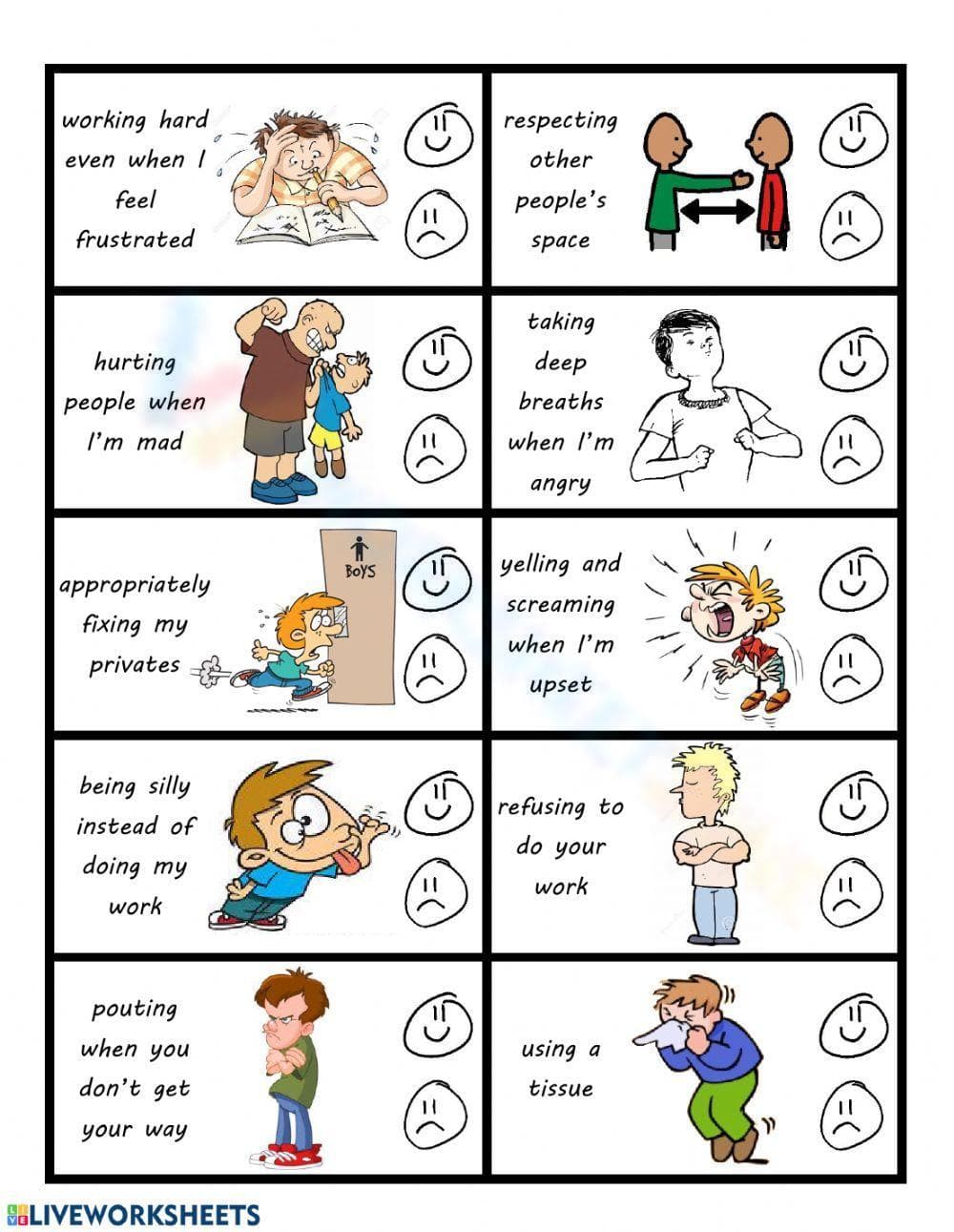
The image is an educational worksheet featuring scenarios related to behavior and emotions. Each scenario includes a picture and a short description, such as 'working hard even when I feel frustrated,' 'respecting other people's space,' 'hurting people when I'm mad,' 'taking deep breaths when I'm angry,' 'appropriately fixing my privates,' 'yelling and screaming when I'm upset,' 'being silly instead of doing my work,' 'refusing to do your work,' 'pouting when you don't get your way,' and 'using a tissue.' Next to each scenario are a happy face and a sad face, presumably for the student to indicate whether the behavior is appropriate or inappropriate.
Grade Level Suitability:
This worksheet is suitable for kindergarten through 3rd grade (K-3). The scenarios are simple and relatable for young children, and the happy/sad face response format is accessible for early learners. The topics covered, such as managing frustration, respecting personal space, and expressing emotions appropriately, are important social-emotional learning concepts for this age group.
Why Use It:
This worksheet helps children develop social-emotional skills and learn to identify appropriate and inappropriate behaviors. It encourages self-reflection and helps children understand the impact of their actions on others. It also introduces positive coping mechanisms, such as taking deep breaths when angry.
How to Use It:
Students can read each scenario and look at the corresponding picture. Then, they should circle either the happy face if the behavior is appropriate or the sad face if the behavior is inappropriate. The worksheet can be used as a class activity, individual assignment, or as a discussion starter about different behaviors and their consequences.
Target Users:
The target users are elementary school students, particularly those in kindergarten through third grade. It's also useful for teachers, counselors, and parents who want to teach children about social skills, emotional regulation, and appropriate behavior.
The image is an educational worksheet featuring scenarios related to behavior and emotions. Each scenario includes a picture and a short description, such as 'working hard even when I feel frustrated,' 'respecting other people's space,' 'hurting people when I'm mad,' 'taking deep breaths when I'm angry,' 'appropriately fixing my privates,' 'yelling and screaming when I'm upset,' 'being silly instead of doing my work,' 'refusing to do your work,' 'pouting when you don't get your way,' and 'using a tissue.' Next to each scenario are a happy face and a sad face, presumably for the student to indicate whether the behavior is appropriate or inappropriate.
Grade Level Suitability:
This worksheet is suitable for kindergarten through 3rd grade (K-3). The scenarios are simple and relatable for young children, and the happy/sad face response format is accessible for early learners. The topics covered, such as managing frustration, respecting personal space, and expressing emotions appropriately, are important social-emotional learning concepts for this age group.
Why Use It:
This worksheet helps children develop social-emotional skills and learn to identify appropriate and inappropriate behaviors. It encourages self-reflection and helps children understand the impact of their actions on others. It also introduces positive coping mechanisms, such as taking deep breaths when angry.
How to Use It:
Students can read each scenario and look at the corresponding picture. Then, they should circle either the happy face if the behavior is appropriate or the sad face if the behavior is inappropriate. The worksheet can be used as a class activity, individual assignment, or as a discussion starter about different behaviors and their consequences.
Target Users:
The target users are elementary school students, particularly those in kindergarten through third grade. It's also useful for teachers, counselors, and parents who want to teach children about social skills, emotional regulation, and appropriate behavior.


