


























0
Views
0
Downloads

0.0
0
0 Likes
Practicing Good Manners: Social Skills Worksheet
0 Views
0 Downloads
Paste this activity's link or code into your existing LMS (Google Classroom, Canvas, Teams, Schoology, Moodle, etc.).
Students can open and work on the activity right away, with no student login required.
You'll still be able to track student progress and results from your teacher account.
Information
Description
What It Is:
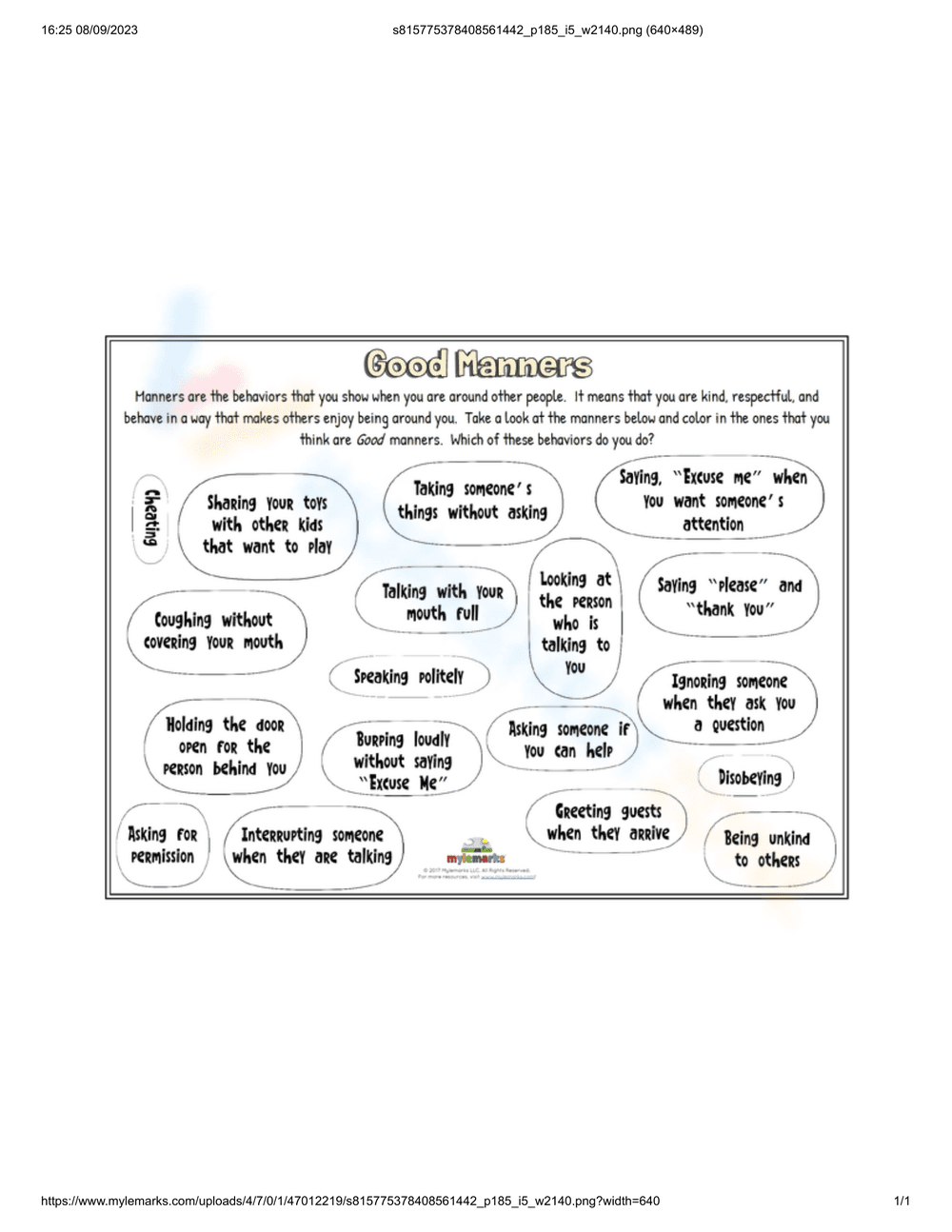
The worksheet is titled 'Good Manners' and provides a definition of manners as behaviors that show you are kind, respectful, and behave in a way that makes others enjoy being around you. It includes a variety of scenarios depicted in bubbles, such as 'Sharing your toys with other kids that want to play,' 'Taking someone's things without asking,' 'Saying 'Excuse me' when you want someone's attention,' 'Coughing without covering your mouth,' 'Talking with your mouth full,' 'Looking at the person who is talking to you,' 'Saying 'Please' and 'Thank you',' 'Holding the door open for the person behind you,' 'Burping loudly without saying 'Excuse me',' 'Asking someone if you can help,' 'Ignoring someone when they ask you a question,' 'Asking for permission,' 'Interrupting someone when they are talking,' 'Greeting guests when they arrive,' and 'Being unkind to others.' The worksheet asks the user to look at the manners below and color in the ones that they think are good manners.
Grade Level Suitability:
This worksheet is suitable for Kindergarten, 1st grade, and 2nd grade. The concepts of good manners are introduced in early elementary education, and the activities are simple enough for young children to understand and complete. The visual nature of the worksheet also caters to younger learners.
Why Use It:
This worksheet helps children learn about and identify good manners. It promotes social skills, empathy, and respect for others. It also encourages critical thinking as children decide which behaviors are considered good manners. It reinforces vocabulary related to etiquette and social interactions.
How to Use It:
Provide crayons or colored pencils. Read the definition of good manners with the child. Then, read each scenario aloud and discuss whether it represents good manners. Instruct the child to color in the bubbles that depict good manners. Review the completed worksheet and discuss any scenarios where the child's answer differs from the expected answer.
Target Users:
The target users are young children in preschool, kindergarten, 1st grade, or 2nd grade. It is also suitable for children with social skills deficits or those who need reinforcement in understanding appropriate behavior. Teachers, parents, and homeschool educators can use this worksheet.
The worksheet is titled 'Good Manners' and provides a definition of manners as behaviors that show you are kind, respectful, and behave in a way that makes others enjoy being around you. It includes a variety of scenarios depicted in bubbles, such as 'Sharing your toys with other kids that want to play,' 'Taking someone's things without asking,' 'Saying 'Excuse me' when you want someone's attention,' 'Coughing without covering your mouth,' 'Talking with your mouth full,' 'Looking at the person who is talking to you,' 'Saying 'Please' and 'Thank you',' 'Holding the door open for the person behind you,' 'Burping loudly without saying 'Excuse me',' 'Asking someone if you can help,' 'Ignoring someone when they ask you a question,' 'Asking for permission,' 'Interrupting someone when they are talking,' 'Greeting guests when they arrive,' and 'Being unkind to others.' The worksheet asks the user to look at the manners below and color in the ones that they think are good manners.
Grade Level Suitability:
This worksheet is suitable for Kindergarten, 1st grade, and 2nd grade. The concepts of good manners are introduced in early elementary education, and the activities are simple enough for young children to understand and complete. The visual nature of the worksheet also caters to younger learners.
Why Use It:
This worksheet helps children learn about and identify good manners. It promotes social skills, empathy, and respect for others. It also encourages critical thinking as children decide which behaviors are considered good manners. It reinforces vocabulary related to etiquette and social interactions.
How to Use It:
Provide crayons or colored pencils. Read the definition of good manners with the child. Then, read each scenario aloud and discuss whether it represents good manners. Instruct the child to color in the bubbles that depict good manners. Review the completed worksheet and discuss any scenarios where the child's answer differs from the expected answer.
Target Users:
The target users are young children in preschool, kindergarten, 1st grade, or 2nd grade. It is also suitable for children with social skills deficits or those who need reinforcement in understanding appropriate behavior. Teachers, parents, and homeschool educators can use this worksheet.


