


























0
Views
0
Downloads

0.0
0
0 Likes
Practice Graham's Law: Gas Behavior Worksheet
0 Views
0 Downloads
Paste this activity's link or code into your existing LMS (Google Classroom, Canvas, Teams, Schoology, Moodle, etc.).
Students can open and work on the activity right away, with no student login required.
You'll still be able to track student progress and results from your teacher account.
Information
Description
What It Is:
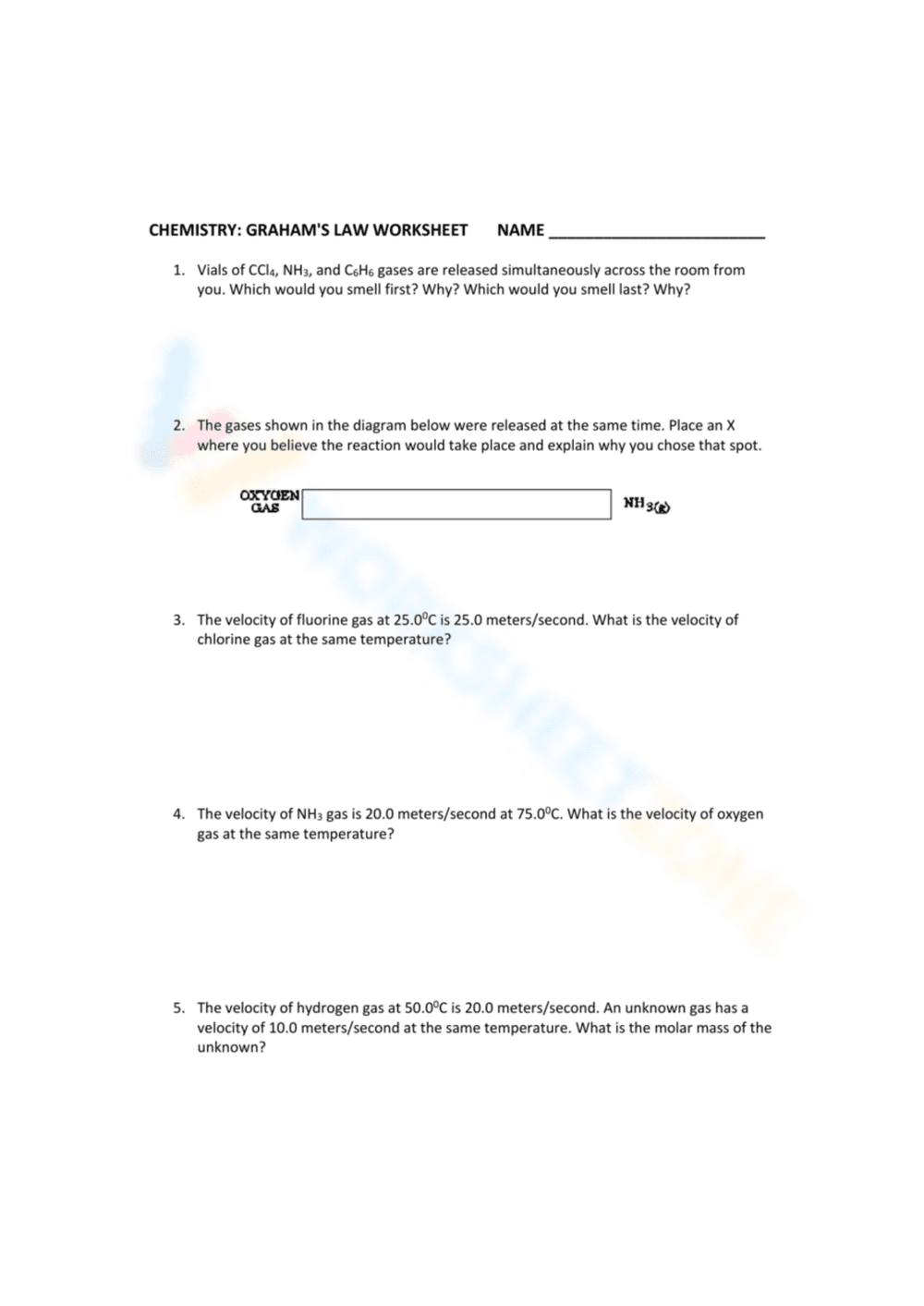
This is a chemistry worksheet focused on Graham's Law of diffusion and effusion. It includes problems involving determining which gas will be smelled first based on molecular weight, predicting reaction locations based on gas diffusion rates, and calculating gas velocities and molar masses using Graham's Law. There's a diagram to mark the reaction point between oxygen and NO2.
Grade Level Suitability:
Suitable for grades 11-12 (High School Chemistry) and introductory college chemistry courses. The concepts of molar mass, gas velocity, diffusion, and effusion, and the application of Graham's Law require a solid foundation in chemistry principles.
Why Use It:
This worksheet helps students understand and apply Graham's Law to predict relative gas velocities and diffusion rates. It reinforces the relationship between molecular weight and gas behavior. It also develops problem-solving skills in chemistry, including calculations and conceptual understanding.
How to Use It:
Students should first review the concepts of Graham's Law and molar mass. Then, they can work through the problems, showing their calculations and providing explanations for their answers. For the diagram question, students should mark an 'X' at the predicted reaction location and justify their choice based on the diffusion rates of the gases.
Target Users:
High school chemistry students, AP chemistry students, and college students taking introductory chemistry courses will benefit from this worksheet. It can be used for homework, in-class practice, or as a review tool.
This is a chemistry worksheet focused on Graham's Law of diffusion and effusion. It includes problems involving determining which gas will be smelled first based on molecular weight, predicting reaction locations based on gas diffusion rates, and calculating gas velocities and molar masses using Graham's Law. There's a diagram to mark the reaction point between oxygen and NO2.
Grade Level Suitability:
Suitable for grades 11-12 (High School Chemistry) and introductory college chemistry courses. The concepts of molar mass, gas velocity, diffusion, and effusion, and the application of Graham's Law require a solid foundation in chemistry principles.
Why Use It:
This worksheet helps students understand and apply Graham's Law to predict relative gas velocities and diffusion rates. It reinforces the relationship between molecular weight and gas behavior. It also develops problem-solving skills in chemistry, including calculations and conceptual understanding.
How to Use It:
Students should first review the concepts of Graham's Law and molar mass. Then, they can work through the problems, showing their calculations and providing explanations for their answers. For the diagram question, students should mark an 'X' at the predicted reaction location and justify their choice based on the diffusion rates of the gases.
Target Users:
High school chemistry students, AP chemistry students, and college students taking introductory chemistry courses will benefit from this worksheet. It can be used for homework, in-class practice, or as a review tool.


