


























1 / 3
0
Views
0
Downloads


0 Likes
Graham's Law Worksheet
0 Views
0 Downloads
Paste this activity's link or code into your existing LMS (Google Classroom, Canvas, Teams, Schoology, Moodle, etc.).
Students can open and work on the activity right away, with no student login required.
You'll still be able to track student progress and results from your teacher account.
Information
Description
What It Is:
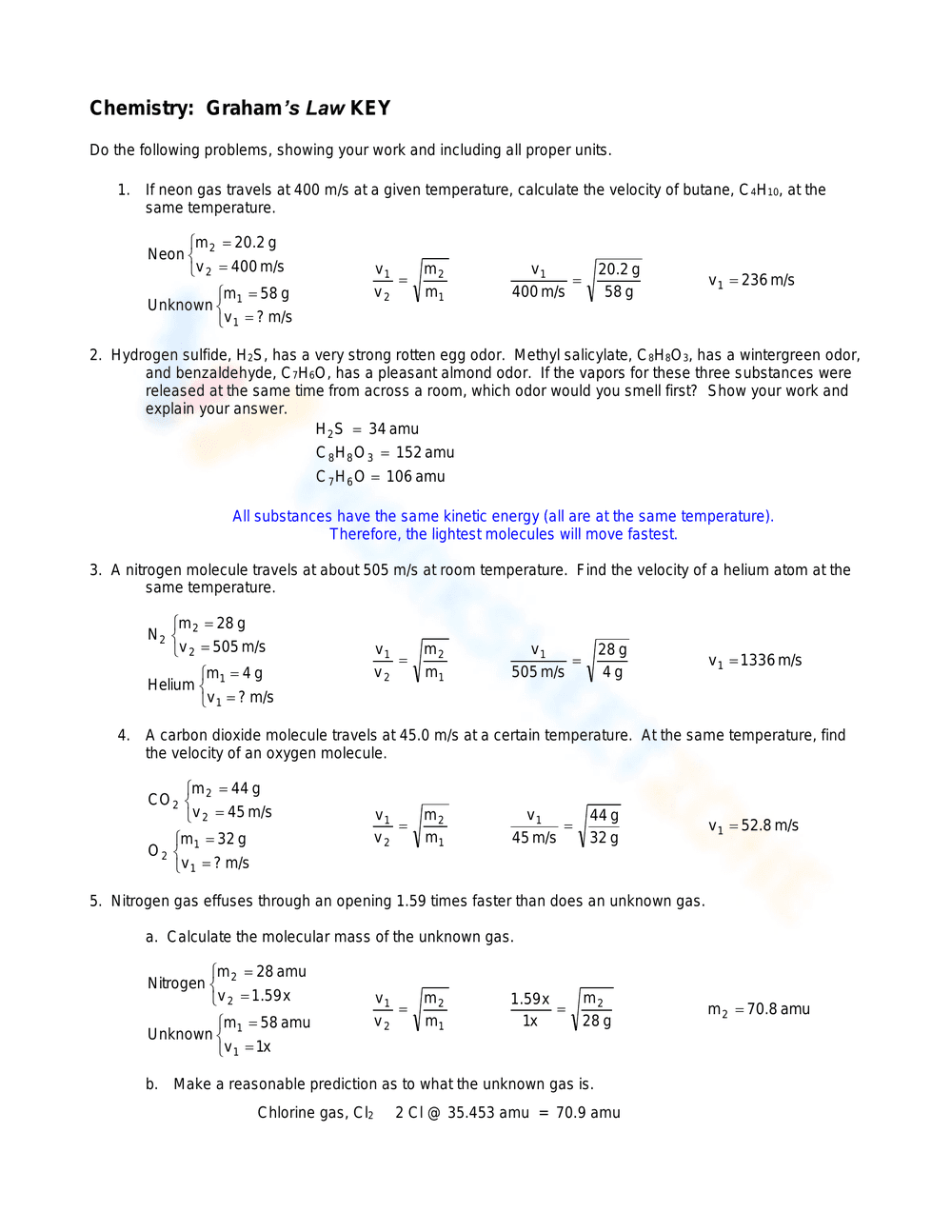
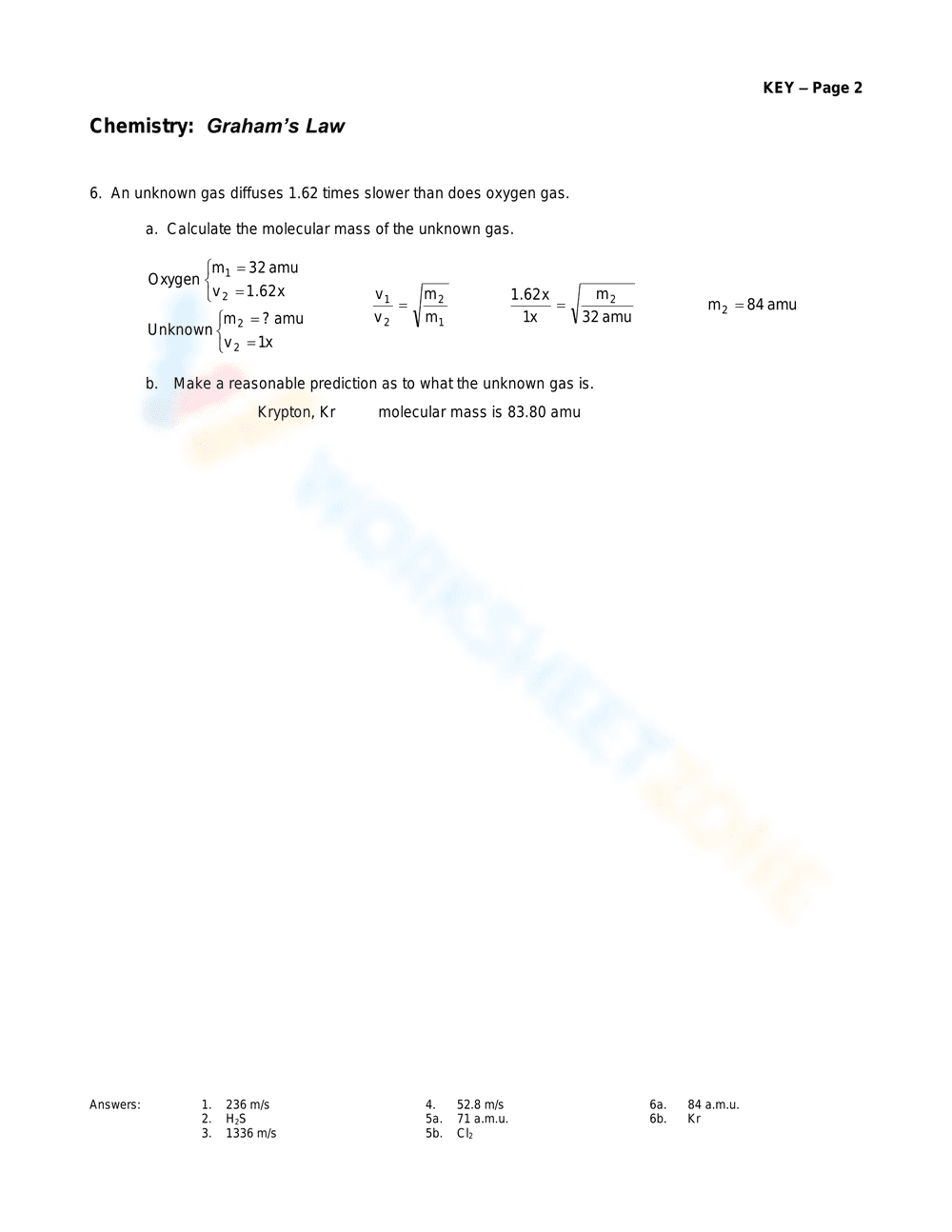
This is a chemistry worksheet focused on Graham's Law. It includes several quantitative problems where students must calculate the velocity or molar mass of gases using Graham's Law. Problems involve neon, butane, hydrogen sulfide, methyl salicylate, benzaldehyde, nitrogen, helium, carbon dioxide, oxygen, and an unknown gas. The worksheet also includes a qualitative question about odor diffusion rates. An answer key is provided.
Grade Level Suitability:
This worksheet is most suitable for high school students, specifically grades 11-12, taking chemistry. The problems require an understanding of molar mass, gas behavior, and algebraic manipulation, which are typically covered in high school chemistry courses.
Why Use It:
This worksheet provides practice in applying Graham's Law to calculate gas velocities and molar masses. It reinforces the concept that lighter molecules diffuse faster. The odor diffusion question connects the abstract concept to a real-world phenomenon. It allows students to develop problem-solving skills and a deeper understanding of gas behavior.
How to Use It:
Students should first review Graham's Law and its formula. Then, they should work through each problem, showing all their work and including proper units. They should use the provided molar masses and velocities to calculate the unknown values. For the odor diffusion problem, they need to consider the molar masses of the given compounds.
Target Users:
The target users are high school chemistry students, particularly those learning about gas laws and kinetic molecular theory. It is also useful for chemistry teachers looking for practice problems on Graham's Law.
This is a chemistry worksheet focused on Graham's Law. It includes several quantitative problems where students must calculate the velocity or molar mass of gases using Graham's Law. Problems involve neon, butane, hydrogen sulfide, methyl salicylate, benzaldehyde, nitrogen, helium, carbon dioxide, oxygen, and an unknown gas. The worksheet also includes a qualitative question about odor diffusion rates. An answer key is provided.
Grade Level Suitability:
This worksheet is most suitable for high school students, specifically grades 11-12, taking chemistry. The problems require an understanding of molar mass, gas behavior, and algebraic manipulation, which are typically covered in high school chemistry courses.
Why Use It:
This worksheet provides practice in applying Graham's Law to calculate gas velocities and molar masses. It reinforces the concept that lighter molecules diffuse faster. The odor diffusion question connects the abstract concept to a real-world phenomenon. It allows students to develop problem-solving skills and a deeper understanding of gas behavior.
How to Use It:
Students should first review Graham's Law and its formula. Then, they should work through each problem, showing all their work and including proper units. They should use the provided molar masses and velocities to calculate the unknown values. For the odor diffusion problem, they need to consider the molar masses of the given compounds.
Target Users:
The target users are high school chemistry students, particularly those learning about gas laws and kinetic molecular theory. It is also useful for chemistry teachers looking for practice problems on Graham's Law.


