


























1 / 4
0
Views
0
Downloads



0.0
0
0 Likes
Graph Linear Functions Skills Worksheet
0 Views
0 Downloads
Paste this activity's link or code into your existing LMS (Google Classroom, Canvas, Teams, Schoology, Moodle, etc.).
Students can open and work on the activity right away, with no student login required.
You'll still be able to track student progress and results from your teacher account.
Information
Description
What It Is:
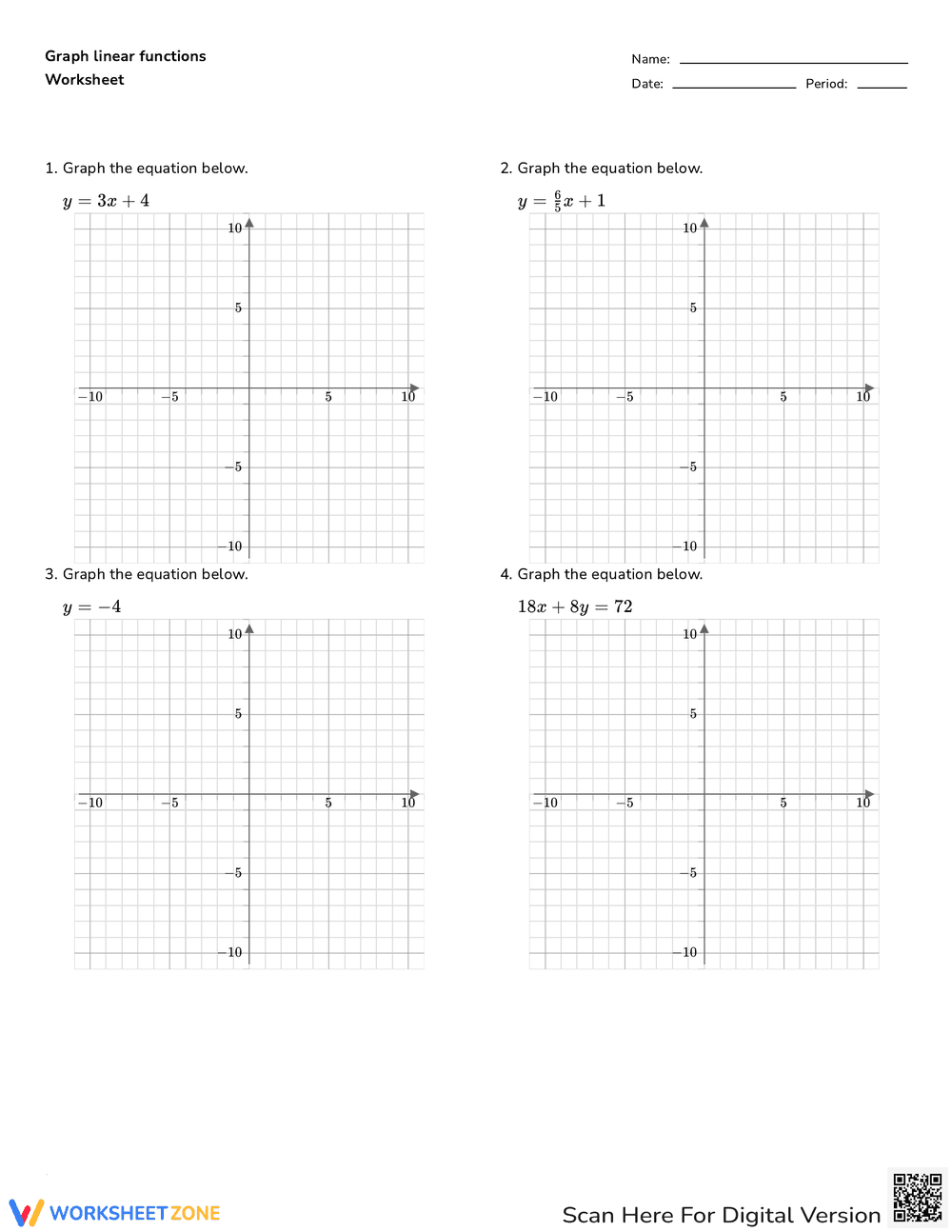
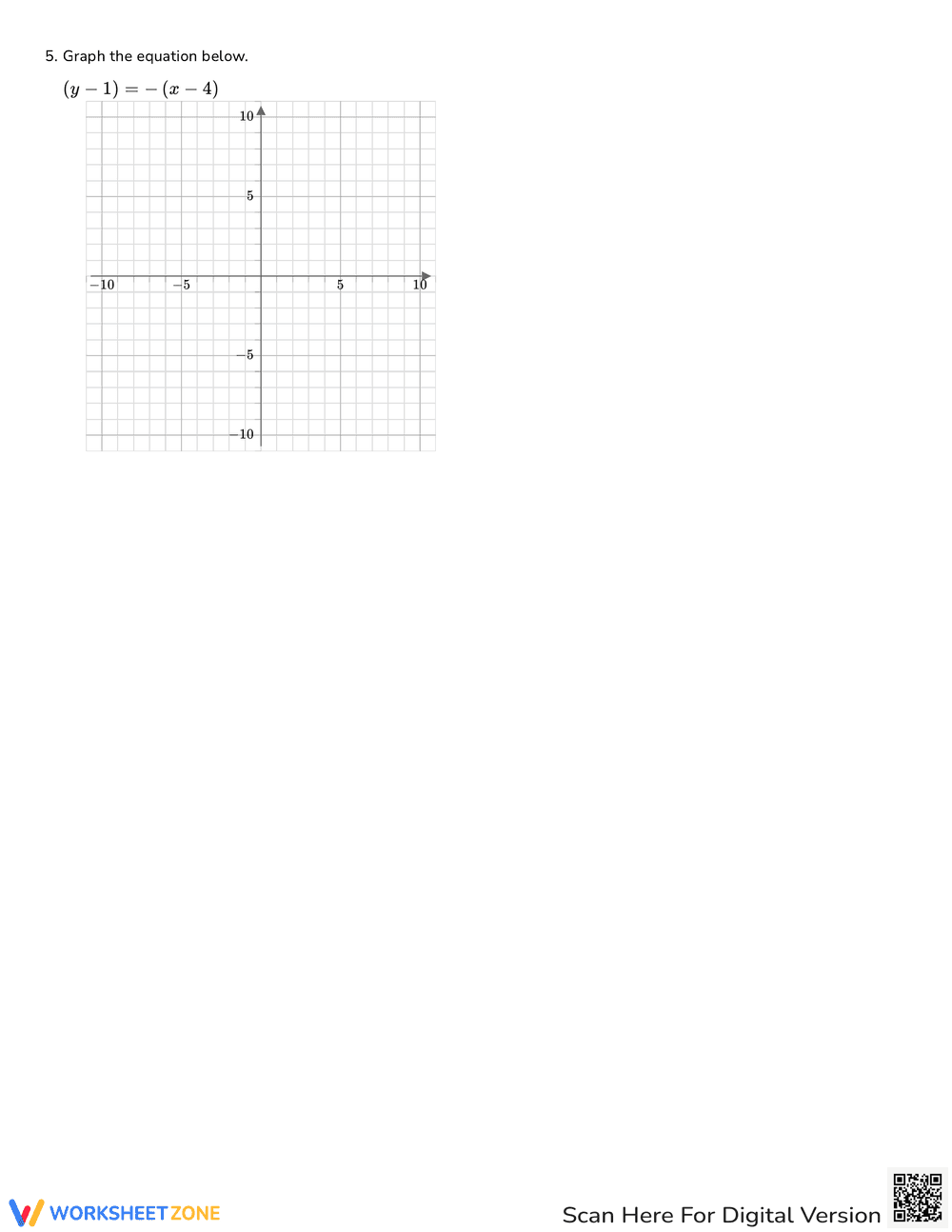
This is a math worksheet focusing on graphing linear functions. It includes four problems where students are asked to graph given equations on a coordinate plane. The equations are in various forms, including slope-intercept form (y = 3x + 4, y = 1/2x + 1), a horizontal line (y = -4), and a standard form equation (18x + 8y = 72). Each problem has a pre-drawn coordinate plane ranging from -10 to 10 on both the x and y axes. The worksheet also has fields for Name, Date, and Period.
Grade Level Suitability:
This worksheet is suitable for grades 8-10, specifically Algebra 1. It requires students to understand and apply concepts like slope, y-intercept, and how to transform equations into a graph. The presence of an equation in standard form makes it more appropriate for higher grades within that range.
Why Use It:
This worksheet provides practice in graphing linear equations. It helps students develop their understanding of the relationship between equations and their graphical representation. It reinforces skills in identifying slope and y-intercept and converting equations into a visual format. It also helps students understand horizontal lines and converting equations from standard form.
How to Use It:
Students should first analyze each equation to determine its slope and y-intercept (or other relevant characteristics). Then, they should plot points on the coordinate plane based on the equation and draw a line connecting those points. For the standard form equation, students may need to convert it to slope-intercept form first.
Target Users:
The target users are students in Algebra 1 or pre-algebra courses who are learning about graphing linear equations. It's also suitable for students needing review or extra practice on this topic. It can be used by teachers for in-class assignments, homework, or assessments.
This is a math worksheet focusing on graphing linear functions. It includes four problems where students are asked to graph given equations on a coordinate plane. The equations are in various forms, including slope-intercept form (y = 3x + 4, y = 1/2x + 1), a horizontal line (y = -4), and a standard form equation (18x + 8y = 72). Each problem has a pre-drawn coordinate plane ranging from -10 to 10 on both the x and y axes. The worksheet also has fields for Name, Date, and Period.
Grade Level Suitability:
This worksheet is suitable for grades 8-10, specifically Algebra 1. It requires students to understand and apply concepts like slope, y-intercept, and how to transform equations into a graph. The presence of an equation in standard form makes it more appropriate for higher grades within that range.
Why Use It:
This worksheet provides practice in graphing linear equations. It helps students develop their understanding of the relationship between equations and their graphical representation. It reinforces skills in identifying slope and y-intercept and converting equations into a visual format. It also helps students understand horizontal lines and converting equations from standard form.
How to Use It:
Students should first analyze each equation to determine its slope and y-intercept (or other relevant characteristics). Then, they should plot points on the coordinate plane based on the equation and draw a line connecting those points. For the standard form equation, students may need to convert it to slope-intercept form first.
Target Users:
The target users are students in Algebra 1 or pre-algebra courses who are learning about graphing linear equations. It's also suitable for students needing review or extra practice on this topic. It can be used by teachers for in-class assignments, homework, or assessments.


