


























1 / 6
0
Views
0
Downloads




0.0
0
0 Likes
Half-Life Calculation Problems
0 Views
0 Downloads
Paste this activity's link or code into your existing LMS (Google Classroom, Canvas, Teams, Schoology, Moodle, etc.).
Students can open and work on the activity right away, with no student login required.
You'll still be able to track student progress and results from your teacher account.
Information
Description
What It Is:
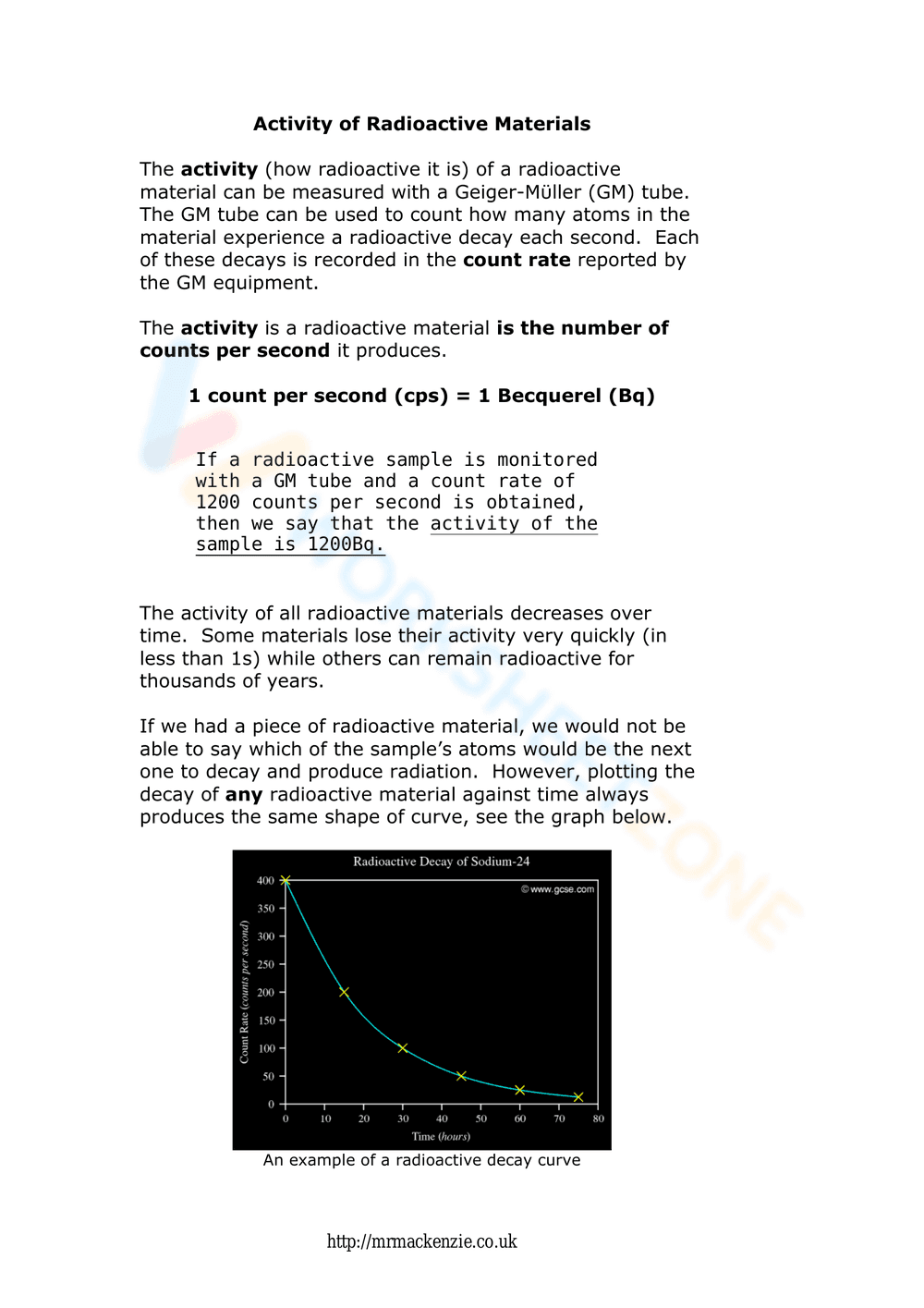
This is a worksheet explaining the activity of radioactive materials. It defines activity as the number of counts per second and relates it to the Becquerel unit. It explains how a Geiger-Müller (GM) tube is used to measure radioactive decay and shows a graph of radioactive decay of Sodium-24 over time.
Grade Level Suitability:
Suitable for grades 9-12 (high school) physics or chemistry students. The concepts of radioactivity, decay rates, and units like Becquerel are typically introduced at this level. The graph interpretation also requires some mathematical understanding.
Why Use It:
This worksheet helps students understand the concept of radioactivity, how it's measured, and how it decreases over time. It introduces the relationship between counts per second and Becquerel and provides a visual representation of radioactive decay.
How to Use It:
Use this as an introductory reading material to define radioactivity. Students can use the graph to determine half-life. Use the example calculation to practice converting counts per second to Becquerels.
Target Users:
High school students studying physics or chemistry, particularly those learning about nuclear physics and radioactivity. It can also be used as a review for introductory college-level science courses.
This is a worksheet explaining the activity of radioactive materials. It defines activity as the number of counts per second and relates it to the Becquerel unit. It explains how a Geiger-Müller (GM) tube is used to measure radioactive decay and shows a graph of radioactive decay of Sodium-24 over time.
Grade Level Suitability:
Suitable for grades 9-12 (high school) physics or chemistry students. The concepts of radioactivity, decay rates, and units like Becquerel are typically introduced at this level. The graph interpretation also requires some mathematical understanding.
Why Use It:
This worksheet helps students understand the concept of radioactivity, how it's measured, and how it decreases over time. It introduces the relationship between counts per second and Becquerel and provides a visual representation of radioactive decay.
How to Use It:
Use this as an introductory reading material to define radioactivity. Students can use the graph to determine half-life. Use the example calculation to practice converting counts per second to Becquerels.
Target Users:
High school students studying physics or chemistry, particularly those learning about nuclear physics and radioactivity. It can also be used as a review for introductory college-level science courses.


