


























0
Views
0
Downloads

0 Likes
Study Guide to Heating Curves
0 Views
0 Downloads
Paste this activity's link or code into your existing LMS (Google Classroom, Canvas, Teams, Schoology, Moodle, etc.).
Students can open and work on the activity right away, with no student login required.
You'll still be able to track student progress and results from your teacher account.
Information
Description
What It Is:
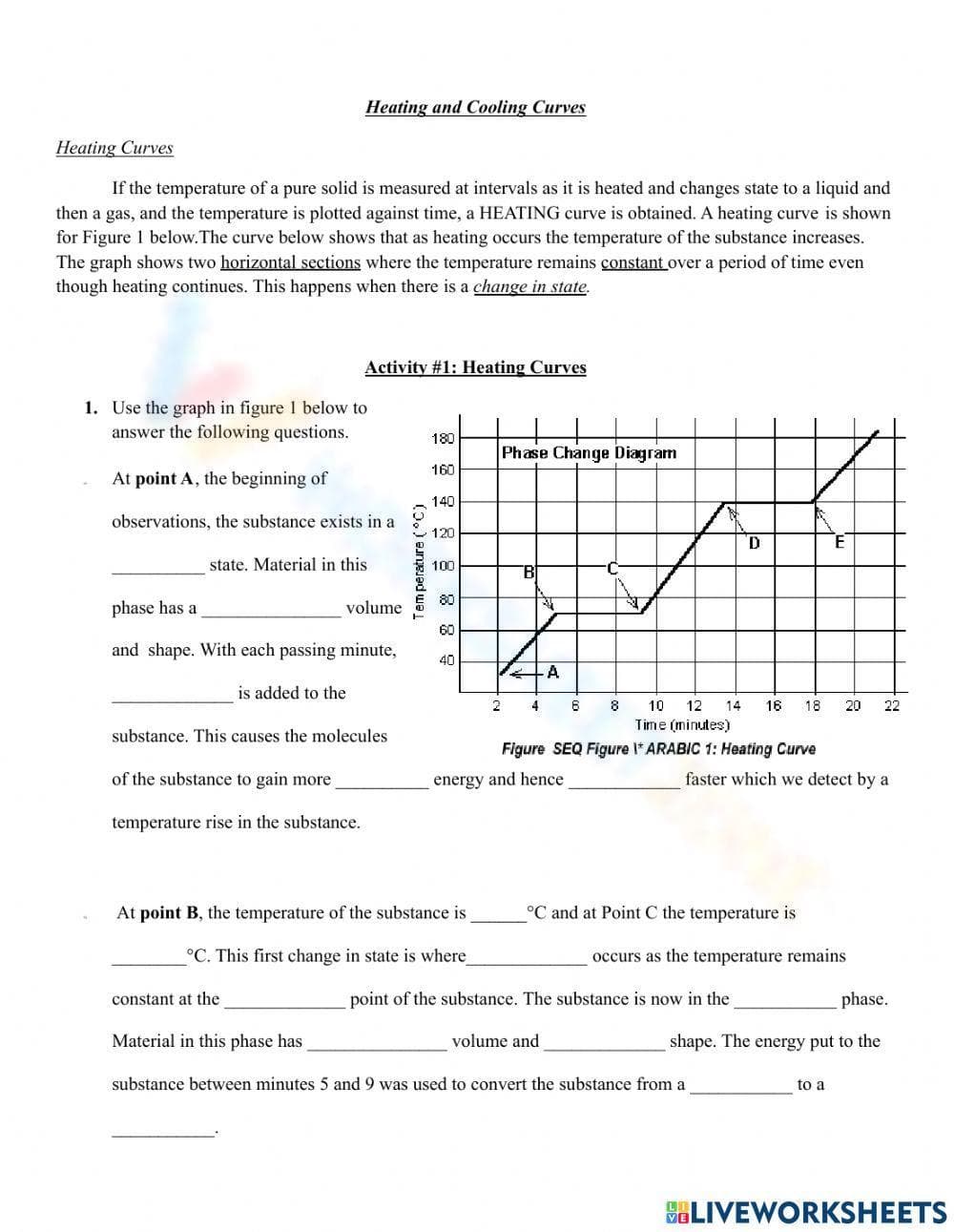
This is a science worksheet focusing on heating and cooling curves. It presents a phase change diagram (temperature vs. time) and asks students to analyze the graph to answer questions about the states of matter at different points (A, B, and C) on the curve. Students need to identify the phase, volume, and shape of the substance at each point, and understand the energy changes involved during phase transitions.
Grade Level Suitability:
Suitable for grades 8-10 (Middle School and early High School). The concepts of phase changes, temperature, and energy transfer are typically introduced in these grades. The graph analysis requires some understanding of interpreting data and scientific reasoning, which is appropriate for this age group.
Why Use It:
This worksheet reinforces the understanding of phase changes (solid, liquid, gas) and their relationship to temperature and energy input. It helps students develop skills in interpreting graphs, making observations, and drawing conclusions about the properties of matter at different phases. It also promotes critical thinking by requiring students to relate the changes in the graph to the changes in the substance's state.
How to Use It:
Students should first read the introductory text about heating curves. Then, they should carefully examine the provided phase change diagram. Using the graph, they should answer the questions about the substance at points A, B, and C, filling in the blanks with the correct terms relating to phase, volume, shape, and energy.
Target Users:
This worksheet is intended for science students in middle school or early high school studying physical science, chemistry, or general science. It is suitable for classroom use, homework assignments, or review activities related to states of matter and phase changes.
This is a science worksheet focusing on heating and cooling curves. It presents a phase change diagram (temperature vs. time) and asks students to analyze the graph to answer questions about the states of matter at different points (A, B, and C) on the curve. Students need to identify the phase, volume, and shape of the substance at each point, and understand the energy changes involved during phase transitions.
Grade Level Suitability:
Suitable for grades 8-10 (Middle School and early High School). The concepts of phase changes, temperature, and energy transfer are typically introduced in these grades. The graph analysis requires some understanding of interpreting data and scientific reasoning, which is appropriate for this age group.
Why Use It:
This worksheet reinforces the understanding of phase changes (solid, liquid, gas) and their relationship to temperature and energy input. It helps students develop skills in interpreting graphs, making observations, and drawing conclusions about the properties of matter at different phases. It also promotes critical thinking by requiring students to relate the changes in the graph to the changes in the substance's state.
How to Use It:
Students should first read the introductory text about heating curves. Then, they should carefully examine the provided phase change diagram. Using the graph, they should answer the questions about the substance at points A, B, and C, filling in the blanks with the correct terms relating to phase, volume, shape, and energy.
Target Users:
This worksheet is intended for science students in middle school or early high school studying physical science, chemistry, or general science. It is suitable for classroom use, homework assignments, or review activities related to states of matter and phase changes.


