


























1 / 2
0
Views
0
Downloads

0.0
0
0 Likes
History of Atomic Theory
0 Views
0 Downloads
Paste this activity's link or code into your existing LMS (Google Classroom, Canvas, Teams, Schoology, Moodle, etc.).
Students can open and work on the activity right away, with no student login required.
You'll still be able to track student progress and results from your teacher account.
Information
Description
What It Is:
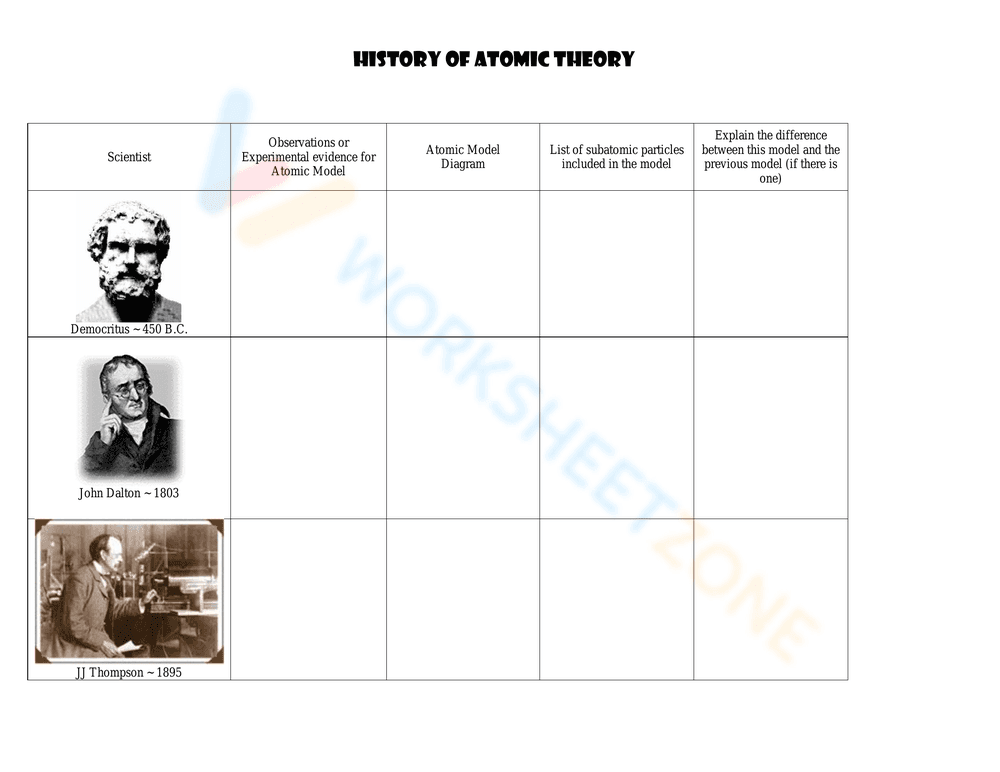
This is a science worksheet titled 'History of Atomic Theory.' It's a table with columns for different scientists (Democritus, John Dalton, and J.J. Thomson), their observations or experimental evidence for their atomic model, an atomic model diagram, a list of subatomic particles included in the model, and an explanation of the difference between this model and the previous model. The worksheet includes pictures of the scientists.
Grade Level Suitability:
This worksheet is suitable for grades 9-12, specifically high school chemistry or physics. The content requires an understanding of atomic structure and the historical development of scientific theories. It is appropriate for students learning about the evolution of the atomic model.
Why Use It:
This worksheet helps students understand the evolution of the atomic theory by prompting them to research and organize information about different scientists and their contributions. It reinforces the scientific method by focusing on observations, evidence, and model development. It also encourages critical thinking by asking students to compare and contrast different models.
How to Use It:
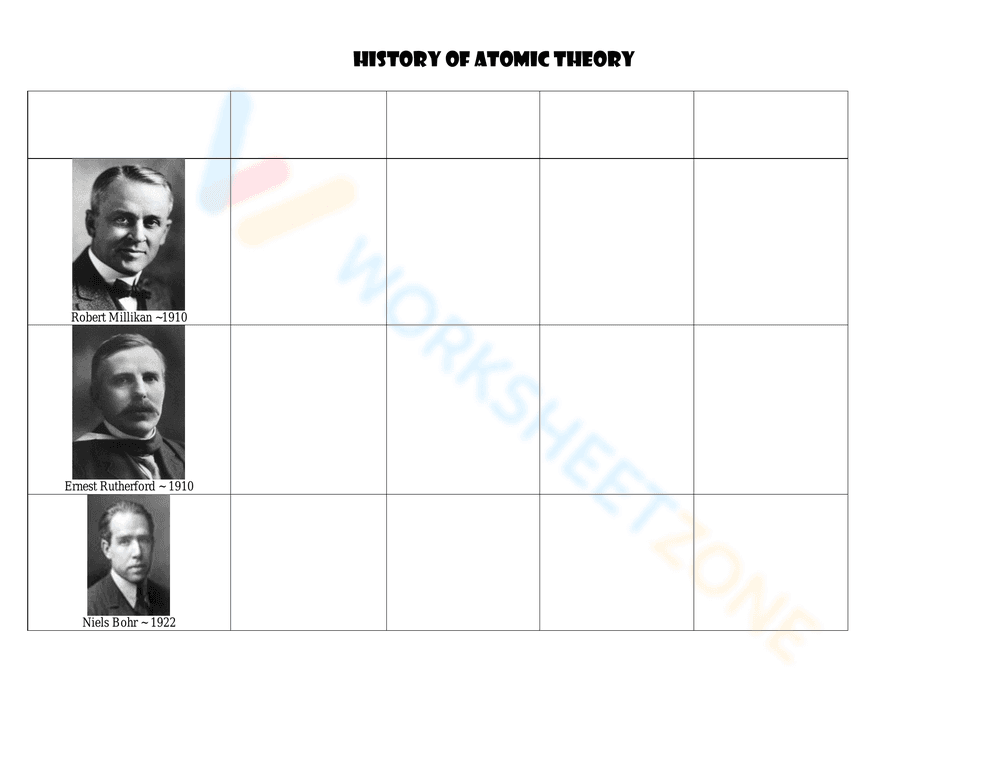
Students should research each scientist listed on the worksheet and fill in the corresponding rows. They should find information about the observations or experiments that led to the development of each atomic model. Students may need to draw or find images of the atomic model diagram. They should also identify the subatomic particles included in each model and explain how each model improved upon the previous one.
Target Users:
This worksheet is designed for high school students studying chemistry or physics. It is also suitable for teachers who want to provide a structured activity to help students learn about the history of atomic theory. Homeschooling parents teaching high school science can also benefit from this resource.
This is a science worksheet titled 'History of Atomic Theory.' It's a table with columns for different scientists (Democritus, John Dalton, and J.J. Thomson), their observations or experimental evidence for their atomic model, an atomic model diagram, a list of subatomic particles included in the model, and an explanation of the difference between this model and the previous model. The worksheet includes pictures of the scientists.
Grade Level Suitability:
This worksheet is suitable for grades 9-12, specifically high school chemistry or physics. The content requires an understanding of atomic structure and the historical development of scientific theories. It is appropriate for students learning about the evolution of the atomic model.
Why Use It:
This worksheet helps students understand the evolution of the atomic theory by prompting them to research and organize information about different scientists and their contributions. It reinforces the scientific method by focusing on observations, evidence, and model development. It also encourages critical thinking by asking students to compare and contrast different models.
How to Use It:
Students should research each scientist listed on the worksheet and fill in the corresponding rows. They should find information about the observations or experiments that led to the development of each atomic model. Students may need to draw or find images of the atomic model diagram. They should also identify the subatomic particles included in each model and explain how each model improved upon the previous one.
Target Users:
This worksheet is designed for high school students studying chemistry or physics. It is also suitable for teachers who want to provide a structured activity to help students learn about the history of atomic theory. Homeschooling parents teaching high school science can also benefit from this resource.


