


























0
Views
0
Downloads

0.0
0
0 Likes
Conflict Resolution Skills Worksheet - Reflect & Learn
0 Views
0 Downloads
Paste this activity's link or code into your existing LMS (Google Classroom, Canvas, Teams, Schoology, Moodle, etc.).
Students can open and work on the activity right away, with no student login required.
You'll still be able to track student progress and results from your teacher account.
Information
Description
What It Is:
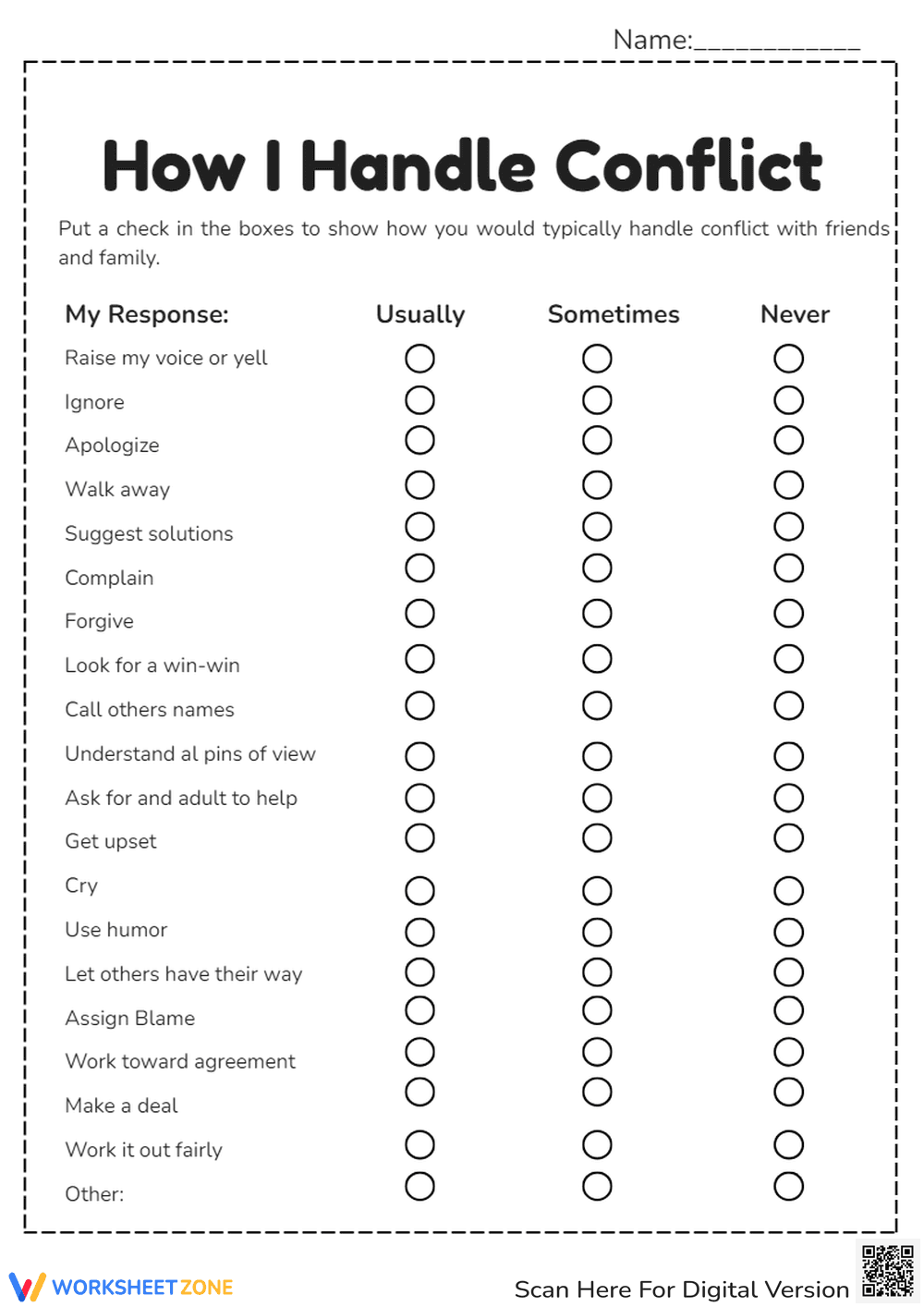
This is a worksheet titled 'How I Handle Conflict'. It prompts students to reflect on their typical responses to conflict with friends and family. The worksheet lists various reactions, such as 'Raise my voice or yell,' 'Ignore,' 'Apologize,' 'Walk away,' and 'Suggest solutions.' Students indicate how often they exhibit each behavior by checking a box under the columns 'Usually,' 'Sometimes,' or 'Never.' There's also a blank line for 'Other' responses.
Grade Level Suitability:
This worksheet is suitable for grades 3-8. The vocabulary is simple enough for younger students to understand, while the self-reflection aspect is appropriate for older elementary and middle school students. It helps them develop social-emotional skills.
Why Use It:
This worksheet helps students develop self-awareness regarding their conflict resolution skills. It encourages them to think critically about their reactions and identify areas for improvement. It promotes emotional intelligence and healthy communication strategies.
How to Use It:
Students should read each statement in the 'My Response' column carefully. For each statement, they should place a checkmark in the 'Usually,' 'Sometimes,' or 'Never' column that best reflects how they typically respond in conflict situations. They can use the 'Other' line to add any responses not already listed.
Target Users:
This worksheet is beneficial for elementary and middle school students, counselors, teachers, and parents who want to foster self-reflection and improve conflict resolution skills. It can be used in classroom settings, counseling sessions, or at home as a tool for social-emotional learning.
This is a worksheet titled 'How I Handle Conflict'. It prompts students to reflect on their typical responses to conflict with friends and family. The worksheet lists various reactions, such as 'Raise my voice or yell,' 'Ignore,' 'Apologize,' 'Walk away,' and 'Suggest solutions.' Students indicate how often they exhibit each behavior by checking a box under the columns 'Usually,' 'Sometimes,' or 'Never.' There's also a blank line for 'Other' responses.
Grade Level Suitability:
This worksheet is suitable for grades 3-8. The vocabulary is simple enough for younger students to understand, while the self-reflection aspect is appropriate for older elementary and middle school students. It helps them develop social-emotional skills.
Why Use It:
This worksheet helps students develop self-awareness regarding their conflict resolution skills. It encourages them to think critically about their reactions and identify areas for improvement. It promotes emotional intelligence and healthy communication strategies.
How to Use It:
Students should read each statement in the 'My Response' column carefully. For each statement, they should place a checkmark in the 'Usually,' 'Sometimes,' or 'Never' column that best reflects how they typically respond in conflict situations. They can use the 'Other' line to add any responses not already listed.
Target Users:
This worksheet is beneficial for elementary and middle school students, counselors, teachers, and parents who want to foster self-reflection and improve conflict resolution skills. It can be used in classroom settings, counseling sessions, or at home as a tool for social-emotional learning.


