


























0
Views
0
Downloads

0.0
0
0 Likes
Human Muscles: Front View Anatomy
0 Views
0 Downloads
Paste this activity's link or code into your existing LMS (Google Classroom, Canvas, Teams, Schoology, Moodle, etc.).
Students can open and work on the activity right away, with no student login required.
You'll still be able to track student progress and results from your teacher account.
Information
Description
What It Is:
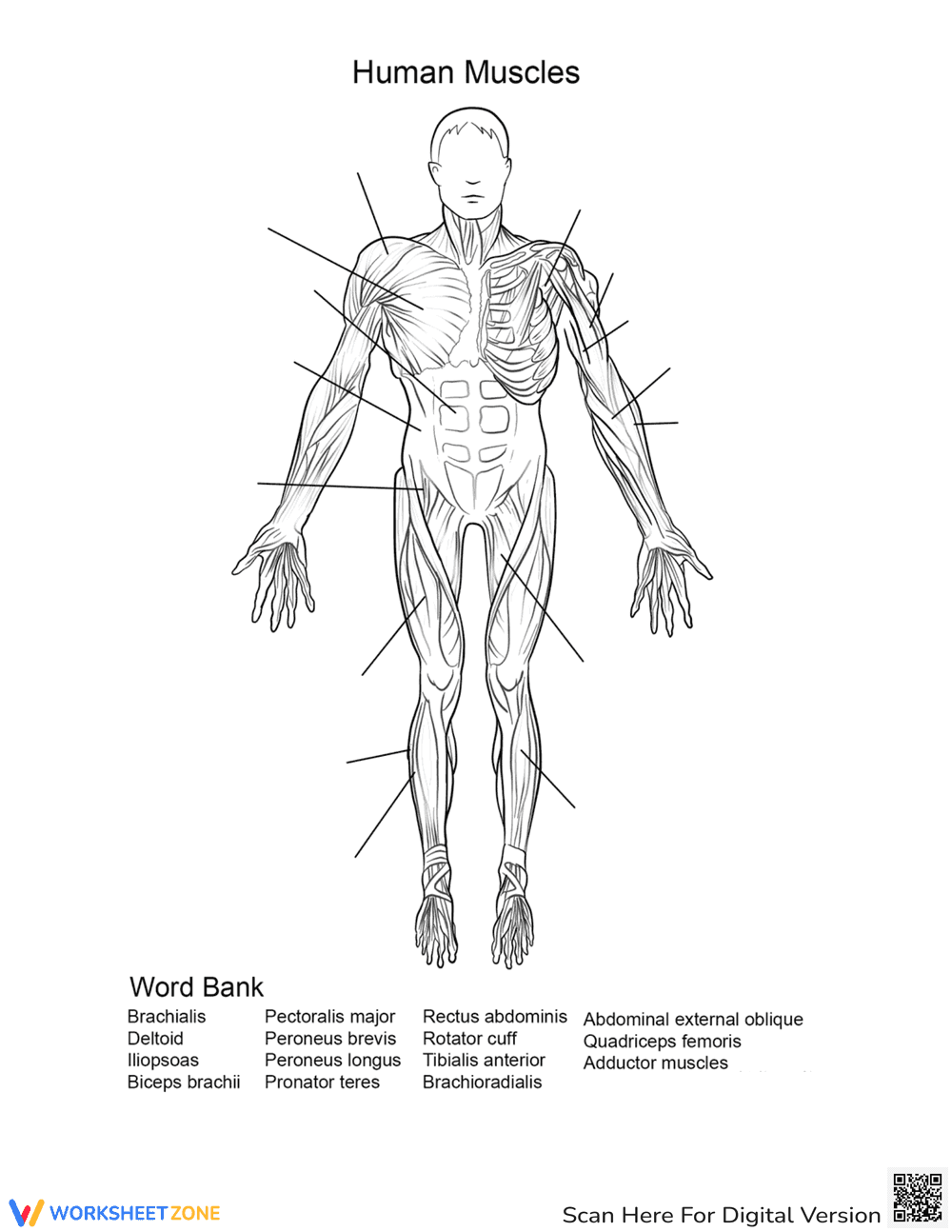
This is an educational worksheet featuring a diagram of human muscles. The worksheet shows an unlabeled anatomical illustration of the human body, with lines pointing to various muscle groups. A word bank is provided below, listing muscles such as brachialis, deltoid, iliopsoas, biceps brachii, pectoralis major, peroneus brevis, peroneus longus, pronator teres, rectus abdominis, rotator cuff, tibialis anterior, brachioradialis, abdominal external oblique, quadriceps femoris, and adductor muscles. The task is to label the muscles on the diagram using the word bank.
Grade Level Suitability:
This worksheet is suitable for grades 7-12, particularly in middle school and high school biology or anatomy classes. The complexity of the muscle names and the level of anatomical detail make it appropriate for older students.
Why Use It:
This worksheet helps students learn and memorize the names and locations of major human muscles. It reinforces anatomical knowledge and improves visual learning skills through labeling. It also aids in understanding the muscular system and its functions.
How to Use It:
Students should use the provided word bank to identify and label each muscle indicated by the lines on the diagram. They can research the location of each muscle to ensure accuracy. The completed worksheet can be used as a study guide or review tool.
Target Users:
This worksheet is ideal for students studying anatomy, biology, or kinesiology. It is also beneficial for teachers looking for supplemental materials to teach the human muscular system. Homeschooling parents teaching human anatomy can also use it.
This is an educational worksheet featuring a diagram of human muscles. The worksheet shows an unlabeled anatomical illustration of the human body, with lines pointing to various muscle groups. A word bank is provided below, listing muscles such as brachialis, deltoid, iliopsoas, biceps brachii, pectoralis major, peroneus brevis, peroneus longus, pronator teres, rectus abdominis, rotator cuff, tibialis anterior, brachioradialis, abdominal external oblique, quadriceps femoris, and adductor muscles. The task is to label the muscles on the diagram using the word bank.
Grade Level Suitability:
This worksheet is suitable for grades 7-12, particularly in middle school and high school biology or anatomy classes. The complexity of the muscle names and the level of anatomical detail make it appropriate for older students.
Why Use It:
This worksheet helps students learn and memorize the names and locations of major human muscles. It reinforces anatomical knowledge and improves visual learning skills through labeling. It also aids in understanding the muscular system and its functions.
How to Use It:
Students should use the provided word bank to identify and label each muscle indicated by the lines on the diagram. They can research the location of each muscle to ensure accuracy. The completed worksheet can be used as a study guide or review tool.
Target Users:
This worksheet is ideal for students studying anatomy, biology, or kinesiology. It is also beneficial for teachers looking for supplemental materials to teach the human muscular system. Homeschooling parents teaching human anatomy can also use it.


