


























1 / 2
0
Views
0
Downloads

0.0
0
0 Likes
Identify Alliteration: Descriptive Adjectives & Nouns
0 Views
0 Downloads
Paste this activity's link or code into your existing LMS (Google Classroom, Canvas, Teams, Schoology, Moodle, etc.).
Students can open and work on the activity right away, with no student login required.
You'll still be able to track student progress and results from your teacher account.
Information
Description
What It Is:
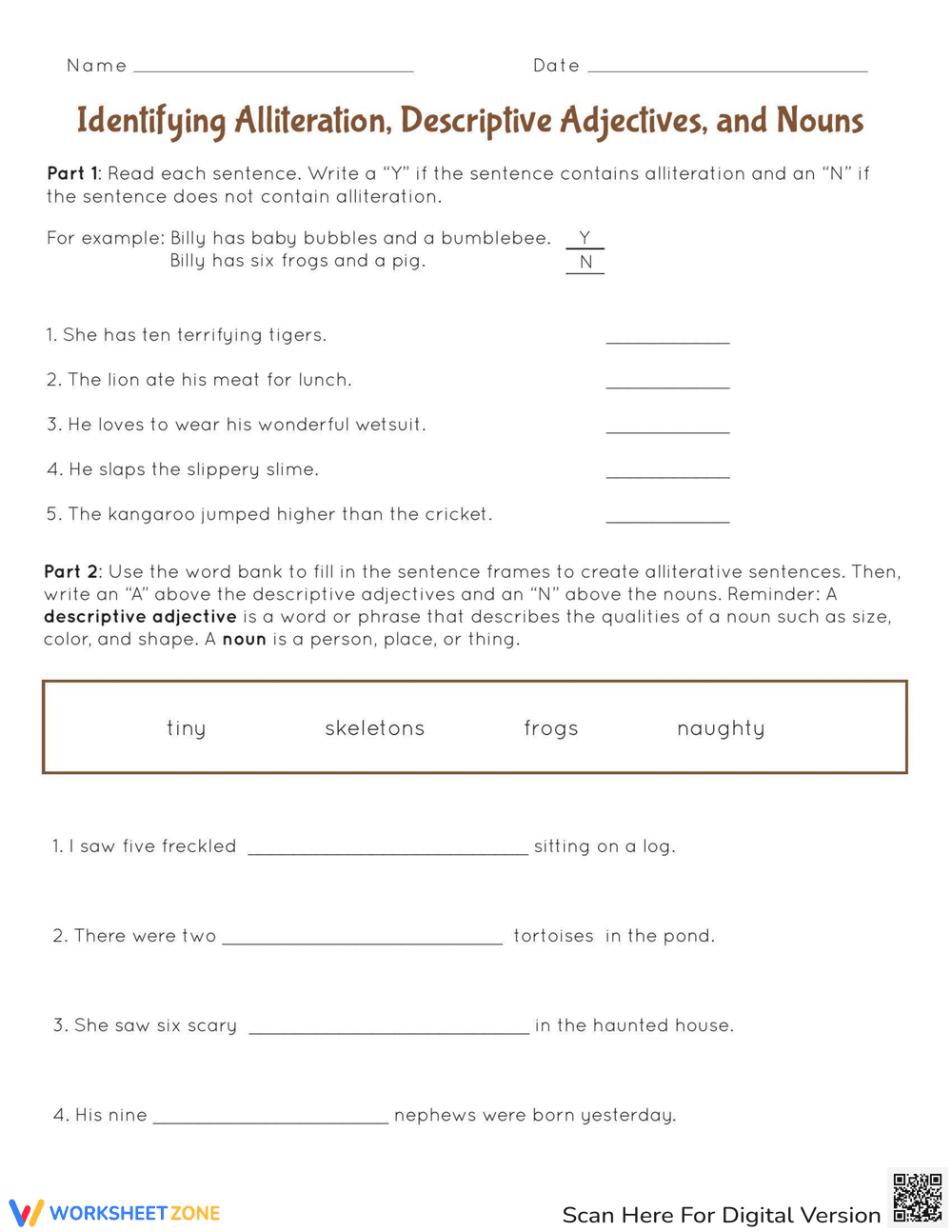
This is an educational worksheet focusing on language arts skills. It includes two parts. Part 1 requires students to identify sentences containing alliteration and mark them with a 'Y' or 'N'. Part 2 involves completing sentences with words from a provided word bank (tiny, skeletons, frogs, naughty) to create alliterative sentences. Students must also label the descriptive adjectives with 'A' and nouns with 'N'.
Grade Level Suitability:
This worksheet is suitable for grades 2-4. The concepts of alliteration, descriptive adjectives, and nouns are typically introduced in these grades. The sentence structure and vocabulary are appropriate for this age range.
Why Use It:
This worksheet helps students practice identifying alliteration and differentiating between nouns and descriptive adjectives. It reinforces vocabulary and sentence construction skills while promoting creative writing through the alliteration exercise. It enhances understanding of parts of speech and literary devices.
How to Use It:
First, instruct students to read each sentence in Part 1 and determine if it contains alliteration, marking 'Y' for yes and 'N' for no. Then, for Part 2, guide students to select words from the word bank to complete the sentences, ensuring they create alliterative phrases. Finally, have them label the descriptive adjectives with 'A' and the nouns with 'N' above the words.
Target Users:
This worksheet is designed for elementary school students, particularly those in grades 2-4, who are learning about alliteration, nouns, and adjectives. It's also beneficial for students who need extra practice with sentence construction and vocabulary development.
This is an educational worksheet focusing on language arts skills. It includes two parts. Part 1 requires students to identify sentences containing alliteration and mark them with a 'Y' or 'N'. Part 2 involves completing sentences with words from a provided word bank (tiny, skeletons, frogs, naughty) to create alliterative sentences. Students must also label the descriptive adjectives with 'A' and nouns with 'N'.
Grade Level Suitability:
This worksheet is suitable for grades 2-4. The concepts of alliteration, descriptive adjectives, and nouns are typically introduced in these grades. The sentence structure and vocabulary are appropriate for this age range.
Why Use It:
This worksheet helps students practice identifying alliteration and differentiating between nouns and descriptive adjectives. It reinforces vocabulary and sentence construction skills while promoting creative writing through the alliteration exercise. It enhances understanding of parts of speech and literary devices.
How to Use It:
First, instruct students to read each sentence in Part 1 and determine if it contains alliteration, marking 'Y' for yes and 'N' for no. Then, for Part 2, guide students to select words from the word bank to complete the sentences, ensuring they create alliterative phrases. Finally, have them label the descriptive adjectives with 'A' and the nouns with 'N' above the words.
Target Users:
This worksheet is designed for elementary school students, particularly those in grades 2-4, who are learning about alliteration, nouns, and adjectives. It's also beneficial for students who need extra practice with sentence construction and vocabulary development.


