


























1 / 5
0
Views
0
Plays


0.0
0
0 Likes
Interpreting Motion Graphs
0 Views
0 Plays
Paste this activity's link or code into your existing LMS (Google Classroom, Canvas, Teams, Schoology, Moodle, etc.).
Students can open and work on the activity right away, with no student login required.
You'll still be able to track student progress and results from your teacher account.
Information
Description
What It Is:
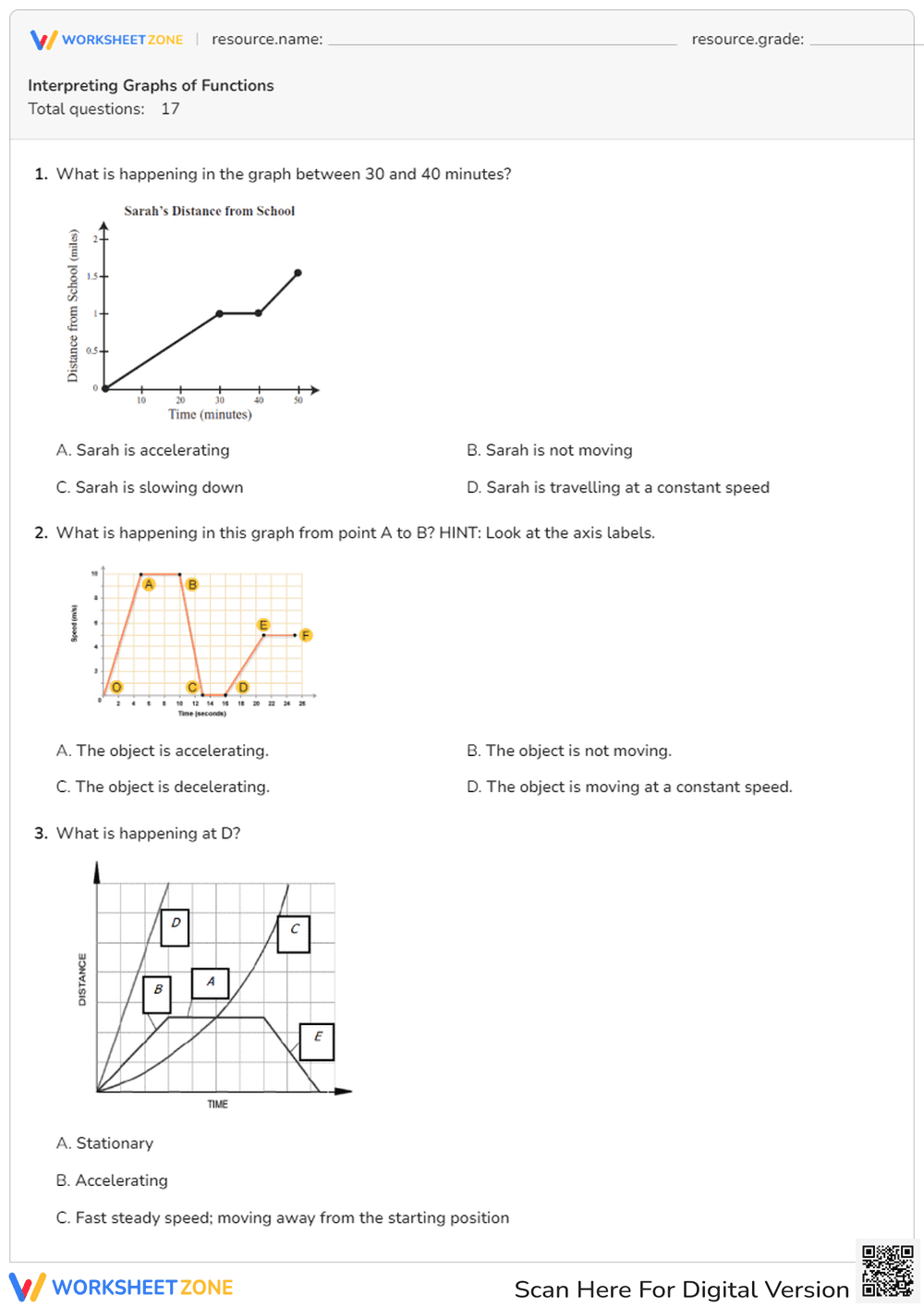
This is a worksheet featuring a speed versus time graph. The graph shows the speed of an object (in meters per second) over a period of 26 seconds. The graph is divided into sections labeled O, A, B, C, D, E, and F, each representing a different phase of the object's motion. The graph includes periods of acceleration (increasing speed), constant speed, and deceleration (decreasing speed).
Grade Level Suitability:
This worksheet is suitable for grades 8-12, particularly in physics or physical science classes. It requires understanding of graphing, interpreting data, and basic concepts of motion, including speed, time, and acceleration.
Why Use It:
This worksheet helps students develop skills in interpreting speed-time graphs. It reinforces the understanding of how graphs can represent motion, differentiate between constant speed, acceleration, and deceleration, and relate these concepts to real-world scenarios.
How to Use It:
Students can use the graph to determine the speed of the object at specific times, calculate the acceleration during certain intervals, and describe the overall motion of the object. The worksheet can be used to answer questions about the object's movement, such as 'What was the object's maximum speed?' or 'During which interval was the object decelerating?'.
Target Users:
This worksheet is designed for students learning about motion, speed, time, and acceleration in physics or physical science courses. It is also useful for students who need to practice interpreting graphs and analyzing data.
This is a worksheet featuring a speed versus time graph. The graph shows the speed of an object (in meters per second) over a period of 26 seconds. The graph is divided into sections labeled O, A, B, C, D, E, and F, each representing a different phase of the object's motion. The graph includes periods of acceleration (increasing speed), constant speed, and deceleration (decreasing speed).
Grade Level Suitability:
This worksheet is suitable for grades 8-12, particularly in physics or physical science classes. It requires understanding of graphing, interpreting data, and basic concepts of motion, including speed, time, and acceleration.
Why Use It:
This worksheet helps students develop skills in interpreting speed-time graphs. It reinforces the understanding of how graphs can represent motion, differentiate between constant speed, acceleration, and deceleration, and relate these concepts to real-world scenarios.
How to Use It:
Students can use the graph to determine the speed of the object at specific times, calculate the acceleration during certain intervals, and describe the overall motion of the object. The worksheet can be used to answer questions about the object's movement, such as 'What was the object's maximum speed?' or 'During which interval was the object decelerating?'.
Target Users:
This worksheet is designed for students learning about motion, speed, time, and acceleration in physics or physical science courses. It is also useful for students who need to practice interpreting graphs and analyzing data.


