


























0
Views
0
Downloads

0.0
0
0 Likes
Introduction to Improper Fractions: Part 2
0 Views
0 Downloads
Paste this activity's link or code into your existing LMS (Google Classroom, Canvas, Teams, Schoology, Moodle, etc.).
Students can open and work on the activity right away, with no student login required.
You'll still be able to track student progress and results from your teacher account.
Information
Description
What It Is:
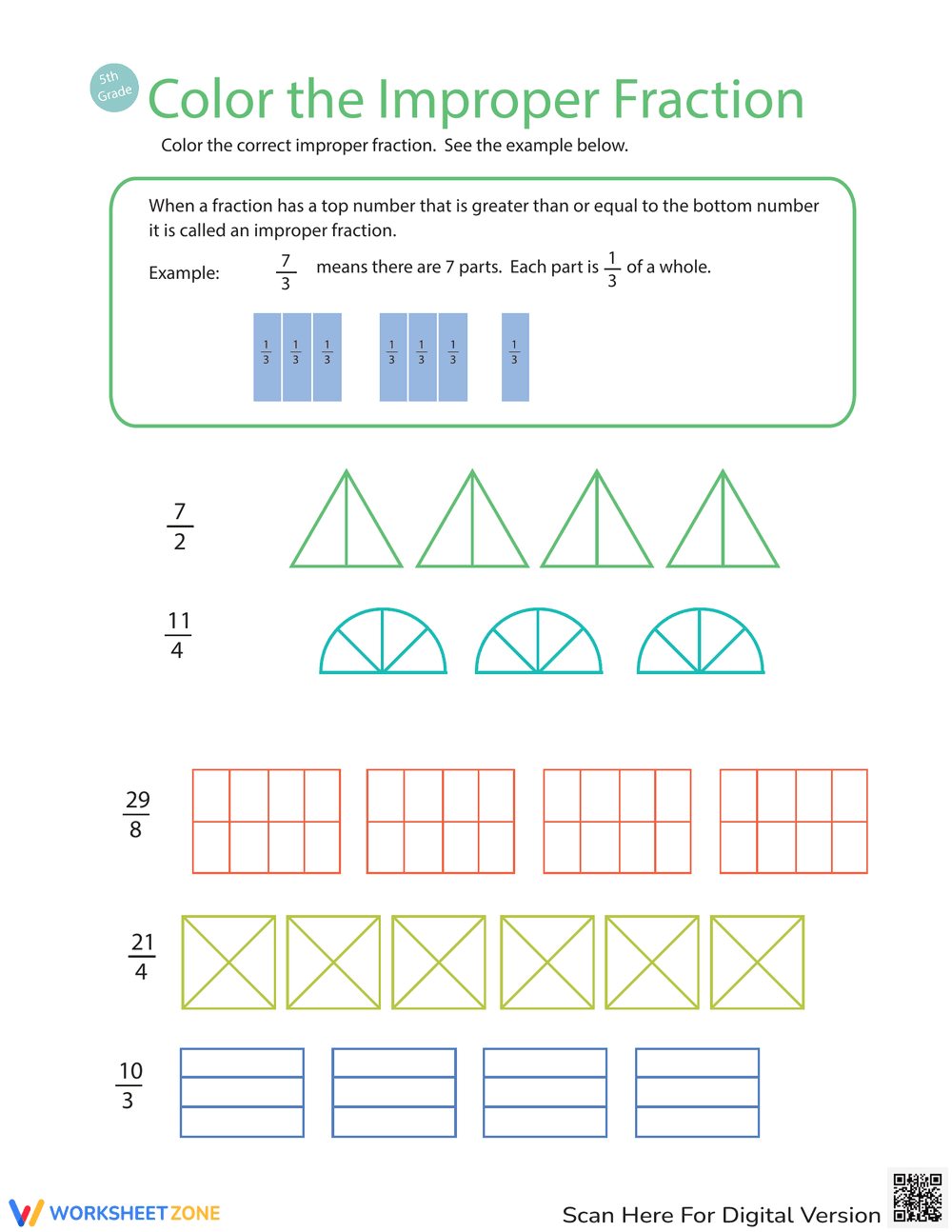
This is a worksheet focused on identifying and visualizing improper fractions. It provides a definition and an example of an improper fraction (7/3). The worksheet then presents several improper fractions (7/2, 11/4, 29/8, 21/4, 10/3) alongside sets of shapes (triangles, semi-circles, rectangles, squares). The student is expected to color the correct number of parts within each shape to represent the given improper fraction.
Grade Level Suitability:
This worksheet is suitable for 5th and 6th grade students. The concept of improper fractions is typically introduced in these grades, and the visual representation aids in understanding the concept. The fractions presented are simple enough to be manageable for students at this level.
Why Use It:
This worksheet helps students visualize and understand improper fractions by connecting them to concrete representations. It reinforces the concept that an improper fraction represents a quantity greater than or equal to one whole. It also provides practice in relating fractions to parts of a whole.
How to Use It:
First, review the definition and example of improper fractions. Then, for each fraction, determine how many whole shapes and fractional parts need to be colored. Color the appropriate number of shapes and parts to represent the improper fraction. For example, for 7/2, you would color three whole triangles and one half of a triangle.
Target Users:
This worksheet is designed for elementary school students in grades 5-6 who are learning about improper fractions. It can be used as a classroom activity, homework assignment, or review exercise. It is particularly helpful for students who benefit from visual learning and hands-on activities.
This is a worksheet focused on identifying and visualizing improper fractions. It provides a definition and an example of an improper fraction (7/3). The worksheet then presents several improper fractions (7/2, 11/4, 29/8, 21/4, 10/3) alongside sets of shapes (triangles, semi-circles, rectangles, squares). The student is expected to color the correct number of parts within each shape to represent the given improper fraction.
Grade Level Suitability:
This worksheet is suitable for 5th and 6th grade students. The concept of improper fractions is typically introduced in these grades, and the visual representation aids in understanding the concept. The fractions presented are simple enough to be manageable for students at this level.
Why Use It:
This worksheet helps students visualize and understand improper fractions by connecting them to concrete representations. It reinforces the concept that an improper fraction represents a quantity greater than or equal to one whole. It also provides practice in relating fractions to parts of a whole.
How to Use It:
First, review the definition and example of improper fractions. Then, for each fraction, determine how many whole shapes and fractional parts need to be colored. Color the appropriate number of shapes and parts to represent the improper fraction. For example, for 7/2, you would color three whole triangles and one half of a triangle.
Target Users:
This worksheet is designed for elementary school students in grades 5-6 who are learning about improper fractions. It can be used as a classroom activity, homework assignment, or review exercise. It is particularly helpful for students who benefit from visual learning and hands-on activities.


