


























0
Views
0
Downloads

0.0
0
0 Likes
Keeping Scales Balanced
0 Views
0 Downloads
Paste this activity's link or code into your existing LMS (Google Classroom, Canvas, Teams, Schoology, Moodle, etc.).
Students can open and work on the activity right away, with no student login required.
You'll still be able to track student progress and results from your teacher account.
Information
Description
What It Is:
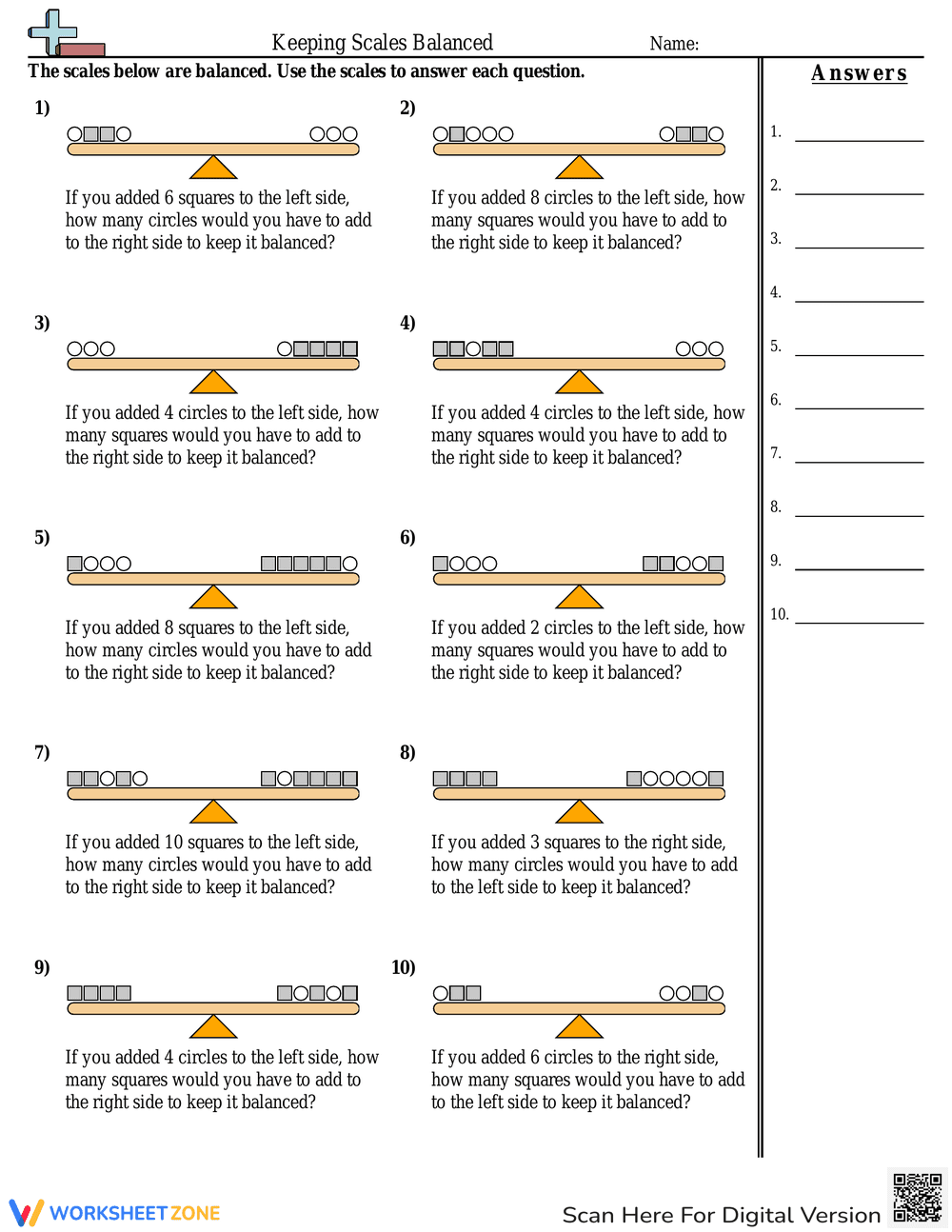
This is a math worksheet titled 'Keeping Scales Balanced'. It presents ten problems where students must determine how many shapes (circles or squares) need to be added to one side of a balanced scale to maintain equilibrium, given that shapes are added to the other side. Each problem shows a visual representation of a balanced scale with shapes on each side. The worksheet also provides a space for the student's name and an answer key area.
Grade Level Suitability:
This worksheet is suitable for grades 1-3. It reinforces basic addition and subtraction concepts within the context of balancing equations, using visual aids to help students understand the relationships between quantities. The problems are relatively simple, involving small numbers of shapes.
Why Use It:
This worksheet helps students develop their understanding of equality and balancing equations. It provides a visual and engaging way to practice addition and subtraction skills. It also introduces the concept of algebraic thinking in a concrete manner.
How to Use It:
Students should analyze each scale to determine the initial balance. Then, they should read the problem to understand which shapes are being added to which side. Finally, they should calculate how many shapes need to be added to the opposite side to maintain balance and write their answer in the provided space.
Target Users:
This worksheet is designed for elementary school students, particularly those in grades 1-3, who are learning about addition, subtraction, and balancing equations. It is also useful for students who benefit from visual aids in math instruction.
This is a math worksheet titled 'Keeping Scales Balanced'. It presents ten problems where students must determine how many shapes (circles or squares) need to be added to one side of a balanced scale to maintain equilibrium, given that shapes are added to the other side. Each problem shows a visual representation of a balanced scale with shapes on each side. The worksheet also provides a space for the student's name and an answer key area.
Grade Level Suitability:
This worksheet is suitable for grades 1-3. It reinforces basic addition and subtraction concepts within the context of balancing equations, using visual aids to help students understand the relationships between quantities. The problems are relatively simple, involving small numbers of shapes.
Why Use It:
This worksheet helps students develop their understanding of equality and balancing equations. It provides a visual and engaging way to practice addition and subtraction skills. It also introduces the concept of algebraic thinking in a concrete manner.
How to Use It:
Students should analyze each scale to determine the initial balance. Then, they should read the problem to understand which shapes are being added to which side. Finally, they should calculate how many shapes need to be added to the opposite side to maintain balance and write their answer in the provided space.
Target Users:
This worksheet is designed for elementary school students, particularly those in grades 1-3, who are learning about addition, subtraction, and balancing equations. It is also useful for students who benefit from visual aids in math instruction.


