


























1 / 2
0
Views
0
Downloads


0.0
0
0 Likes
Kinetic and Potential Activity
0 Views
0 Downloads
Paste this activity's link or code into your existing LMS (Google Classroom, Canvas, Teams, Schoology, Moodle, etc.).
Students can open and work on the activity right away, with no student login required.
You'll still be able to track student progress and results from your teacher account.
Information
Description
What It Is:
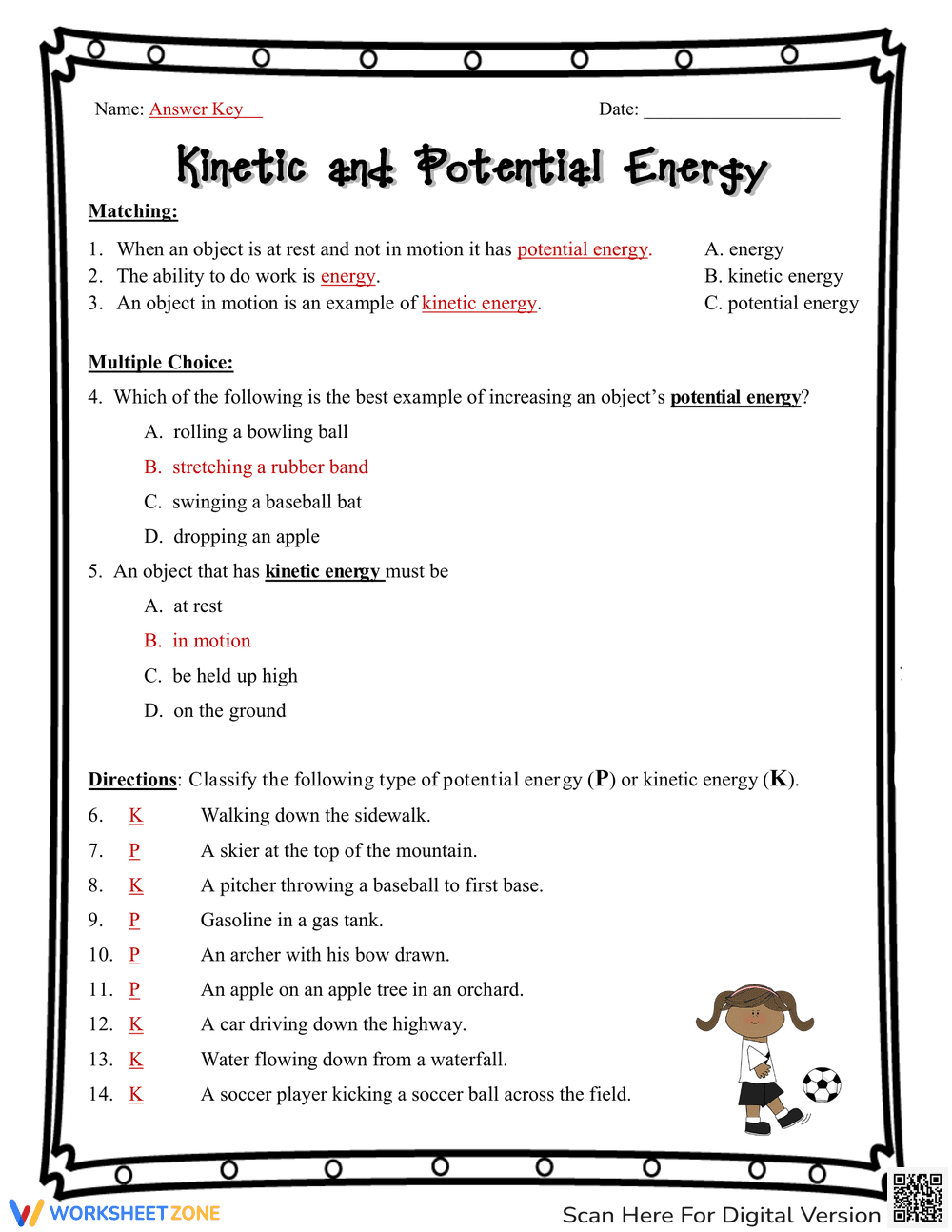
This is a worksheet focused on Kinetic and Potential Energy. It includes three sections: a matching section where students match definitions to energy types, a multiple-choice section testing understanding of kinetic and potential energy examples, and a classification section where students identify examples as either potential (P) or kinetic (K) energy. Examples include walking, a skier, a pitcher, gasoline, an apple on a tree, a car driving, a waterfall, and a soccer player kicking a ball.
Grade Level Suitability:
This worksheet is suitable for grades 4-6. The concepts of kinetic and potential energy are introduced in these grades, and the examples are relatable and age-appropriate. The multiple-choice and matching questions provide a good review of basic definitions.
Why Use It:
This worksheet reinforces the understanding of kinetic and potential energy through various activities. It helps students differentiate between the two types of energy and apply their knowledge to real-world examples. It also provides practice in critical thinking and problem-solving skills.
How to Use It:
Students should first read the definitions and examples provided. For the matching section, they should match each statement to the correct energy type (A, B, or C). In the multiple-choice section, they select the best answer for each question. For the classification section, they should write 'P' for potential energy or 'K' for kinetic energy next to each example.
Target Users:
This worksheet is designed for elementary and middle school students learning about kinetic and potential energy. It can be used by teachers as a classroom activity or homework assignment, and by parents for supplemental learning at home. It's also helpful for students who need extra practice or review on this topic.
This is a worksheet focused on Kinetic and Potential Energy. It includes three sections: a matching section where students match definitions to energy types, a multiple-choice section testing understanding of kinetic and potential energy examples, and a classification section where students identify examples as either potential (P) or kinetic (K) energy. Examples include walking, a skier, a pitcher, gasoline, an apple on a tree, a car driving, a waterfall, and a soccer player kicking a ball.
Grade Level Suitability:
This worksheet is suitable for grades 4-6. The concepts of kinetic and potential energy are introduced in these grades, and the examples are relatable and age-appropriate. The multiple-choice and matching questions provide a good review of basic definitions.
Why Use It:
This worksheet reinforces the understanding of kinetic and potential energy through various activities. It helps students differentiate between the two types of energy and apply their knowledge to real-world examples. It also provides practice in critical thinking and problem-solving skills.
How to Use It:
Students should first read the definitions and examples provided. For the matching section, they should match each statement to the correct energy type (A, B, or C). In the multiple-choice section, they select the best answer for each question. For the classification section, they should write 'P' for potential energy or 'K' for kinetic energy next to each example.
Target Users:
This worksheet is designed for elementary and middle school students learning about kinetic and potential energy. It can be used by teachers as a classroom activity or homework assignment, and by parents for supplemental learning at home. It's also helpful for students who need extra practice or review on this topic.


