


























1 / 2
0
Views
0
Downloads


0.0
0
0 Likes
Historical Setting Comparison Chart - Literary Analysis Grades 6-8
0 Views
0 Downloads
Paste this activity's link or code into your existing LMS (Google Classroom, Canvas, Teams, Schoology, Moodle, etc.).
Students can open and work on the activity right away, with no student login required.
You'll still be able to track student progress and results from your teacher account.
Information
Description
What It Is:
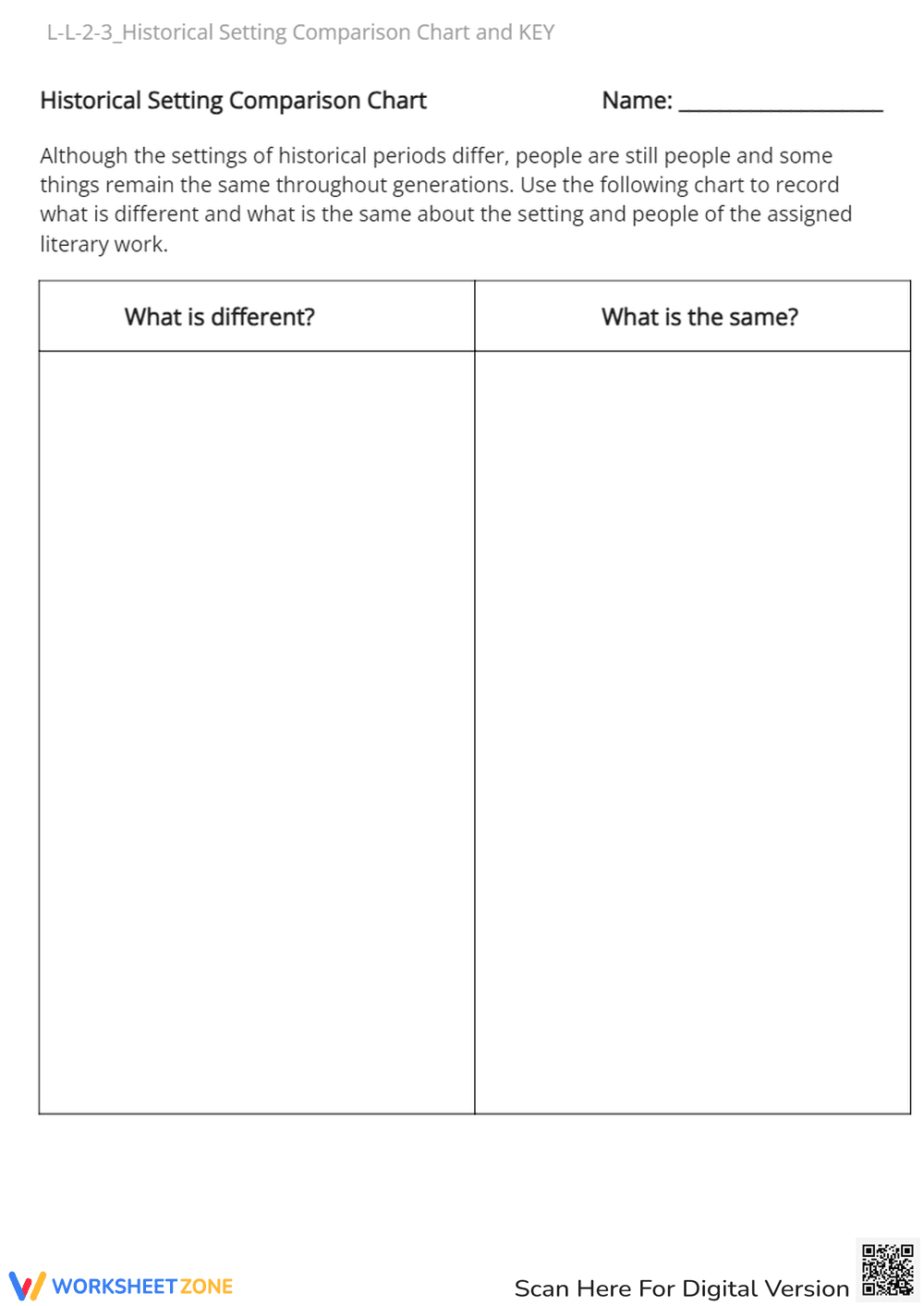
This is a worksheet titled 'Historical Setting Comparison Chart.' It prompts students to analyze a literary work and compare historical settings. The worksheet includes a two-column chart labeled 'What is different?' and 'What is the same?' to record observations about the settings and people in the assigned literary work.
Grade Level Suitability:
This worksheet is suitable for grades 6-8. The concepts of historical setting and comparison require a level of analytical thinking typically developed in middle school. The task requires students to understand and analyze literary texts, a skill that is cultivated in these grades.
Why Use It:
This worksheet helps students develop critical thinking skills by analyzing and comparing historical settings within a literary work. It encourages students to identify similarities and differences across time periods, fostering a deeper understanding of history and literature. It also promotes textual analysis and comprehension.
How to Use It:
Provide students with a literary work that spans different historical settings or compares to another historical setting. Instruct them to read the text and then use the chart to record the differences and similarities they observe between the settings and people depicted. Encourage them to provide specific examples from the text to support their observations.
Target Users:
This worksheet is designed for middle school students (grades 6-8) studying literature and history. It is also suitable for teachers looking for resources to enhance their students' analytical and comparative skills. It can be used in English Language Arts or Social Studies classes.
This is a worksheet titled 'Historical Setting Comparison Chart.' It prompts students to analyze a literary work and compare historical settings. The worksheet includes a two-column chart labeled 'What is different?' and 'What is the same?' to record observations about the settings and people in the assigned literary work.
Grade Level Suitability:
This worksheet is suitable for grades 6-8. The concepts of historical setting and comparison require a level of analytical thinking typically developed in middle school. The task requires students to understand and analyze literary texts, a skill that is cultivated in these grades.
Why Use It:
This worksheet helps students develop critical thinking skills by analyzing and comparing historical settings within a literary work. It encourages students to identify similarities and differences across time periods, fostering a deeper understanding of history and literature. It also promotes textual analysis and comprehension.
How to Use It:
Provide students with a literary work that spans different historical settings or compares to another historical setting. Instruct them to read the text and then use the chart to record the differences and similarities they observe between the settings and people depicted. Encourage them to provide specific examples from the text to support their observations.
Target Users:
This worksheet is designed for middle school students (grades 6-8) studying literature and history. It is also suitable for teachers looking for resources to enhance their students' analytical and comparative skills. It can be used in English Language Arts or Social Studies classes.


