


























1 / 2
0
Views
0
Downloads

0.0
0
0 Likes
Lattice Multiplication D
0 Views
0 Downloads
Paste this activity's link or code into your existing LMS (Google Classroom, Canvas, Teams, Schoology, Moodle, etc.).
Students can open and work on the activity right away, with no student login required.
You'll still be able to track student progress and results from your teacher account.
Information
Description
What It Is:
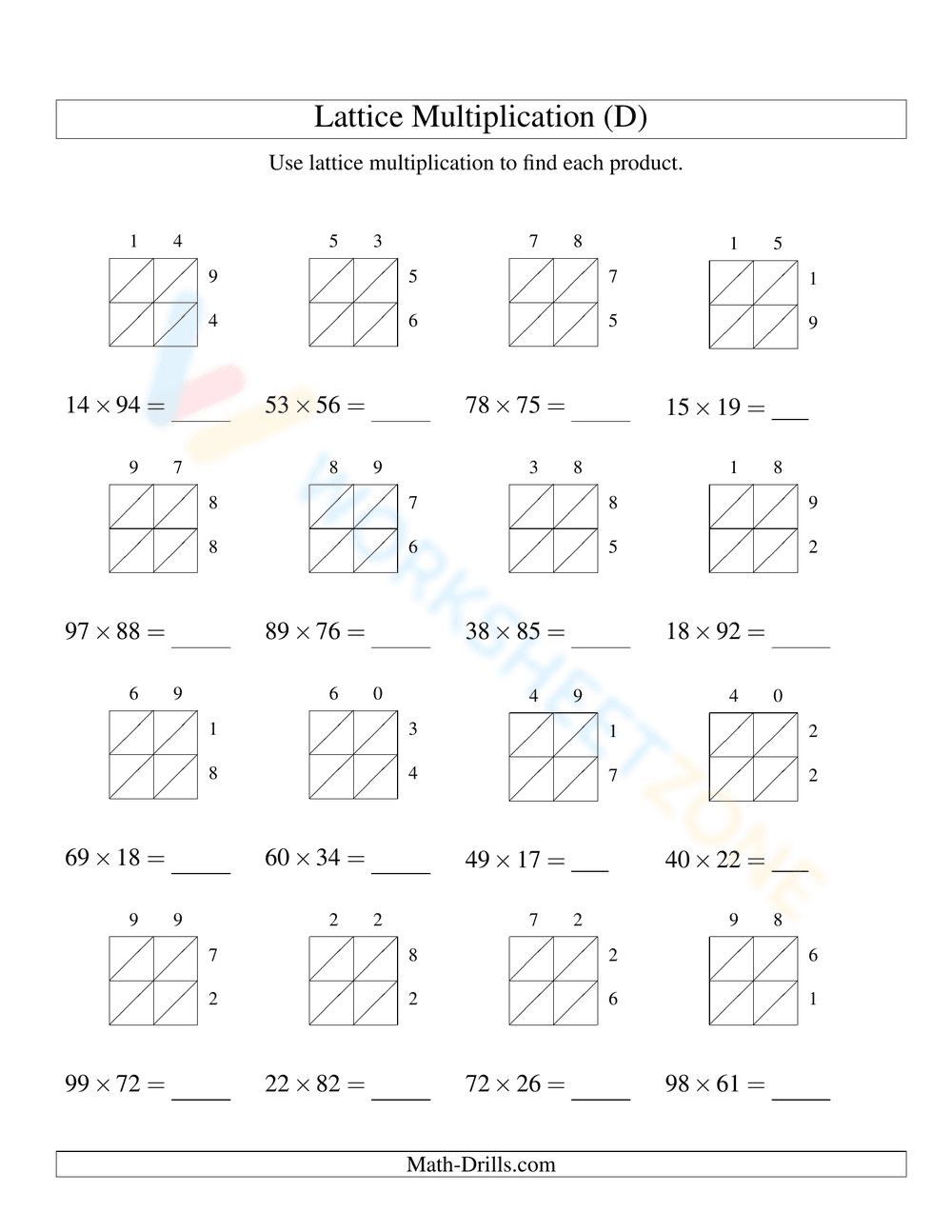
This is a math worksheet focusing on lattice multiplication. It presents a series of multiplication problems, each accompanied by a pre-drawn lattice grid. The problems involve multiplying two-digit numbers, such as 14 x 94, 53 x 56, 78 x 75, 15 x 19, and so on. Students are expected to use the lattice method to solve each problem and write the final product.
Grade Level Suitability:
This worksheet is suitable for 4th and 5th grade students. It's appropriate for these grades because it focuses on multi-digit multiplication, a concept typically introduced and reinforced at these levels. The lattice method provides a visual and structured approach to multiplying larger numbers, which can be helpful for students still developing their multiplication skills.
Why Use It:
This worksheet helps students learn and practice the lattice multiplication method. The lattice method can be a helpful alternative to the standard algorithm, particularly for visual learners. It breaks down the multiplication process into smaller, more manageable steps, reducing the chance of errors. It also reinforces place value understanding and addition skills.
How to Use It:
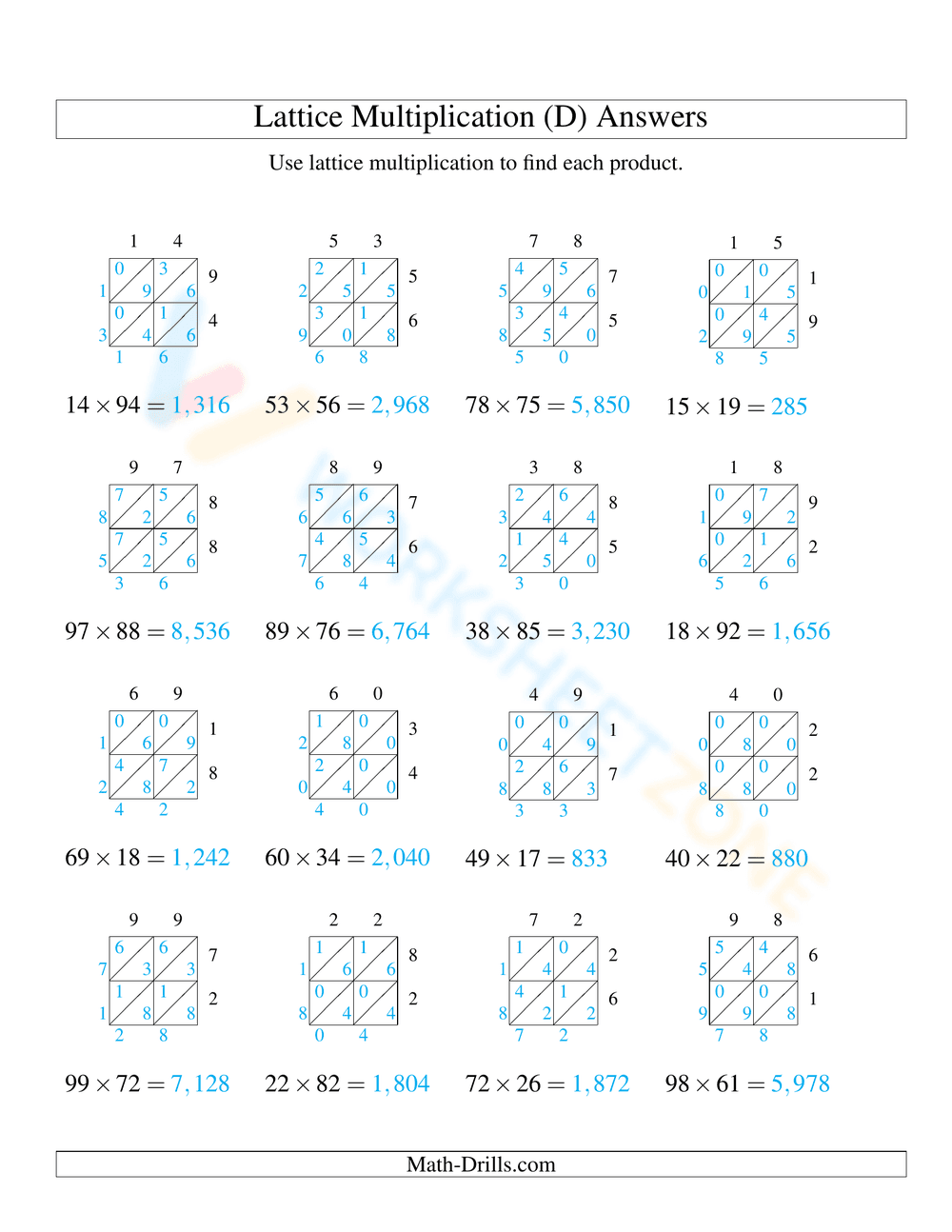
Students should use the lattice grids provided to perform the multiplication for each problem. Write the digits of the two numbers to be multiplied along the top and right side of the lattice. Multiply each digit and fill in the corresponding cell, splitting the tens and ones digits diagonally. Finally, add the numbers along the diagonals to find the product. Write the final answer on the line provided.
Target Users:
This worksheet is ideal for elementary school students in grades 4-5 who are learning or practicing multi-digit multiplication. It's also suitable for students who struggle with the standard multiplication algorithm and may benefit from a more visual and structured approach. Teachers can use it as a classroom activity, homework assignment, or review exercise.
This is a math worksheet focusing on lattice multiplication. It presents a series of multiplication problems, each accompanied by a pre-drawn lattice grid. The problems involve multiplying two-digit numbers, such as 14 x 94, 53 x 56, 78 x 75, 15 x 19, and so on. Students are expected to use the lattice method to solve each problem and write the final product.
Grade Level Suitability:
This worksheet is suitable for 4th and 5th grade students. It's appropriate for these grades because it focuses on multi-digit multiplication, a concept typically introduced and reinforced at these levels. The lattice method provides a visual and structured approach to multiplying larger numbers, which can be helpful for students still developing their multiplication skills.
Why Use It:
This worksheet helps students learn and practice the lattice multiplication method. The lattice method can be a helpful alternative to the standard algorithm, particularly for visual learners. It breaks down the multiplication process into smaller, more manageable steps, reducing the chance of errors. It also reinforces place value understanding and addition skills.
How to Use It:
Students should use the lattice grids provided to perform the multiplication for each problem. Write the digits of the two numbers to be multiplied along the top and right side of the lattice. Multiply each digit and fill in the corresponding cell, splitting the tens and ones digits diagonally. Finally, add the numbers along the diagonals to find the product. Write the final answer on the line provided.
Target Users:
This worksheet is ideal for elementary school students in grades 4-5 who are learning or practicing multi-digit multiplication. It's also suitable for students who struggle with the standard multiplication algorithm and may benefit from a more visual and structured approach. Teachers can use it as a classroom activity, homework assignment, or review exercise.


