


























1 / 2
0
Views
0
Downloads


0.0
0
0 Likes
Law of Conservation of Mass: True or False
0 Views
0 Downloads
Paste this activity's link or code into your existing LMS (Google Classroom, Canvas, Teams, Schoology, Moodle, etc.).
Students can open and work on the activity right away, with no student login required.
You'll still be able to track student progress and results from your teacher account.
Information
Description
What It Is:
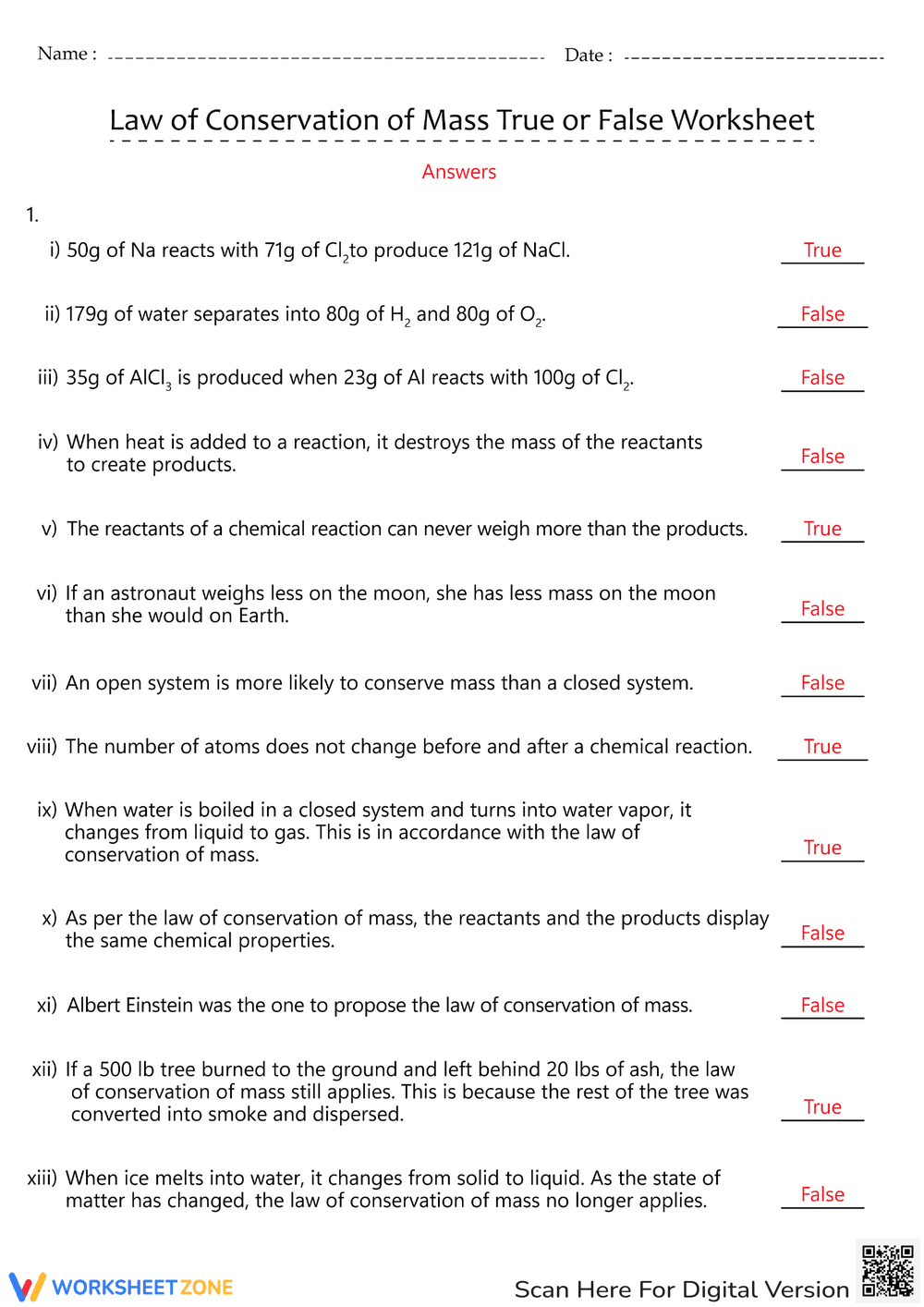
This is a worksheet titled 'Law of Conservation of Mass True or False Worksheet.' It presents a series of statements related to the law of conservation of mass, and students are asked to determine whether each statement is true or false. The statements cover topics like chemical reactions, open and closed systems, phase changes (melting, boiling), and the relationship between mass and weight. Some statements include specific masses of reactants and products.
Grade Level Suitability:
This worksheet is most suitable for grades 8-10. It requires an understanding of basic chemistry concepts, including chemical reactions, elements, compounds, and the law of conservation of mass. Some questions also touch on physics concepts like open and closed systems.
Why Use It:
This worksheet reinforces the understanding of the law of conservation of mass by requiring students to apply the concept to various scenarios. It encourages critical thinking and helps students differentiate between accurate and inaccurate statements about mass conservation in chemical and physical processes. It also helps to clarify common misconceptions about mass, weight, and chemical reactions.
How to Use It:
Students should read each statement carefully and determine whether it accurately reflects the law of conservation of mass. They should then write 'True' or 'False' in the provided blank space next to each statement. Students may need to perform calculations or apply their knowledge of chemical reactions and physical changes to answer correctly.
Target Users:
The target users are middle school and high school students studying chemistry or physical science. It is appropriate for students learning about the law of conservation of mass and chemical reactions. It can be used as a homework assignment, in-class activity, or review exercise.
This is a worksheet titled 'Law of Conservation of Mass True or False Worksheet.' It presents a series of statements related to the law of conservation of mass, and students are asked to determine whether each statement is true or false. The statements cover topics like chemical reactions, open and closed systems, phase changes (melting, boiling), and the relationship between mass and weight. Some statements include specific masses of reactants and products.
Grade Level Suitability:
This worksheet is most suitable for grades 8-10. It requires an understanding of basic chemistry concepts, including chemical reactions, elements, compounds, and the law of conservation of mass. Some questions also touch on physics concepts like open and closed systems.
Why Use It:
This worksheet reinforces the understanding of the law of conservation of mass by requiring students to apply the concept to various scenarios. It encourages critical thinking and helps students differentiate between accurate and inaccurate statements about mass conservation in chemical and physical processes. It also helps to clarify common misconceptions about mass, weight, and chemical reactions.
How to Use It:
Students should read each statement carefully and determine whether it accurately reflects the law of conservation of mass. They should then write 'True' or 'False' in the provided blank space next to each statement. Students may need to perform calculations or apply their knowledge of chemical reactions and physical changes to answer correctly.
Target Users:
The target users are middle school and high school students studying chemistry or physical science. It is appropriate for students learning about the law of conservation of mass and chemical reactions. It can be used as a homework assignment, in-class activity, or review exercise.


