


























1 / 2
0
Views
0
Downloads


0.0
0
0 Likes
Conservation of Mass With Answers
0 Views
0 Downloads
Paste this activity's link or code into your existing LMS (Google Classroom, Canvas, Teams, Schoology, Moodle, etc.).
Students can open and work on the activity right away, with no student login required.
You'll still be able to track student progress and results from your teacher account.
Information
Description
What It Is:
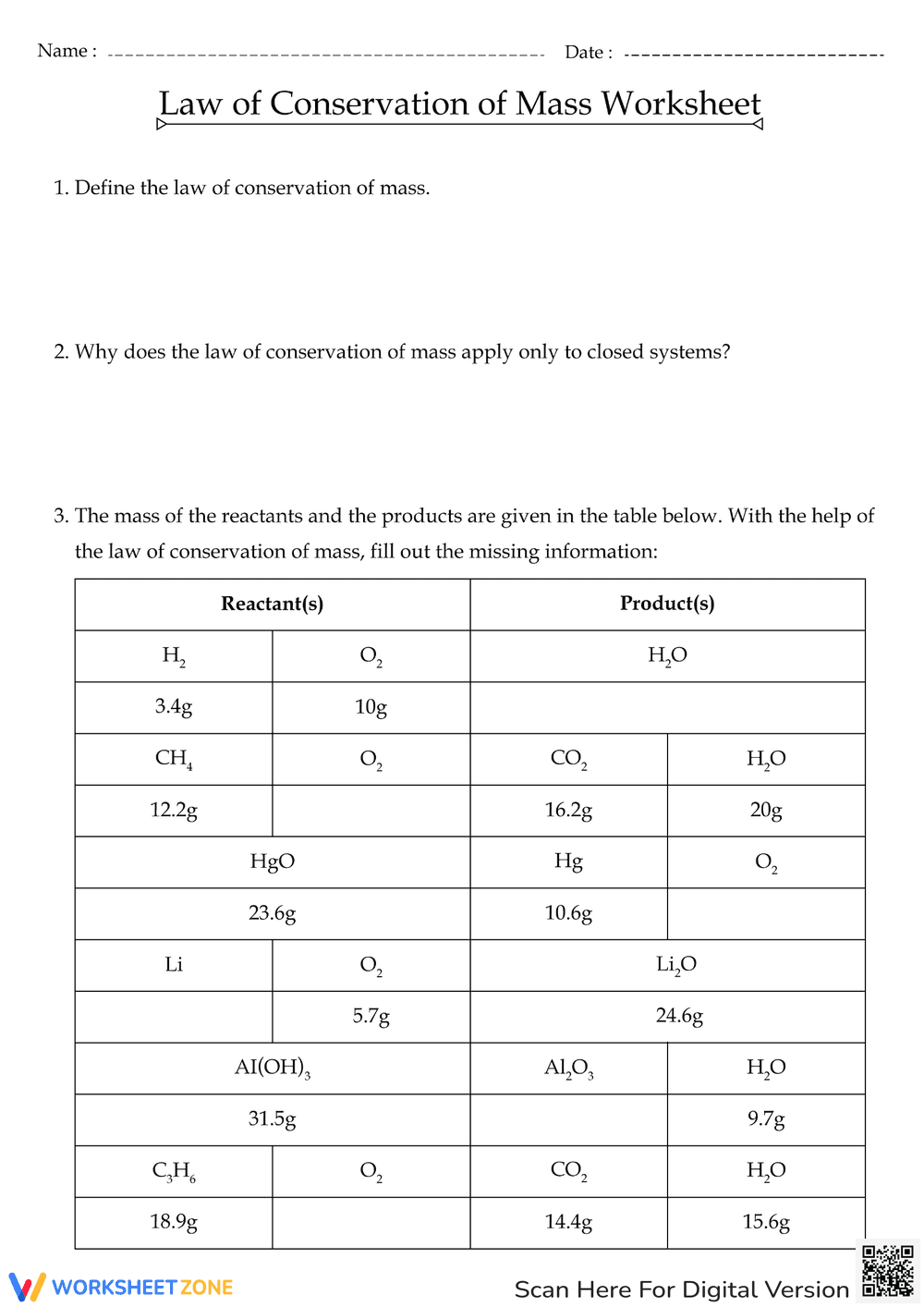
This is a 'Law of Conservation of Mass' worksheet. It includes questions asking the student to define the law of conservation of mass and explain why it applies only to closed systems. The worksheet also features a table where students need to use the law of conservation of mass to fill in missing mass values for reactants and products in chemical reactions. The chemical reactions involve various compounds like H2, O2, H2O, CH4, CO2, HgO, Hg, Li, Li2O, Al(OH)3, Al2O3 and C2H6.
Grade Level Suitability:
This worksheet is most suitable for grades 9-12, specifically high school chemistry. The concepts covered require an understanding of basic chemistry principles, chemical formulas, and the law of conservation of mass, which are typically introduced in high school chemistry courses.
Why Use It:
This worksheet helps students understand and apply the law of conservation of mass. It reinforces their understanding of chemical reactions and stoichiometry by requiring them to calculate missing masses. It also encourages critical thinking about the conditions under which the law of conservation of mass holds true.
How to Use It:
Students should first define the law of conservation of mass and explain why it applies only to closed systems. Then, for each row in the table, they should use the provided masses of reactants and products to calculate the missing mass of either a reactant or a product, ensuring the total mass remains constant throughout the reaction.
Target Users:
The target users are high school students taking chemistry courses, particularly those learning about stoichiometry and the law of conservation of mass. It's also suitable for teachers looking for practice materials to reinforce these concepts.
This is a 'Law of Conservation of Mass' worksheet. It includes questions asking the student to define the law of conservation of mass and explain why it applies only to closed systems. The worksheet also features a table where students need to use the law of conservation of mass to fill in missing mass values for reactants and products in chemical reactions. The chemical reactions involve various compounds like H2, O2, H2O, CH4, CO2, HgO, Hg, Li, Li2O, Al(OH)3, Al2O3 and C2H6.
Grade Level Suitability:
This worksheet is most suitable for grades 9-12, specifically high school chemistry. The concepts covered require an understanding of basic chemistry principles, chemical formulas, and the law of conservation of mass, which are typically introduced in high school chemistry courses.
Why Use It:
This worksheet helps students understand and apply the law of conservation of mass. It reinforces their understanding of chemical reactions and stoichiometry by requiring them to calculate missing masses. It also encourages critical thinking about the conditions under which the law of conservation of mass holds true.
How to Use It:
Students should first define the law of conservation of mass and explain why it applies only to closed systems. Then, for each row in the table, they should use the provided masses of reactants and products to calculate the missing mass of either a reactant or a product, ensuring the total mass remains constant throughout the reaction.
Target Users:
The target users are high school students taking chemistry courses, particularly those learning about stoichiometry and the law of conservation of mass. It's also suitable for teachers looking for practice materials to reinforce these concepts.


