


























1 / 2
0
Views
0
Downloads


0.0
0
0 Likes
Life Cycle of a Star Book Project
0 Views
0 Downloads
Paste this activity's link or code into your existing LMS (Google Classroom, Canvas, Teams, Schoology, Moodle, etc.).
Students can open and work on the activity right away, with no student login required.
You'll still be able to track student progress and results from your teacher account.
Information
Description
What It Is:
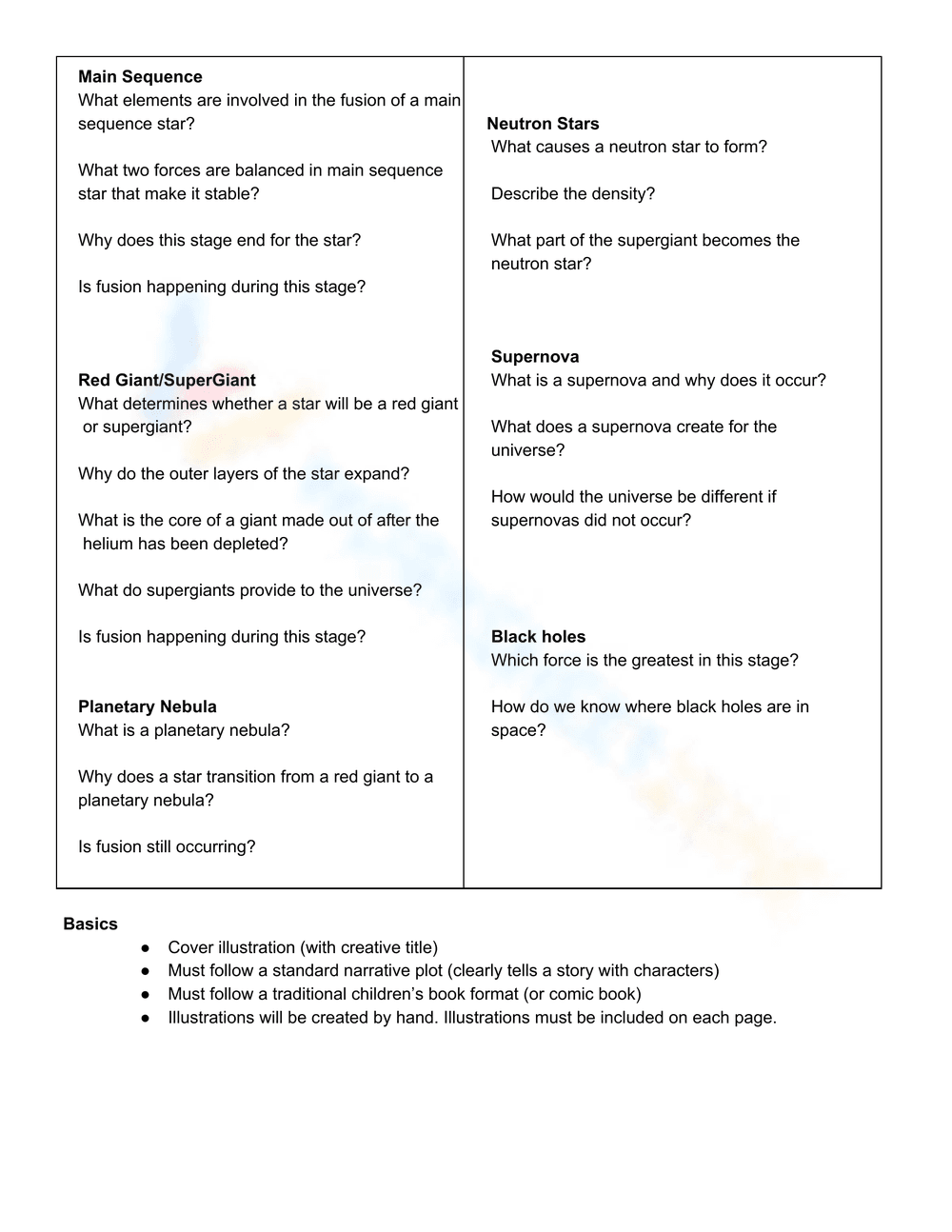
This is an educational worksheet for a children's book project about the life cycle of a star. It outlines the assignment, project learning targets (describing stages, factors determining fate, and role in element formation), and lists the stages of stellar evolution for low, high, and giant mass stars (Nebula, Protostar, Main Sequence, Red Giant/Supergiant, Planetary Nebula/Supernova, White Dwarf/Neutron Star/Black Hole). It also includes questions about Nebulae/Protostars and White Dwarfs to be answered in the children's book.
Grade Level Suitability:
Grades 6-9. The concepts of stellar evolution and the different types of stars require some understanding of physics and astronomy, making it suitable for middle school grades. The project of writing a children's book also encourages creative writing skills applicable to these grade levels.
Why Use It:
This worksheet helps students understand the life cycle of stars and the factors that influence their evolution. It promotes research skills, creative writing, and the ability to explain complex scientific concepts in an accessible way. It also fosters critical thinking through the included questions about specific stages.
How to Use It:
Students should first research the life cycle of stars, focusing on the different stages outlined in the worksheet for low, high, and giant mass stars. Then, they will write a children's story about a star's life, answering the questions provided in their story. The storyboard and rough draft are preparatory steps to the final book.
Target Users:
Middle school students (grades 6-9) studying astronomy or space science. It is also suitable for teachers looking for a creative project to assess students' understanding of stellar evolution.
This is an educational worksheet for a children's book project about the life cycle of a star. It outlines the assignment, project learning targets (describing stages, factors determining fate, and role in element formation), and lists the stages of stellar evolution for low, high, and giant mass stars (Nebula, Protostar, Main Sequence, Red Giant/Supergiant, Planetary Nebula/Supernova, White Dwarf/Neutron Star/Black Hole). It also includes questions about Nebulae/Protostars and White Dwarfs to be answered in the children's book.
Grade Level Suitability:
Grades 6-9. The concepts of stellar evolution and the different types of stars require some understanding of physics and astronomy, making it suitable for middle school grades. The project of writing a children's book also encourages creative writing skills applicable to these grade levels.
Why Use It:
This worksheet helps students understand the life cycle of stars and the factors that influence their evolution. It promotes research skills, creative writing, and the ability to explain complex scientific concepts in an accessible way. It also fosters critical thinking through the included questions about specific stages.
How to Use It:
Students should first research the life cycle of stars, focusing on the different stages outlined in the worksheet for low, high, and giant mass stars. Then, they will write a children's story about a star's life, answering the questions provided in their story. The storyboard and rough draft are preparatory steps to the final book.
Target Users:
Middle school students (grades 6-9) studying astronomy or space science. It is also suitable for teachers looking for a creative project to assess students' understanding of stellar evolution.


