


























1 / 3
0
Views
0
Downloads


0.0
0
0 Likes
Exploring Loud and Soft Sounds Worksheet
0 Views
0 Downloads
Paste this activity's link or code into your existing LMS (Google Classroom, Canvas, Teams, Schoology, Moodle, etc.).
Students can open and work on the activity right away, with no student login required.
You'll still be able to track student progress and results from your teacher account.
Information
Description
What It Is:
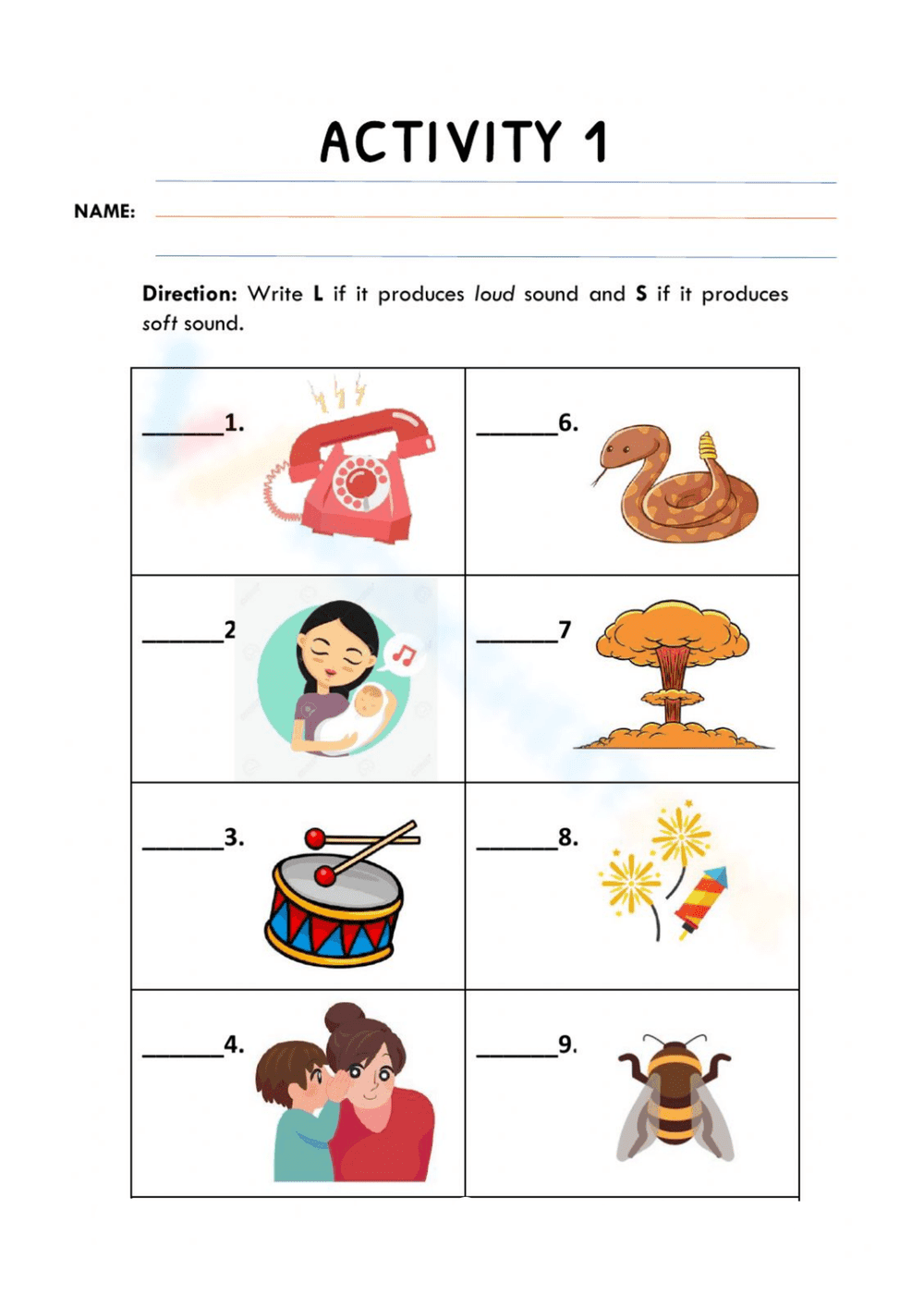
This is an educational worksheet titled 'Activity 1' designed to help students differentiate between loud and soft sounds. The worksheet features nine numbered boxes, each containing a picture: a ringing telephone, a mother holding a baby, a drum, a child whispering to an adult, a snake, an explosion, fireworks, and a bee. Students are instructed to write 'L' in the blank space provided if the picture represents a loud sound and 'S' if it represents a soft sound. There is also a space for the student's name at the top.
Grade Level Suitability:
This worksheet is suitable for kindergarten and first grade. The concepts of loud and soft sounds are typically introduced at these grade levels. The images are clear and simple, making them easily recognizable for young children.
Why Use It:
This worksheet helps students develop their auditory discrimination skills by identifying and categorizing sounds as either loud or soft. It reinforces phonological awareness and sound recognition, which are essential for early literacy development. It also builds vocabulary through associating words with sounds.
How to Use It:
First, have the student write their name on the provided line. Then, explain the directions clearly: 'Write L if the picture makes a loud sound, and write S if the picture makes a soft sound.' Go through each picture with the student, asking them to identify the object and then decide whether it makes a loud or soft sound. Finally, have them write the appropriate letter (L or S) in the blank space next to each picture.
Target Users:
This worksheet is designed for kindergarten and first-grade students learning about sounds. It is also beneficial for students who need extra practice with auditory discrimination or phonological awareness. It can be used in a classroom setting, as a homeschooling activity, or for individual practice.
This is an educational worksheet titled 'Activity 1' designed to help students differentiate between loud and soft sounds. The worksheet features nine numbered boxes, each containing a picture: a ringing telephone, a mother holding a baby, a drum, a child whispering to an adult, a snake, an explosion, fireworks, and a bee. Students are instructed to write 'L' in the blank space provided if the picture represents a loud sound and 'S' if it represents a soft sound. There is also a space for the student's name at the top.
Grade Level Suitability:
This worksheet is suitable for kindergarten and first grade. The concepts of loud and soft sounds are typically introduced at these grade levels. The images are clear and simple, making them easily recognizable for young children.
Why Use It:
This worksheet helps students develop their auditory discrimination skills by identifying and categorizing sounds as either loud or soft. It reinforces phonological awareness and sound recognition, which are essential for early literacy development. It also builds vocabulary through associating words with sounds.
How to Use It:
First, have the student write their name on the provided line. Then, explain the directions clearly: 'Write L if the picture makes a loud sound, and write S if the picture makes a soft sound.' Go through each picture with the student, asking them to identify the object and then decide whether it makes a loud or soft sound. Finally, have them write the appropriate letter (L or S) in the blank space next to each picture.
Target Users:
This worksheet is designed for kindergarten and first-grade students learning about sounds. It is also beneficial for students who need extra practice with auditory discrimination or phonological awareness. It can be used in a classroom setting, as a homeschooling activity, or for individual practice.


