


























0
Views
0
Downloads

0 Likes
Quadrilateral Venn Diagram - Classify Shapes & Geometry Fun!
0 Views
0 Downloads
Paste this activity's link or code into your existing LMS (Google Classroom, Canvas, Teams, Schoology, Moodle, etc.).
Students can open and work on the activity right away, with no student login required.
You'll still be able to track student progress and results from your teacher account.
Information
Description
What It Is:
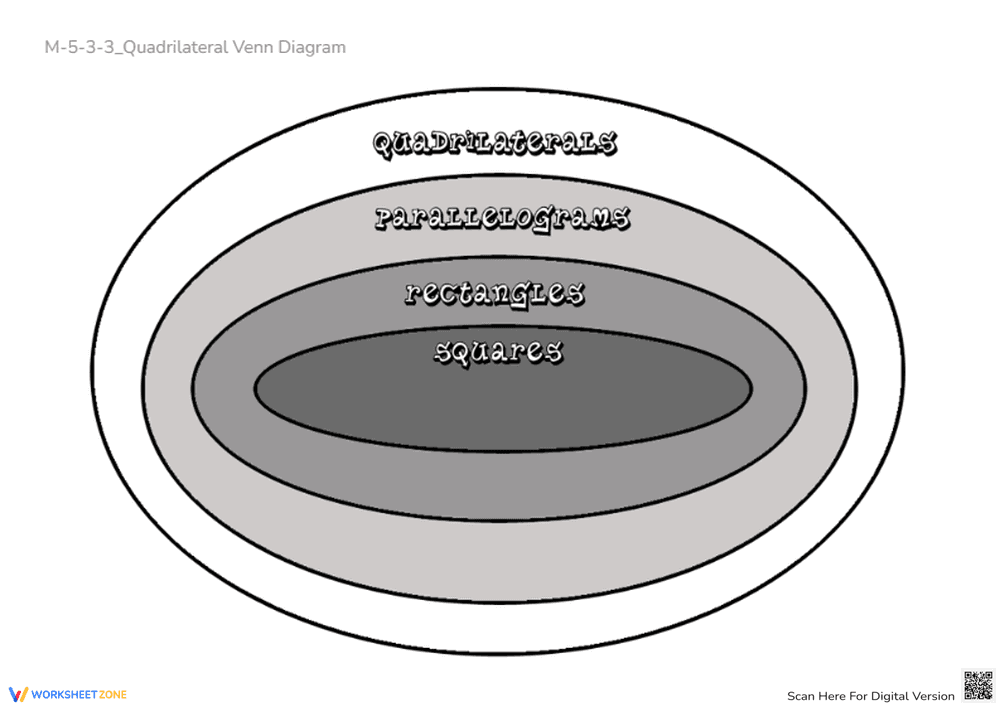
This is a math worksheet featuring a Venn diagram focused on quadrilaterals. The diagram visually represents the relationships between different types of quadrilaterals, including quadrilaterals, parallelograms, rectangles, and squares, with squares nested within rectangles, rectangles within parallelograms, and parallelograms within quadrilaterals. It's a tool for understanding hierarchical relationships between geometric shapes.
Grade Level Suitability:
This worksheet is most suitable for grades 5-7. It reinforces geometric concepts and classification, and Venn diagrams are typically introduced around this grade range. The complexity of understanding the relationships between different types of quadrilaterals makes it appropriate for upper elementary and middle school students.
Why Use It:
This worksheet helps students visualize and understand the hierarchical relationships between quadrilaterals. It reinforces geometric concepts and develops critical thinking skills by requiring students to classify shapes based on their properties. It also promotes a deeper understanding of geometric vocabulary and shape attributes.
How to Use It:
Students can use this worksheet to classify different quadrilaterals. They can write examples of each type of quadrilateral within the appropriate section of the Venn diagram. Additionally, they can use it as a reference tool when learning about the properties of different quadrilaterals. Teachers can also use it as a visual aid during lessons on geometry.
Target Users:
The target users for this worksheet are students in grades 5-7 who are learning about geometry and quadrilaterals. It is also useful for teachers who are looking for a visual aid to support their lessons on geometric shapes and their relationships. Students who benefit from visual learning will find this worksheet particularly helpful.
This is a math worksheet featuring a Venn diagram focused on quadrilaterals. The diagram visually represents the relationships between different types of quadrilaterals, including quadrilaterals, parallelograms, rectangles, and squares, with squares nested within rectangles, rectangles within parallelograms, and parallelograms within quadrilaterals. It's a tool for understanding hierarchical relationships between geometric shapes.
Grade Level Suitability:
This worksheet is most suitable for grades 5-7. It reinforces geometric concepts and classification, and Venn diagrams are typically introduced around this grade range. The complexity of understanding the relationships between different types of quadrilaterals makes it appropriate for upper elementary and middle school students.
Why Use It:
This worksheet helps students visualize and understand the hierarchical relationships between quadrilaterals. It reinforces geometric concepts and develops critical thinking skills by requiring students to classify shapes based on their properties. It also promotes a deeper understanding of geometric vocabulary and shape attributes.
How to Use It:
Students can use this worksheet to classify different quadrilaterals. They can write examples of each type of quadrilateral within the appropriate section of the Venn diagram. Additionally, they can use it as a reference tool when learning about the properties of different quadrilaterals. Teachers can also use it as a visual aid during lessons on geometry.
Target Users:
The target users for this worksheet are students in grades 5-7 who are learning about geometry and quadrilaterals. It is also useful for teachers who are looking for a visual aid to support their lessons on geometric shapes and their relationships. Students who benefit from visual learning will find this worksheet particularly helpful.


