


























0
Views
0
Downloads

0 Likes
Animals Probability: Roll & Tally - Set the Animals Free!
0 Views
0 Downloads
Paste this activity's link or code into your existing LMS (Google Classroom, Canvas, Teams, Schoology, Moodle, etc.).
Students can open and work on the activity right away, with no student login required.
You'll still be able to track student progress and results from your teacher account.
Information
Description
What It Is:
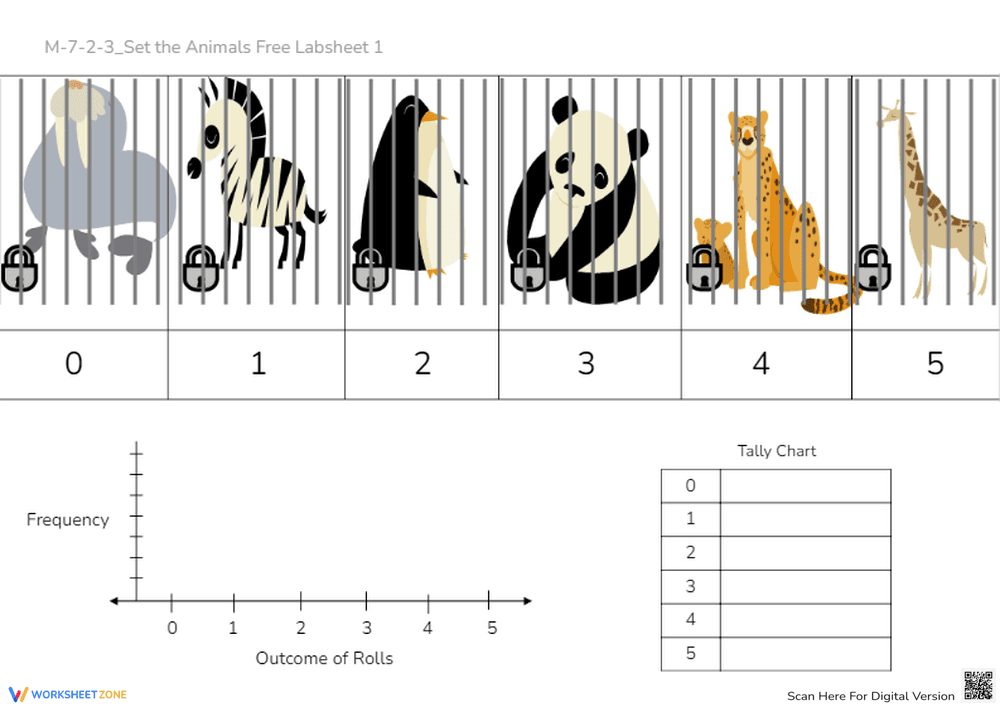
This is an educational worksheet titled 'Set the Animals Free Labsheet 1.' It features a row of caged animals (seal, zebra, penguin, panda, cheetah with cub, and giraffe) each associated with a number from 0 to 5. Each cage is locked. Below this, there's a blank frequency graph with 'Outcome of Rolls' on the x-axis and 'Frequency' on the y-axis, and a blank tally chart with numbers 0 to 5 listed. It appears designed for a probability or data collection activity.
Grade Level Suitability:
This worksheet is likely suitable for grades 1-3. The concepts of tallying, graphing, and associating numbers with objects are typically introduced in these grades. The animal theme makes it engaging for younger learners.
Why Use It:
This worksheet helps students practice counting, data collection using tally marks, and graphing skills. It can be used to teach basic probability concepts by having students roll a die (or use a number generator) and record the results, then graph the frequency of each number rolled. The animal theme can increase student engagement.
How to Use It:
Students would roll a die (or use a random number generator from 0 to 5), record each result in the tally chart, and then use the tally chart data to create a bar graph on the provided frequency graph. The goal is to track the frequency of each number rolled and visually represent the data.
Target Users:
This worksheet is ideal for elementary school students learning about data collection, tallying, graphing, and basic probability. It's also suitable for teachers looking for engaging activities to reinforce these concepts.
This is an educational worksheet titled 'Set the Animals Free Labsheet 1.' It features a row of caged animals (seal, zebra, penguin, panda, cheetah with cub, and giraffe) each associated with a number from 0 to 5. Each cage is locked. Below this, there's a blank frequency graph with 'Outcome of Rolls' on the x-axis and 'Frequency' on the y-axis, and a blank tally chart with numbers 0 to 5 listed. It appears designed for a probability or data collection activity.
Grade Level Suitability:
This worksheet is likely suitable for grades 1-3. The concepts of tallying, graphing, and associating numbers with objects are typically introduced in these grades. The animal theme makes it engaging for younger learners.
Why Use It:
This worksheet helps students practice counting, data collection using tally marks, and graphing skills. It can be used to teach basic probability concepts by having students roll a die (or use a number generator) and record the results, then graph the frequency of each number rolled. The animal theme can increase student engagement.
How to Use It:
Students would roll a die (or use a random number generator from 0 to 5), record each result in the tally chart, and then use the tally chart data to create a bar graph on the provided frequency graph. The goal is to track the frequency of each number rolled and visually represent the data.
Target Users:
This worksheet is ideal for elementary school students learning about data collection, tallying, graphing, and basic probability. It's also suitable for teachers looking for engaging activities to reinforce these concepts.


