


























1 / 2
0
Views
0
Downloads

0.0
0
0 Likes
Linear Equations Matching Worksheet - Graphs, Tables & Equations
0 Views
0 Downloads
Paste this activity's link or code into your existing LMS (Google Classroom, Canvas, Teams, Schoology, Moodle, etc.).
Students can open and work on the activity right away, with no student login required.
You'll still be able to track student progress and results from your teacher account.
Information
Description
What It Is:
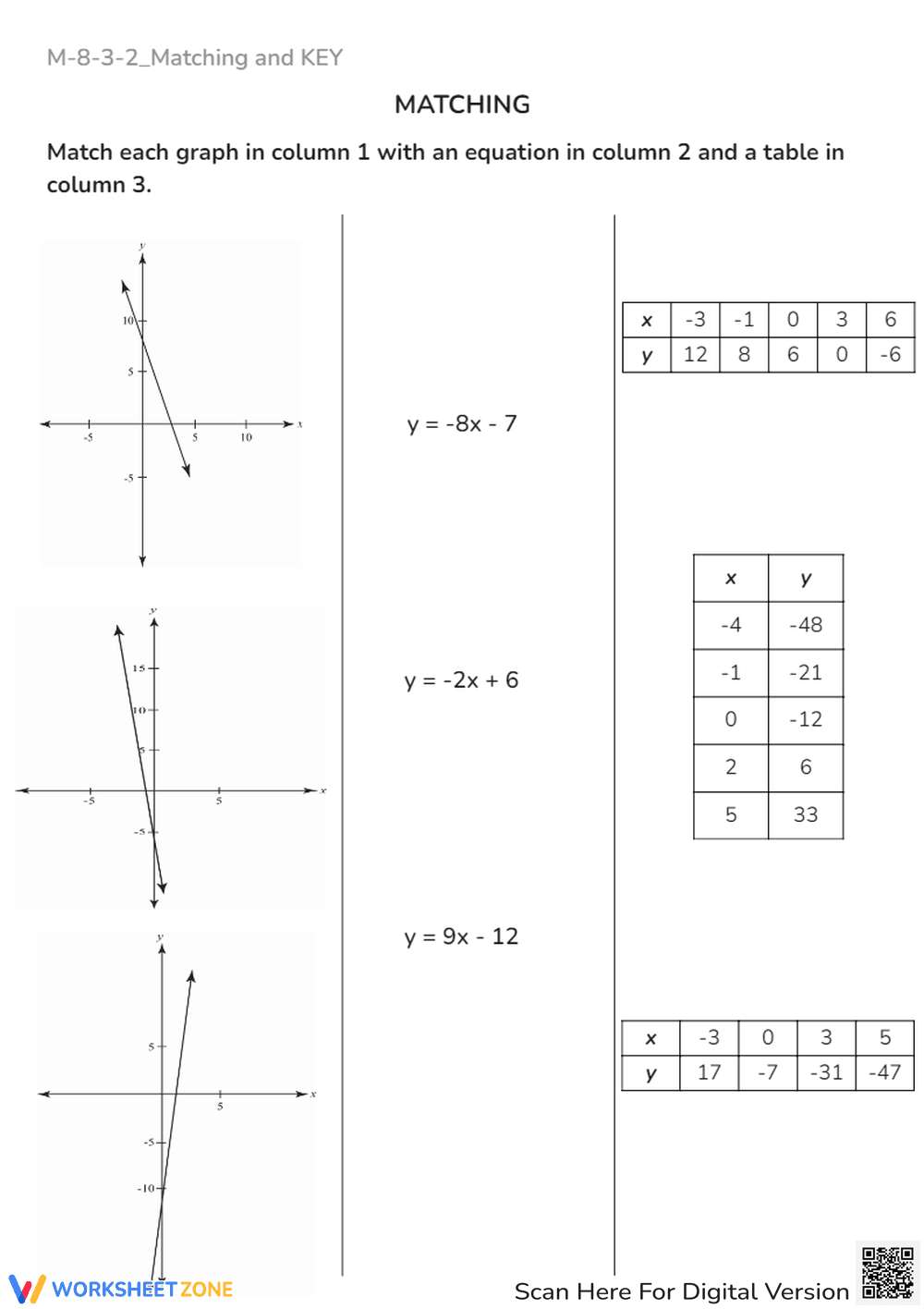
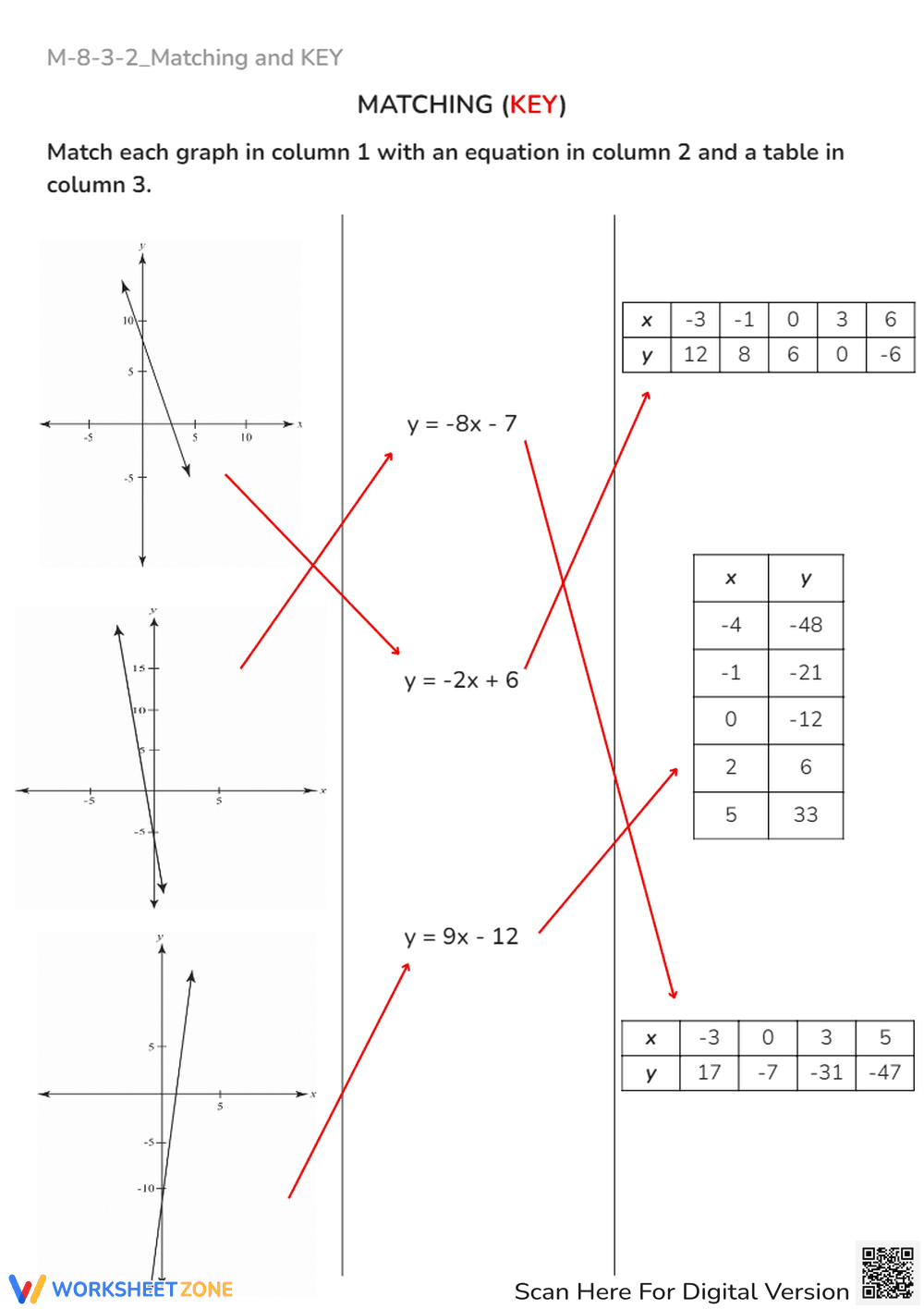
This is a matching worksheet focusing on linear equations. Students are required to match graphs of linear equations (in slope-intercept form) to their corresponding equations and tables of values. There are three graphs, three equations (y = -8x - 7, y = -2x + 6, y = 9x - 12), and three tables showing x and y values.
Grade Level Suitability:
This worksheet is suitable for 8th and 9th grade students. It reinforces the concepts of graphing linear equations, understanding slope and y-intercept, and relating equations to their graphical representation and tabular data.
Why Use It:
This worksheet provides a visual and analytical exercise for students to connect different representations of linear functions. It helps students to reinforce their understanding of linear equations, graphs, and tables, and to develop problem-solving skills by matching corresponding elements.
How to Use It:
Students should examine each graph, equation, and table. They need to determine the slope and y-intercept from the graph, and match it to the correct equation. Then, they should verify their choice by checking if the x and y values in the table satisfy the equation. Students can draw lines connecting the matching graph, equation, and table.
Target Users:
This worksheet is designed for students in middle school or early high school studying linear equations and functions. It is beneficial for students who need to practice matching different representations of linear relationships. It can also be used as a review or assessment tool.
This is a matching worksheet focusing on linear equations. Students are required to match graphs of linear equations (in slope-intercept form) to their corresponding equations and tables of values. There are three graphs, three equations (y = -8x - 7, y = -2x + 6, y = 9x - 12), and three tables showing x and y values.
Grade Level Suitability:
This worksheet is suitable for 8th and 9th grade students. It reinforces the concepts of graphing linear equations, understanding slope and y-intercept, and relating equations to their graphical representation and tabular data.
Why Use It:
This worksheet provides a visual and analytical exercise for students to connect different representations of linear functions. It helps students to reinforce their understanding of linear equations, graphs, and tables, and to develop problem-solving skills by matching corresponding elements.
How to Use It:
Students should examine each graph, equation, and table. They need to determine the slope and y-intercept from the graph, and match it to the correct equation. Then, they should verify their choice by checking if the x and y values in the table satisfy the equation. Students can draw lines connecting the matching graph, equation, and table.
Target Users:
This worksheet is designed for students in middle school or early high school studying linear equations and functions. It is beneficial for students who need to practice matching different representations of linear relationships. It can also be used as a review or assessment tool.


