


























1 / 2
0
Views
0
Downloads


0.0
0
0 Likes
Macromolecule Worksheet for Biology Students
0 Views
0 Downloads
Paste this activity's link or code into your existing LMS (Google Classroom, Canvas, Teams, Schoology, Moodle, etc.).
Students can open and work on the activity right away, with no student login required.
You'll still be able to track student progress and results from your teacher account.
Information
Description
What It Is:
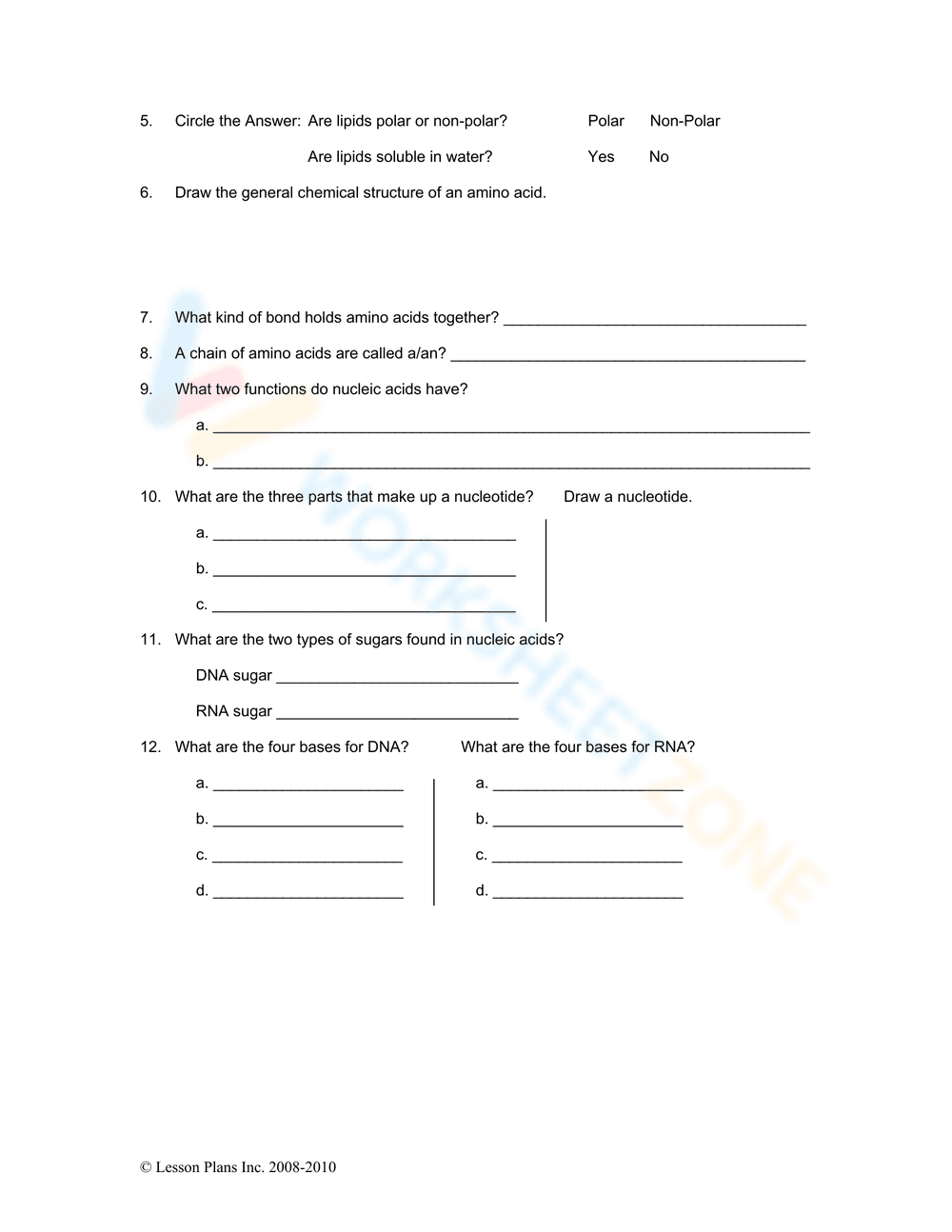
This is a macromolecule worksheet. It includes defining monomer and polymer, drawing a starch polymer using hexagons to represent monomers, completing a table to identify food examples, monomers, and polymers for carbohydrates, lipids, proteins and nucleic acids. The worksheet also contains questions about the number of rings in monosaccharides, disaccharides, and polysaccharides, and asks for examples of common monosaccharides and polysaccharides.
Grade Level Suitability:
This worksheet is suitable for high school biology, specifically grades 9-12. The concepts of macromolecules, monomers, and polymers are typically covered in high school biology curricula. The drawing and table completion activities require a foundational understanding of biological molecules.
Why Use It:
This worksheet reinforces understanding of macromolecules by requiring students to define key terms, visualize polymer structure, and connect macromolecules to food sources. It helps students differentiate between monomers and polymers and relate them to carbohydrates, lipids, proteins, and nucleic acids.
How to Use It:
Students should first define monomer and polymer. Next, they will draw a starch polymer, labeling a monomer and polymer within the drawing. They then complete the table by providing food examples, identifying monomers, and naming polymers for each macromolecule. Finally, students answer the questions about saccharide structures and common polysaccharides.
Target Users:
The target users are high school students studying biology, particularly those learning about macromolecules, monomers, polymers, and their biological functions. It is also useful for teachers as a review or assessment tool.
This is a macromolecule worksheet. It includes defining monomer and polymer, drawing a starch polymer using hexagons to represent monomers, completing a table to identify food examples, monomers, and polymers for carbohydrates, lipids, proteins and nucleic acids. The worksheet also contains questions about the number of rings in monosaccharides, disaccharides, and polysaccharides, and asks for examples of common monosaccharides and polysaccharides.
Grade Level Suitability:
This worksheet is suitable for high school biology, specifically grades 9-12. The concepts of macromolecules, monomers, and polymers are typically covered in high school biology curricula. The drawing and table completion activities require a foundational understanding of biological molecules.
Why Use It:
This worksheet reinforces understanding of macromolecules by requiring students to define key terms, visualize polymer structure, and connect macromolecules to food sources. It helps students differentiate between monomers and polymers and relate them to carbohydrates, lipids, proteins, and nucleic acids.
How to Use It:
Students should first define monomer and polymer. Next, they will draw a starch polymer, labeling a monomer and polymer within the drawing. They then complete the table by providing food examples, identifying monomers, and naming polymers for each macromolecule. Finally, students answer the questions about saccharide structures and common polysaccharides.
Target Users:
The target users are high school students studying biology, particularly those learning about macromolecules, monomers, polymers, and their biological functions. It is also useful for teachers as a review or assessment tool.


