


























0
Views
0
Downloads

0 Likes
Picture Math Addition Worksheet
0 Views
0 Downloads
Paste this activity's link or code into your existing LMS (Google Classroom, Canvas, Teams, Schoology, Moodle, etc.).
Students can open and work on the activity right away, with no student login required.
You'll still be able to track student progress and results from your teacher account.
Information
Description
What It Is:
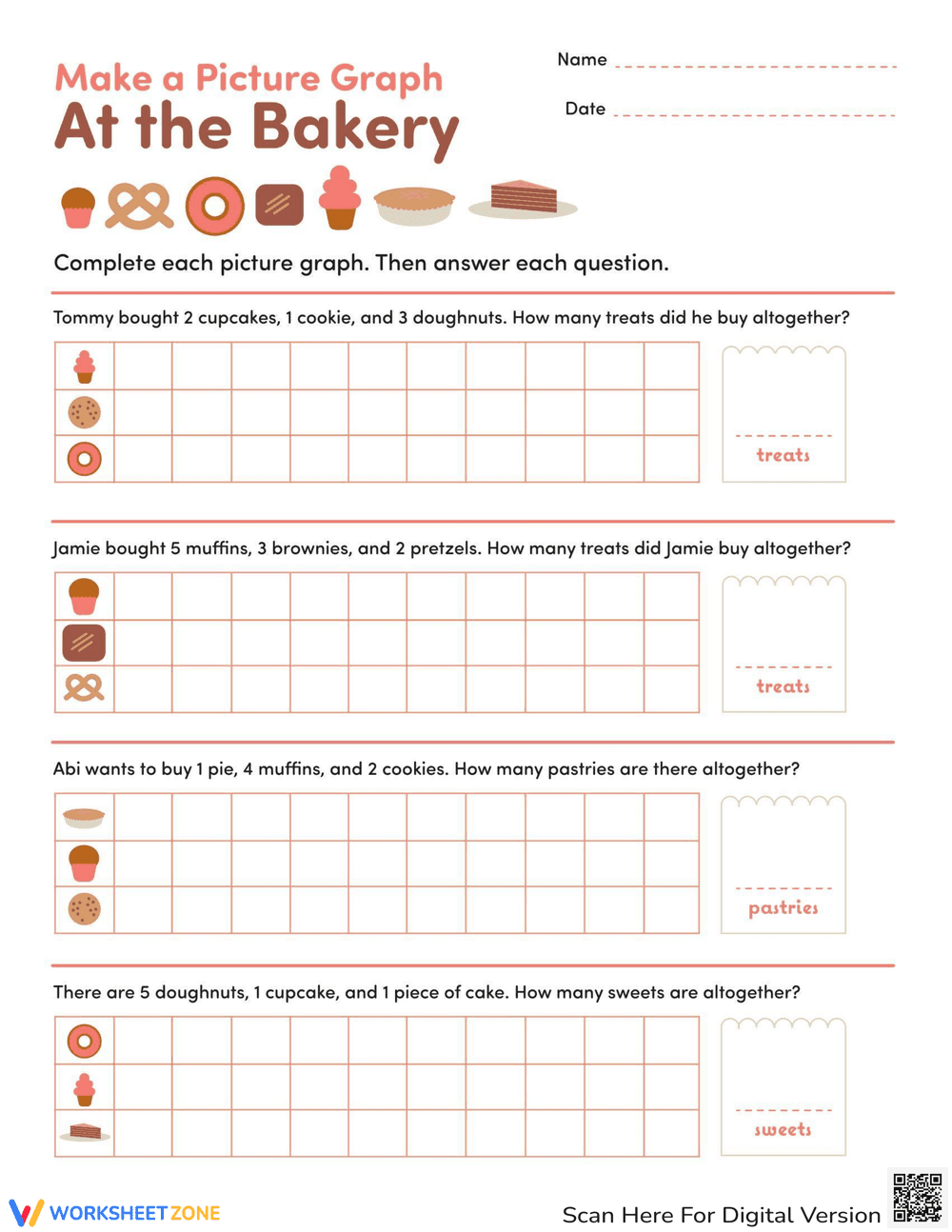
This is an educational worksheet titled 'Make a Picture Graph At the Bakery'. It features four separate picture graph activities. Each activity presents a word problem about buying bakery items (cupcakes, cookies, doughnuts, muffins, brownies, pretzels, pie, cake) and asks the student to complete a picture graph based on the information given. The student then answers a question about the total number of treats or pastries.
Grade Level Suitability:
This worksheet is suitable for 1st and 2nd grade. It focuses on basic addition and data representation using picture graphs, which are common skills taught in these grade levels. The word problems are simple and use small numbers, making them accessible to young learners.
Why Use It:
This worksheet reinforces basic addition skills and introduces or reinforces the concept of picture graphs. It helps students visualize data and connect mathematical concepts to real-world scenarios (buying treats at a bakery). It also promotes problem-solving skills as students need to interpret the word problems and translate them into a visual representation.
How to Use It:
First, read the word problem aloud with the student. Then, help them draw the correct number of pictures (cupcakes, cookies, etc.) in the corresponding row of the picture graph. Finally, have the student count the total number of items and write the answer in the provided space.
Target Users:
This worksheet is designed for elementary school students, specifically those in 1st or 2nd grade who are learning about picture graphs and practicing basic addition. It can be used by teachers in the classroom or by parents at home for extra practice.
This is an educational worksheet titled 'Make a Picture Graph At the Bakery'. It features four separate picture graph activities. Each activity presents a word problem about buying bakery items (cupcakes, cookies, doughnuts, muffins, brownies, pretzels, pie, cake) and asks the student to complete a picture graph based on the information given. The student then answers a question about the total number of treats or pastries.
Grade Level Suitability:
This worksheet is suitable for 1st and 2nd grade. It focuses on basic addition and data representation using picture graphs, which are common skills taught in these grade levels. The word problems are simple and use small numbers, making them accessible to young learners.
Why Use It:
This worksheet reinforces basic addition skills and introduces or reinforces the concept of picture graphs. It helps students visualize data and connect mathematical concepts to real-world scenarios (buying treats at a bakery). It also promotes problem-solving skills as students need to interpret the word problems and translate them into a visual representation.
How to Use It:
First, read the word problem aloud with the student. Then, help them draw the correct number of pictures (cupcakes, cookies, etc.) in the corresponding row of the picture graph. Finally, have the student count the total number of items and write the answer in the provided space.
Target Users:
This worksheet is designed for elementary school students, specifically those in 1st or 2nd grade who are learning about picture graphs and practicing basic addition. It can be used by teachers in the classroom or by parents at home for extra practice.


