


























0
Views
0
Downloads

0.0
0
0 Likes
Practice Molar Mass Conversion
0 Views
0 Downloads
Paste this activity's link or code into your existing LMS (Google Classroom, Canvas, Teams, Schoology, Moodle, etc.).
Students can open and work on the activity right away, with no student login required.
You'll still be able to track student progress and results from your teacher account.
Information
Description
What It Is:
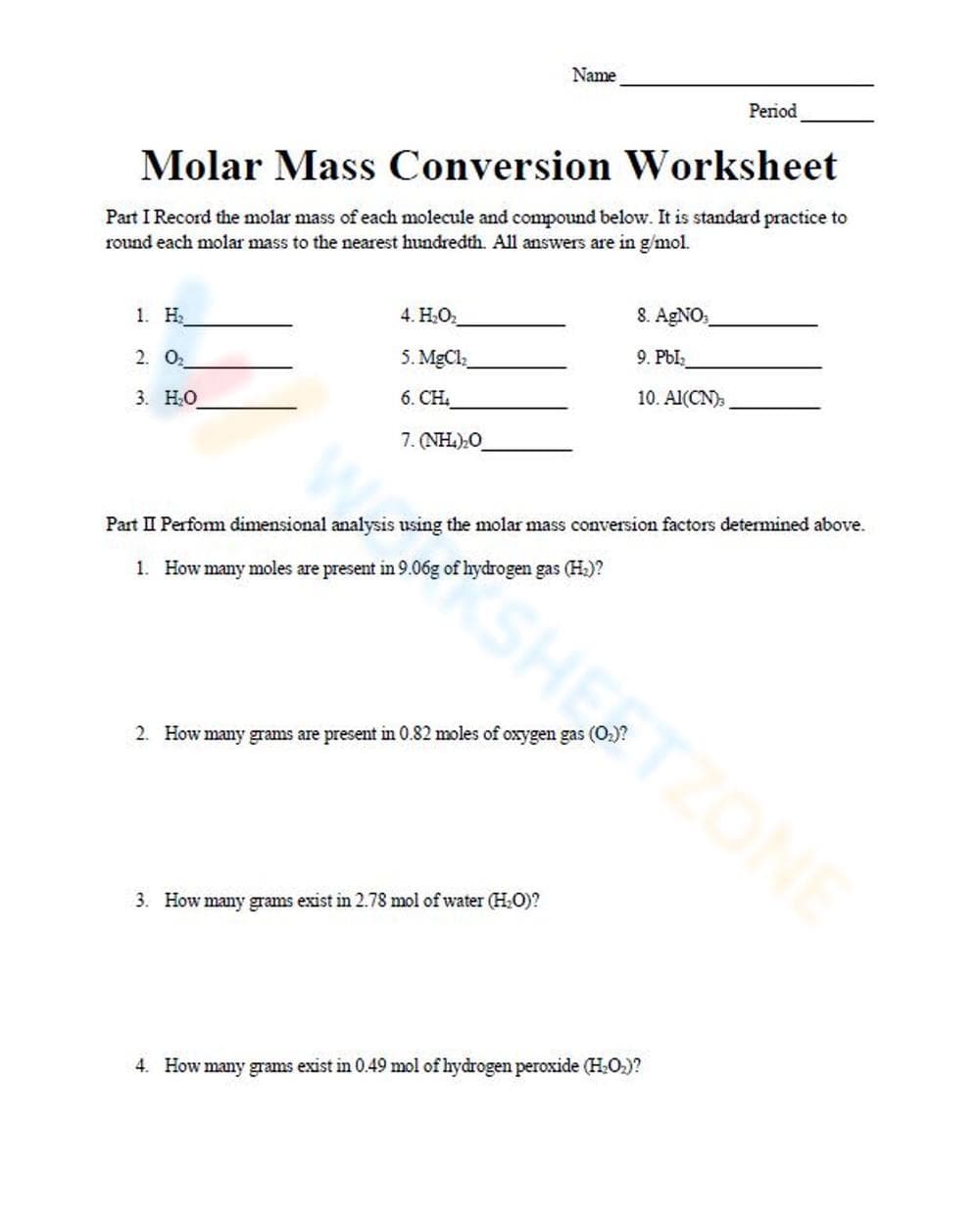
This is a molar mass conversion worksheet. Part I requires students to record the molar mass of various molecules and compounds, including H₂, O₂, H₂O, H₂O₂, MgCl₂, CH₄, OSH₂O, AgNO₃, PbI₂, and Al(CN)₃. Part II involves performing dimensional analysis using molar mass conversion factors to solve problems such as converting grams of hydrogen gas to moles, moles of oxygen gas to grams, moles of water to grams, and moles of hydrogen peroxide to grams. The molar masses should be rounded to the nearest hundredth.
Grade Level Suitability:
This worksheet is suitable for high school chemistry, specifically grades 10-12. It requires a solid understanding of chemical formulas, molar mass calculations, and dimensional analysis, typically covered in these grades.
Why Use It:
This worksheet provides practice in calculating molar masses of compounds and converting between grams and moles using dimensional analysis. It reinforces understanding of chemical formulas and their relationship to molar mass, and it develops problem-solving skills in stoichiometry.
How to Use It:
Students should first use a periodic table to determine the atomic masses of each element in the given compounds. They should then calculate the molar mass of each compound in Part I, rounding to the nearest hundredth. In Part II, students will use the molar masses they calculated to perform dimensional analysis, converting between grams and moles for the given substances.
Target Users:
This worksheet is designed for high school chemistry students who are learning about molar mass, the mole concept, and stoichiometry. It is also suitable for teachers looking for practice problems to reinforce these concepts.
This is a molar mass conversion worksheet. Part I requires students to record the molar mass of various molecules and compounds, including H₂, O₂, H₂O, H₂O₂, MgCl₂, CH₄, OSH₂O, AgNO₃, PbI₂, and Al(CN)₃. Part II involves performing dimensional analysis using molar mass conversion factors to solve problems such as converting grams of hydrogen gas to moles, moles of oxygen gas to grams, moles of water to grams, and moles of hydrogen peroxide to grams. The molar masses should be rounded to the nearest hundredth.
Grade Level Suitability:
This worksheet is suitable for high school chemistry, specifically grades 10-12. It requires a solid understanding of chemical formulas, molar mass calculations, and dimensional analysis, typically covered in these grades.
Why Use It:
This worksheet provides practice in calculating molar masses of compounds and converting between grams and moles using dimensional analysis. It reinforces understanding of chemical formulas and their relationship to molar mass, and it develops problem-solving skills in stoichiometry.
How to Use It:
Students should first use a periodic table to determine the atomic masses of each element in the given compounds. They should then calculate the molar mass of each compound in Part I, rounding to the nearest hundredth. In Part II, students will use the molar masses they calculated to perform dimensional analysis, converting between grams and moles for the given substances.
Target Users:
This worksheet is designed for high school chemistry students who are learning about molar mass, the mole concept, and stoichiometry. It is also suitable for teachers looking for practice problems to reinforce these concepts.


