


























0
Views
0
Downloads

0.0
0
0 Likes
Mole Ratio Practice: Stoichiometry Worksheet for High School Chemistry
0 Views
0 Downloads
Paste this activity's link or code into your existing LMS (Google Classroom, Canvas, Teams, Schoology, Moodle, etc.).
Students can open and work on the activity right away, with no student login required.
You'll still be able to track student progress and results from your teacher account.
Information
Description
What It Is:
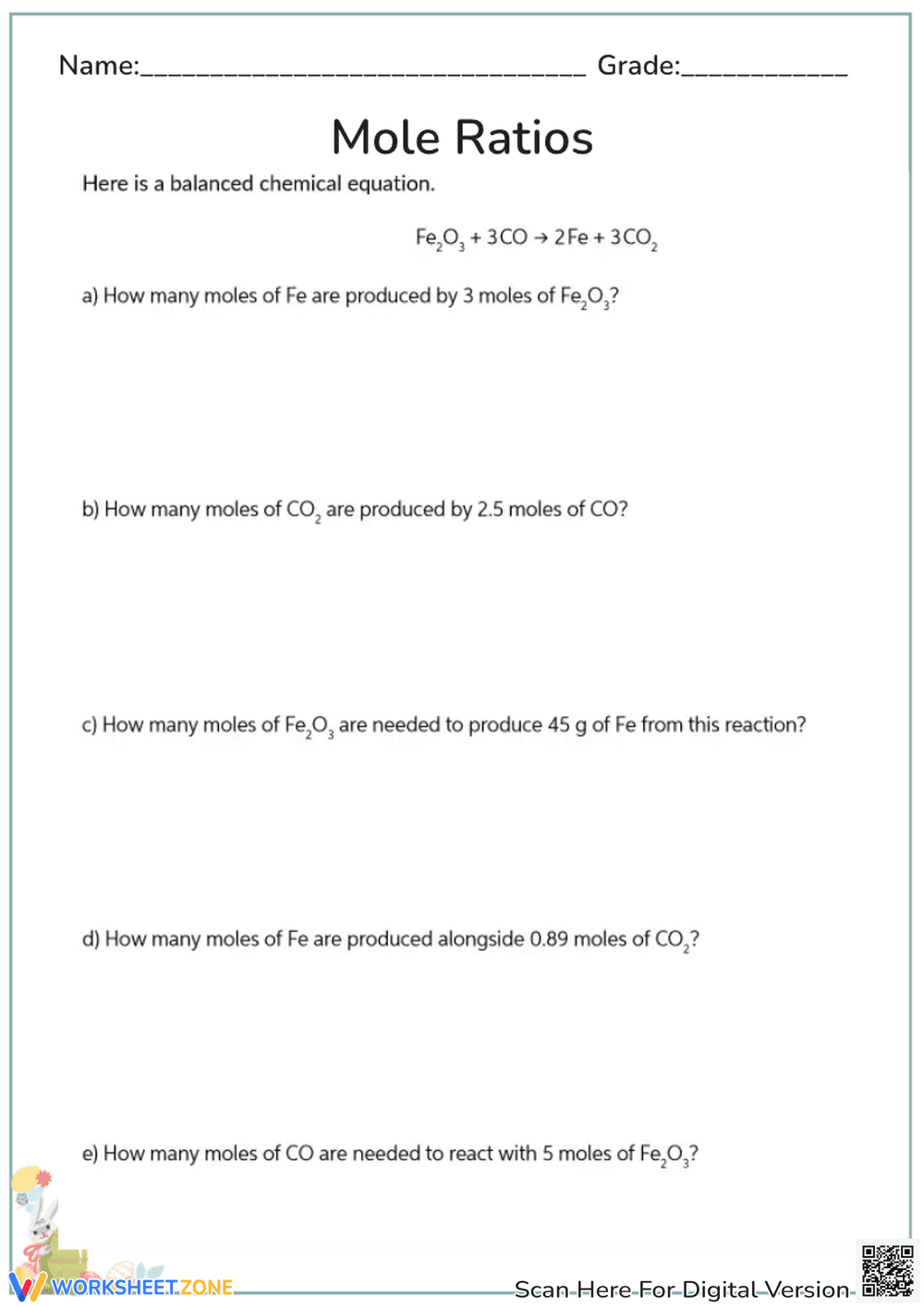
This is a chemistry worksheet focused on mole ratios. It presents a balanced chemical equation: Fe₂O₃ + 3CO → 2Fe + 3CO₂. Students are asked to calculate the number of moles of reactants or products based on the given moles of other substances in the reaction, including one problem involving grams of Fe. The worksheet provides spaces for the student's name and grade.
Grade Level Suitability:
This worksheet is suitable for high school chemistry students, specifically grades 10-12. It requires an understanding of balanced chemical equations, mole concepts, and stoichiometric calculations, which are typically taught at the high school level. The conversion from grams to moles makes it appropriate for a more advanced understanding.
Why Use It:
This worksheet helps students practice applying mole ratios derived from balanced chemical equations to solve stoichiometry problems. It reinforces their understanding of the relationship between reactants and products in a chemical reaction and develops their problem-solving skills in quantitative chemistry.
How to Use It:
Students should first analyze the provided balanced chemical equation. Then, for each question, they should use the mole ratios from the balanced equation to calculate the unknown quantity. For question c, they will need to convert grams of Fe to moles before using the mole ratio. Students should show their work and write their answers in the spaces provided or on a separate sheet of paper.
Target Users:
The target users are high school chemistry students who are learning about stoichiometry and mole ratios. It is also useful for teachers who need practice problems for their students to reinforce these concepts.
This is a chemistry worksheet focused on mole ratios. It presents a balanced chemical equation: Fe₂O₃ + 3CO → 2Fe + 3CO₂. Students are asked to calculate the number of moles of reactants or products based on the given moles of other substances in the reaction, including one problem involving grams of Fe. The worksheet provides spaces for the student's name and grade.
Grade Level Suitability:
This worksheet is suitable for high school chemistry students, specifically grades 10-12. It requires an understanding of balanced chemical equations, mole concepts, and stoichiometric calculations, which are typically taught at the high school level. The conversion from grams to moles makes it appropriate for a more advanced understanding.
Why Use It:
This worksheet helps students practice applying mole ratios derived from balanced chemical equations to solve stoichiometry problems. It reinforces their understanding of the relationship between reactants and products in a chemical reaction and develops their problem-solving skills in quantitative chemistry.
How to Use It:
Students should first analyze the provided balanced chemical equation. Then, for each question, they should use the mole ratios from the balanced equation to calculate the unknown quantity. For question c, they will need to convert grams of Fe to moles before using the mole ratio. Students should show their work and write their answers in the spaces provided or on a separate sheet of paper.
Target Users:
The target users are high school chemistry students who are learning about stoichiometry and mole ratios. It is also useful for teachers who need practice problems for their students to reinforce these concepts.


