


























0
Views
0
Downloads

0.0
0
0 Likes
Practice Balancing Equations in Chemistry
0 Views
0 Downloads
Paste this activity's link or code into your existing LMS (Google Classroom, Canvas, Teams, Schoology, Moodle, etc.).
Students can open and work on the activity right away, with no student login required.
You'll still be able to track student progress and results from your teacher account.
Information
Description
What It Is:
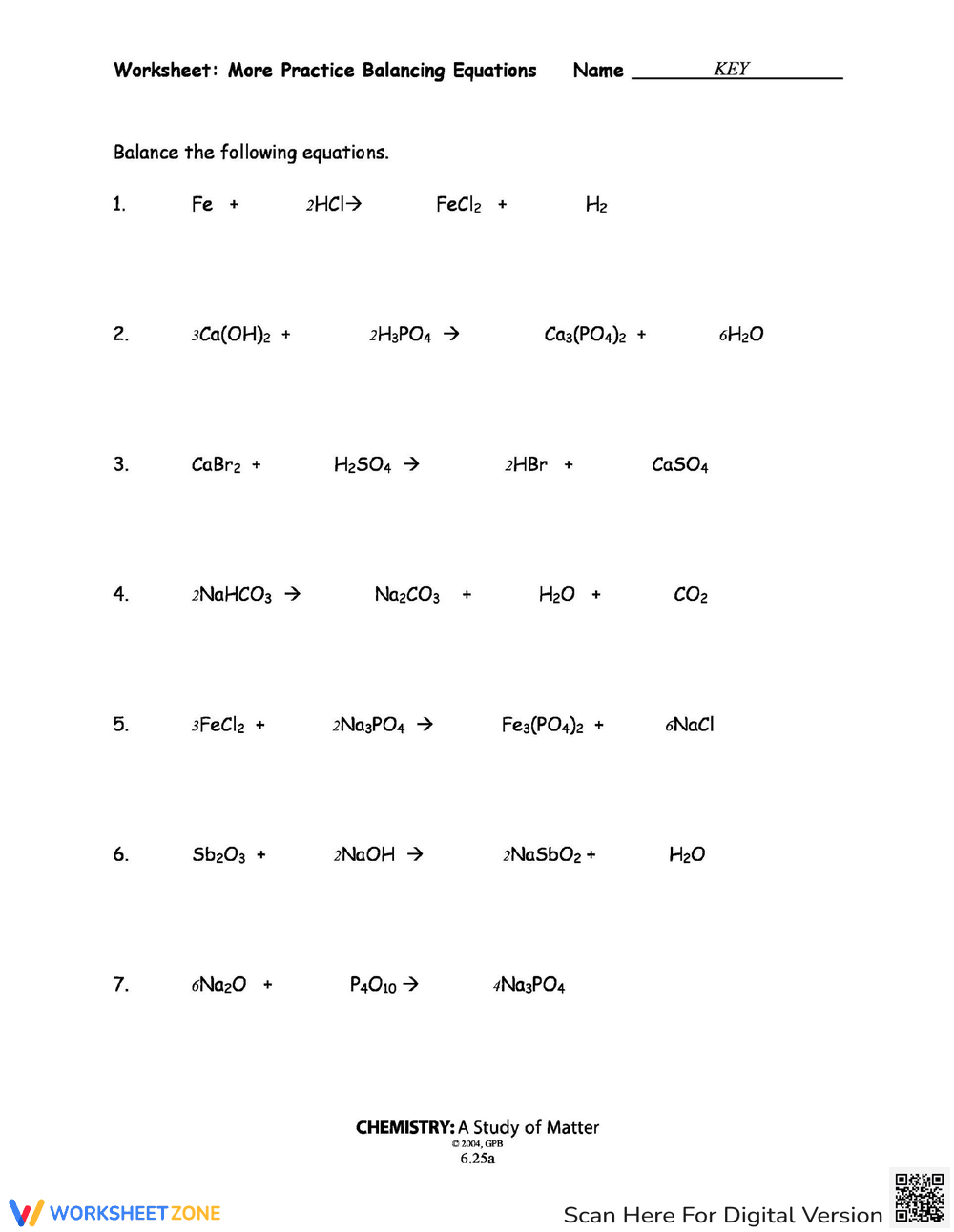
This is a chemistry worksheet titled 'More Practice Balancing Equations.' It presents seven chemical equations that students need to balance by filling in the appropriate coefficients in front of each chemical formula. The equations involve various elements and compounds such as Iron (Fe), Hydrochloric Acid (HCl), Cobalt Hydroxide (Co(OH)2), Phosphoric Acid (H3PO4), Calcium Bromide (CaBr2), Sulfuric Acid (H2SO4), Sodium Bicarbonate (NaHCO3), Ferrous Chloride (FeCl2), Sodium Phosphate (Na3PO4), Antimony Trioxide (Sb2O3), Sodium Hydroxide (NaOH), Sodium Oxide (Na2O), and Phosphorus Pentoxide (P4O10). There is a space for the student's name and the word 'KEY' suggesting this may be the answer key.
Grade Level Suitability:
This worksheet is most suitable for high school students, specifically grades 9-12, taking chemistry. Balancing chemical equations is a core concept typically introduced in high school chemistry courses. The complexity of the compounds suggests a solid foundation in basic chemistry concepts is needed.
Why Use It:
This worksheet provides practice in balancing chemical equations, a fundamental skill in chemistry. It helps students develop a deeper understanding of stoichiometry, conservation of mass, and chemical reactions. It reinforces the ability to manipulate chemical formulas and apply the principles of balancing.
How to Use It:
Students should examine each chemical equation and determine the number of atoms of each element on both sides of the equation. Then, they should add coefficients (whole numbers) in front of the chemical formulas to equalize the number of atoms of each element on both sides. Students should continue adjusting coefficients until the equation is balanced, ensuring the same number of atoms of each element appears on both the reactant and product sides.
Target Users:
The target users are high school chemistry students who are learning or reviewing how to balance chemical equations. It can be used as a practice exercise, homework assignment, or review activity. It is also suitable for teachers looking for supplemental materials to reinforce this key chemistry concept.
This is a chemistry worksheet titled 'More Practice Balancing Equations.' It presents seven chemical equations that students need to balance by filling in the appropriate coefficients in front of each chemical formula. The equations involve various elements and compounds such as Iron (Fe), Hydrochloric Acid (HCl), Cobalt Hydroxide (Co(OH)2), Phosphoric Acid (H3PO4), Calcium Bromide (CaBr2), Sulfuric Acid (H2SO4), Sodium Bicarbonate (NaHCO3), Ferrous Chloride (FeCl2), Sodium Phosphate (Na3PO4), Antimony Trioxide (Sb2O3), Sodium Hydroxide (NaOH), Sodium Oxide (Na2O), and Phosphorus Pentoxide (P4O10). There is a space for the student's name and the word 'KEY' suggesting this may be the answer key.
Grade Level Suitability:
This worksheet is most suitable for high school students, specifically grades 9-12, taking chemistry. Balancing chemical equations is a core concept typically introduced in high school chemistry courses. The complexity of the compounds suggests a solid foundation in basic chemistry concepts is needed.
Why Use It:
This worksheet provides practice in balancing chemical equations, a fundamental skill in chemistry. It helps students develop a deeper understanding of stoichiometry, conservation of mass, and chemical reactions. It reinforces the ability to manipulate chemical formulas and apply the principles of balancing.
How to Use It:
Students should examine each chemical equation and determine the number of atoms of each element on both sides of the equation. Then, they should add coefficients (whole numbers) in front of the chemical formulas to equalize the number of atoms of each element on both sides. Students should continue adjusting coefficients until the equation is balanced, ensuring the same number of atoms of each element appears on both the reactant and product sides.
Target Users:
The target users are high school chemistry students who are learning or reviewing how to balance chemical equations. It can be used as a practice exercise, homework assignment, or review activity. It is also suitable for teachers looking for supplemental materials to reinforce this key chemistry concept.


