


























0
Views
0
Downloads

0.0
0
0 Likes
Interactive Mouse Party Worksheet
0 Views
0 Downloads
Paste this activity's link or code into your existing LMS (Google Classroom, Canvas, Teams, Schoology, Moodle, etc.).
Students can open and work on the activity right away, with no student login required.
You'll still be able to track student progress and results from your teacher account.
Information
Description
What It Is:
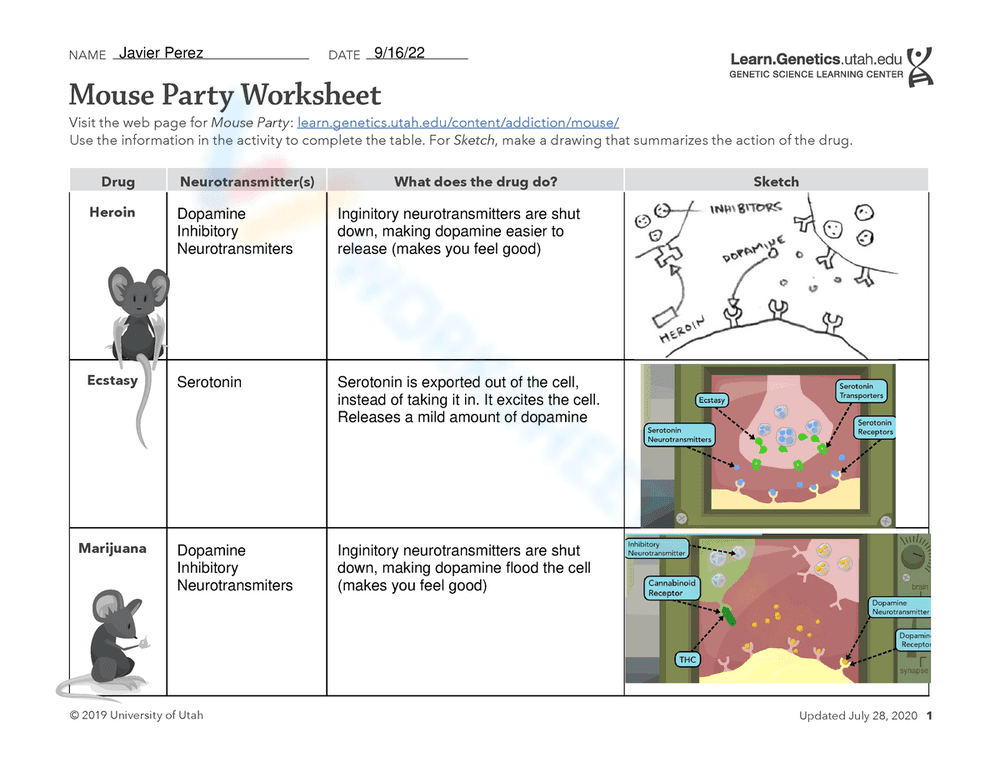
This is a worksheet titled 'Mouse Party Worksheet' from Learn.Genetics.Utah.edu. It features a table with three rows, each dedicated to a different drug: Heroin, Ecstasy, and Marijuana. Each row includes columns for 'Drug,' 'Neurotransmitter(s),' 'What does the drug do?', and 'Sketch.' The worksheet requires students to fill in the table based on information found on the provided website, including drawing a sketch summarizing the action of each drug. The worksheet includes pre-drawn mouse characters next to the drug names.
Grade Level Suitability:
This worksheet is likely suitable for high school students (Grades 9-12) and possibly advanced middle school students (Grade 8). The content involves understanding neurotransmitters and the effects of drugs on the brain, which are typically covered in high school biology or health classes.
Why Use It:
This worksheet helps students learn about the effects of different drugs on neurotransmitters in the brain. It promotes critical thinking and information synthesis by requiring students to research and summarize information. The sketch component encourages visual learning and helps students understand complex processes.
How to Use It:
Students should first visit the provided website (learn.genetics.utah.edu/content/addiction/mouse/). They should then use the information on the website to complete the table. This includes identifying the neurotransmitters affected by each drug, describing the drug's action, and creating a sketch that summarizes the action of the drug.
Target Users:
This worksheet is targeted towards high school students studying biology, health, or neuroscience. It could also be used in introductory college-level courses on these topics. The worksheet is appropriate for students who are learning about the nervous system and the effects of drugs on the brain.
This is a worksheet titled 'Mouse Party Worksheet' from Learn.Genetics.Utah.edu. It features a table with three rows, each dedicated to a different drug: Heroin, Ecstasy, and Marijuana. Each row includes columns for 'Drug,' 'Neurotransmitter(s),' 'What does the drug do?', and 'Sketch.' The worksheet requires students to fill in the table based on information found on the provided website, including drawing a sketch summarizing the action of each drug. The worksheet includes pre-drawn mouse characters next to the drug names.
Grade Level Suitability:
This worksheet is likely suitable for high school students (Grades 9-12) and possibly advanced middle school students (Grade 8). The content involves understanding neurotransmitters and the effects of drugs on the brain, which are typically covered in high school biology or health classes.
Why Use It:
This worksheet helps students learn about the effects of different drugs on neurotransmitters in the brain. It promotes critical thinking and information synthesis by requiring students to research and summarize information. The sketch component encourages visual learning and helps students understand complex processes.
How to Use It:
Students should first visit the provided website (learn.genetics.utah.edu/content/addiction/mouse/). They should then use the information on the website to complete the table. This includes identifying the neurotransmitters affected by each drug, describing the drug's action, and creating a sketch that summarizes the action of the drug.
Target Users:
This worksheet is targeted towards high school students studying biology, health, or neuroscience. It could also be used in introductory college-level courses on these topics. The worksheet is appropriate for students who are learning about the nervous system and the effects of drugs on the brain.


