


























0
Views
0
Downloads

0.0
0
0 Likes
Drugs and The Brain Connection
0 Views
0 Downloads
Paste this activity's link or code into your existing LMS (Google Classroom, Canvas, Teams, Schoology, Moodle, etc.).
Students can open and work on the activity right away, with no student login required.
You'll still be able to track student progress and results from your teacher account.
Information
Description
What It Is:
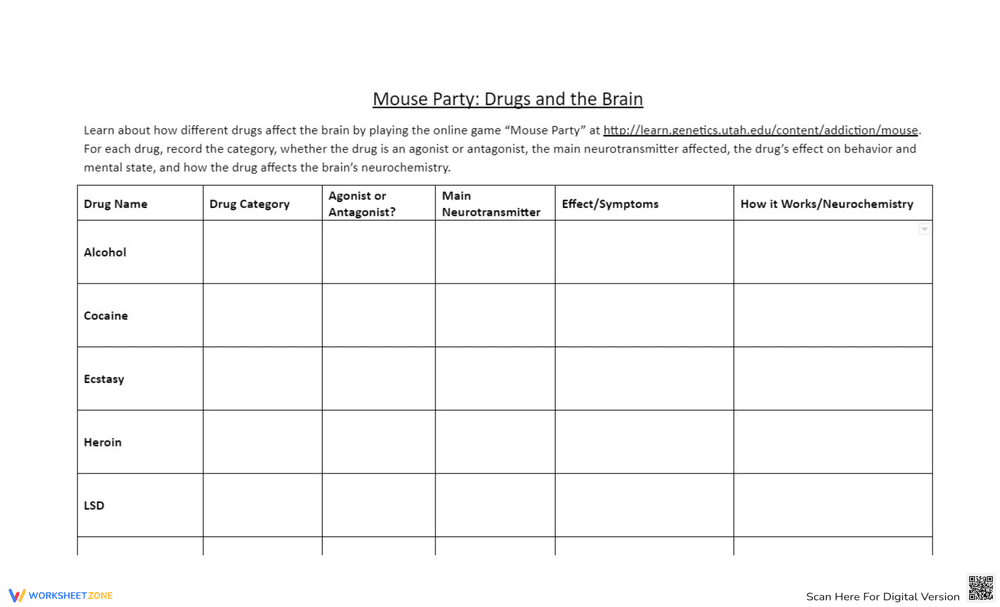
This is an educational worksheet titled 'Mouse Party: Drugs and the Brain.' It instructs students to learn about how different drugs affect the brain by playing the online game 'Mouse Party.' The worksheet contains a table with the following columns: Drug Name, Drug Category, Agonist or Antagonist?, Main Neurotransmitter, Effect/Symptoms, and How it Works/Neurochemistry. The worksheet includes rows for Alcohol, Cocaine, Ecstasy, Heroin, and LSD.
Grade Level Suitability:
This worksheet appears suitable for high school students (grades 9-12) and potentially introductory college level courses. The content deals with complex topics like neurotransmitters, agonists/antagonists, and neurochemistry, which require a basic understanding of biology and chemistry.
Why Use It:
This worksheet helps students understand the effects of different drugs on the brain and body by relating the drug's category and mechanism of action to its effects and symptoms. It encourages interactive learning through the 'Mouse Party' game and reinforces concepts through structured note-taking in the provided table.
How to Use It:
Students should first play the 'Mouse Party' online game (link provided). Then, for each drug listed (Alcohol, Cocaine, Ecstasy, Heroin, LSD), they should fill in the table with the appropriate information regarding the drug's category, whether it's an agonist or antagonist, the main neurotransmitter affected, the effects/symptoms of the drug, and how it works on a neurochemical level.
Target Users:
The target users for this worksheet are high school students studying biology, health, or psychology, as well as college students in introductory neuroscience or psychology courses. It is beneficial for students learning about the biological basis of drug effects and addiction.
This is an educational worksheet titled 'Mouse Party: Drugs and the Brain.' It instructs students to learn about how different drugs affect the brain by playing the online game 'Mouse Party.' The worksheet contains a table with the following columns: Drug Name, Drug Category, Agonist or Antagonist?, Main Neurotransmitter, Effect/Symptoms, and How it Works/Neurochemistry. The worksheet includes rows for Alcohol, Cocaine, Ecstasy, Heroin, and LSD.
Grade Level Suitability:
This worksheet appears suitable for high school students (grades 9-12) and potentially introductory college level courses. The content deals with complex topics like neurotransmitters, agonists/antagonists, and neurochemistry, which require a basic understanding of biology and chemistry.
Why Use It:
This worksheet helps students understand the effects of different drugs on the brain and body by relating the drug's category and mechanism of action to its effects and symptoms. It encourages interactive learning through the 'Mouse Party' game and reinforces concepts through structured note-taking in the provided table.
How to Use It:
Students should first play the 'Mouse Party' online game (link provided). Then, for each drug listed (Alcohol, Cocaine, Ecstasy, Heroin, LSD), they should fill in the table with the appropriate information regarding the drug's category, whether it's an agonist or antagonist, the main neurotransmitter affected, the effects/symptoms of the drug, and how it works on a neurochemical level.
Target Users:
The target users for this worksheet are high school students studying biology, health, or psychology, as well as college students in introductory neuroscience or psychology courses. It is beneficial for students learning about the biological basis of drug effects and addiction.


