


























1 / 2
0
Views
0
Downloads


0 Likes
Mouse Party Graphic Organizer Worksheet
0 Views
0 Downloads
Paste this activity's link or code into your existing LMS (Google Classroom, Canvas, Teams, Schoology, Moodle, etc.).
Students can open and work on the activity right away, with no student login required.
You'll still be able to track student progress and results from your teacher account.
Information
Description
What It Is:
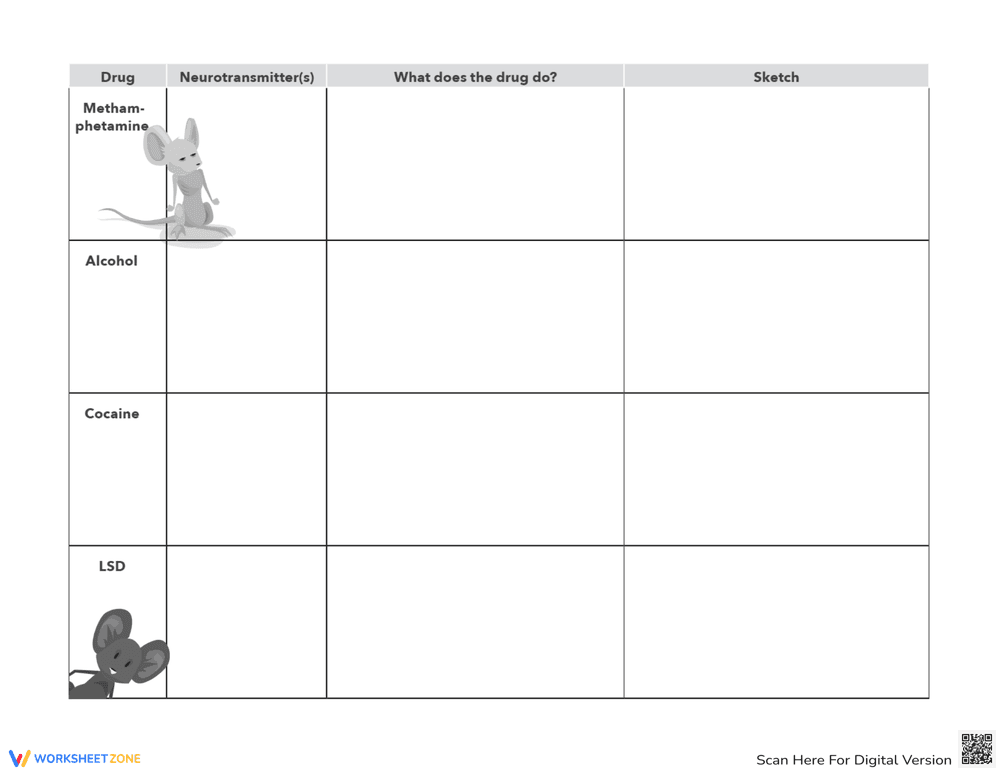
This is a 'Mouse Party' worksheet designed to help students understand the effects of different drugs on neurotransmitters. The worksheet includes a table with rows for 'Heroin,' 'Ecstasy,' and 'Marijuana.' Students are instructed to use provided information to complete the table, filling in columns for 'Neurotransmitter(s),' 'What does the drug do?', and a 'Sketch' summarizing the drug's action. The Heroin row already has a cartoon mouse image and a partially completed sketch showing neurons and receptors.
Grade Level Suitability:
This worksheet appears suitable for high school students, specifically grades 9-12. The content involves understanding complex biological processes related to neurotransmitters and drug effects, which is typically covered in high school biology or health classes.
Why Use It:
This worksheet helps students visualize and understand the complex interactions between drugs and neurotransmitters. It promotes critical thinking by requiring students to synthesize information and create a visual representation of the drug's action. It also reinforces learning about the nervous system and the impact of substances on brain function.
How to Use It:
Students should use the provided information (likely from an accompanying text or presentation) to complete the table. For each drug (Heroin, Ecstasy, Marijuana), they need to identify the neurotransmitters affected, describe the drug's action, and create a sketch illustrating how the drug interacts with neurons and receptors. The completed sketch for Heroin serves as an example.
Target Users:
The target users are high school students in biology, health, or psychology classes studying the effects of drugs on the nervous system. It is also suitable for educators looking for engaging activities to teach about neurotransmitters and substance abuse.
This is a 'Mouse Party' worksheet designed to help students understand the effects of different drugs on neurotransmitters. The worksheet includes a table with rows for 'Heroin,' 'Ecstasy,' and 'Marijuana.' Students are instructed to use provided information to complete the table, filling in columns for 'Neurotransmitter(s),' 'What does the drug do?', and a 'Sketch' summarizing the drug's action. The Heroin row already has a cartoon mouse image and a partially completed sketch showing neurons and receptors.
Grade Level Suitability:
This worksheet appears suitable for high school students, specifically grades 9-12. The content involves understanding complex biological processes related to neurotransmitters and drug effects, which is typically covered in high school biology or health classes.
Why Use It:
This worksheet helps students visualize and understand the complex interactions between drugs and neurotransmitters. It promotes critical thinking by requiring students to synthesize information and create a visual representation of the drug's action. It also reinforces learning about the nervous system and the impact of substances on brain function.
How to Use It:
Students should use the provided information (likely from an accompanying text or presentation) to complete the table. For each drug (Heroin, Ecstasy, Marijuana), they need to identify the neurotransmitters affected, describe the drug's action, and create a sketch illustrating how the drug interacts with neurons and receptors. The completed sketch for Heroin serves as an example.
Target Users:
The target users are high school students in biology, health, or psychology classes studying the effects of drugs on the nervous system. It is also suitable for educators looking for engaging activities to teach about neurotransmitters and substance abuse.


