


























1 / 3
0
Views
0
Downloads



0.0
0
0 Likes
Engaging Mouse Party Worksheet Activity
0 Views
0 Downloads
Paste this activity's link or code into your existing LMS (Google Classroom, Canvas, Teams, Schoology, Moodle, etc.).
Students can open and work on the activity right away, with no student login required.
You'll still be able to track student progress and results from your teacher account.
Information
Description
What It Is:
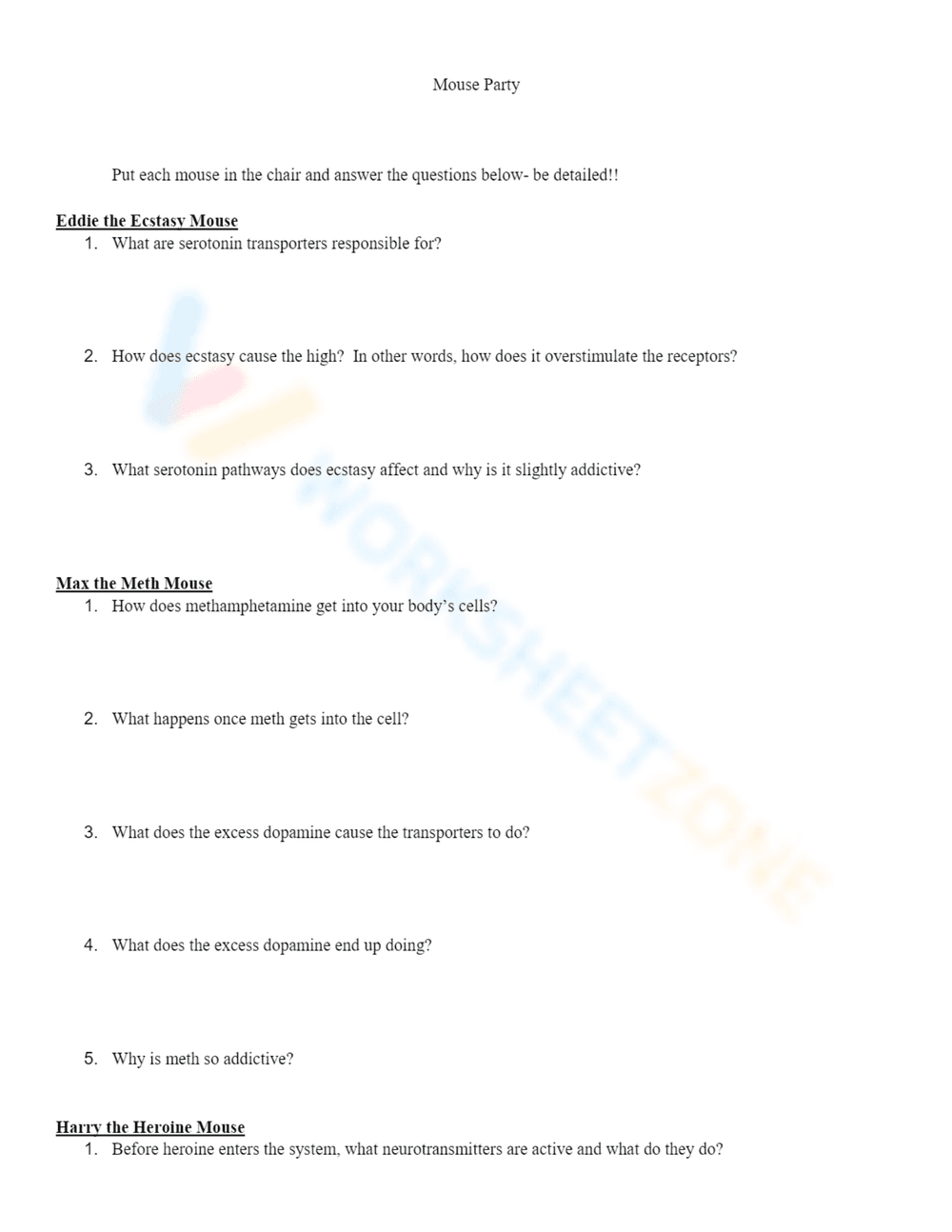
This is an educational worksheet titled 'Mouse Party' that explores the effects of different drugs on the brain. It presents scenarios featuring 'Eddie the Ecstasy Mouse,' 'Max the Meth Mouse,' and 'Harry the Heroine Mouse.' Students are asked to answer detailed questions about how each drug affects neurotransmitters and pathways in the body. Questions cover topics such as serotonin transporters, the effects of ecstasy on receptors, methamphetamine's entry into cells, dopamine's role, and the addictive nature of meth and heroin.
Grade Level Suitability:
This worksheet is most suitable for high school students (Grades 10-12), particularly those in biology, health, or psychology classes. The content requires an understanding of basic neurobiology, neurotransmitters, and the effects of drugs on the nervous system.
Why Use It:
This worksheet provides an engaging and thought-provoking way to learn about the physiological effects of drugs. It promotes critical thinking and encourages students to analyze complex biological processes. It can also serve as a starting point for discussions about addiction and the importance of making informed choices about drug use.
How to Use It:
Students should read each scenario carefully and then answer the questions in detail, using their knowledge of biology and neuroscience. Encourage students to research information as needed to provide comprehensive answers. The worksheet can be completed individually or in small groups, followed by a class discussion.
Target Users:
The target users are high school students studying biology, health, or psychology, as well as educators looking for resources to teach about the effects of drugs on the brain and nervous system.
This is an educational worksheet titled 'Mouse Party' that explores the effects of different drugs on the brain. It presents scenarios featuring 'Eddie the Ecstasy Mouse,' 'Max the Meth Mouse,' and 'Harry the Heroine Mouse.' Students are asked to answer detailed questions about how each drug affects neurotransmitters and pathways in the body. Questions cover topics such as serotonin transporters, the effects of ecstasy on receptors, methamphetamine's entry into cells, dopamine's role, and the addictive nature of meth and heroin.
Grade Level Suitability:
This worksheet is most suitable for high school students (Grades 10-12), particularly those in biology, health, or psychology classes. The content requires an understanding of basic neurobiology, neurotransmitters, and the effects of drugs on the nervous system.
Why Use It:
This worksheet provides an engaging and thought-provoking way to learn about the physiological effects of drugs. It promotes critical thinking and encourages students to analyze complex biological processes. It can also serve as a starting point for discussions about addiction and the importance of making informed choices about drug use.
How to Use It:
Students should read each scenario carefully and then answer the questions in detail, using their knowledge of biology and neuroscience. Encourage students to research information as needed to provide comprehensive answers. The worksheet can be completed individually or in small groups, followed by a class discussion.
Target Users:
The target users are high school students studying biology, health, or psychology, as well as educators looking for resources to teach about the effects of drugs on the brain and nervous system.


