


























0
Views
0
Downloads

0 Likes
Mouse Party: Drugs and Neurotransmitters
0 Views
0 Downloads
Paste this activity's link or code into your existing LMS (Google Classroom, Canvas, Teams, Schoology, Moodle, etc.).
Students can open and work on the activity right away, with no student login required.
You'll still be able to track student progress and results from your teacher account.
Information
Description
What It Is:
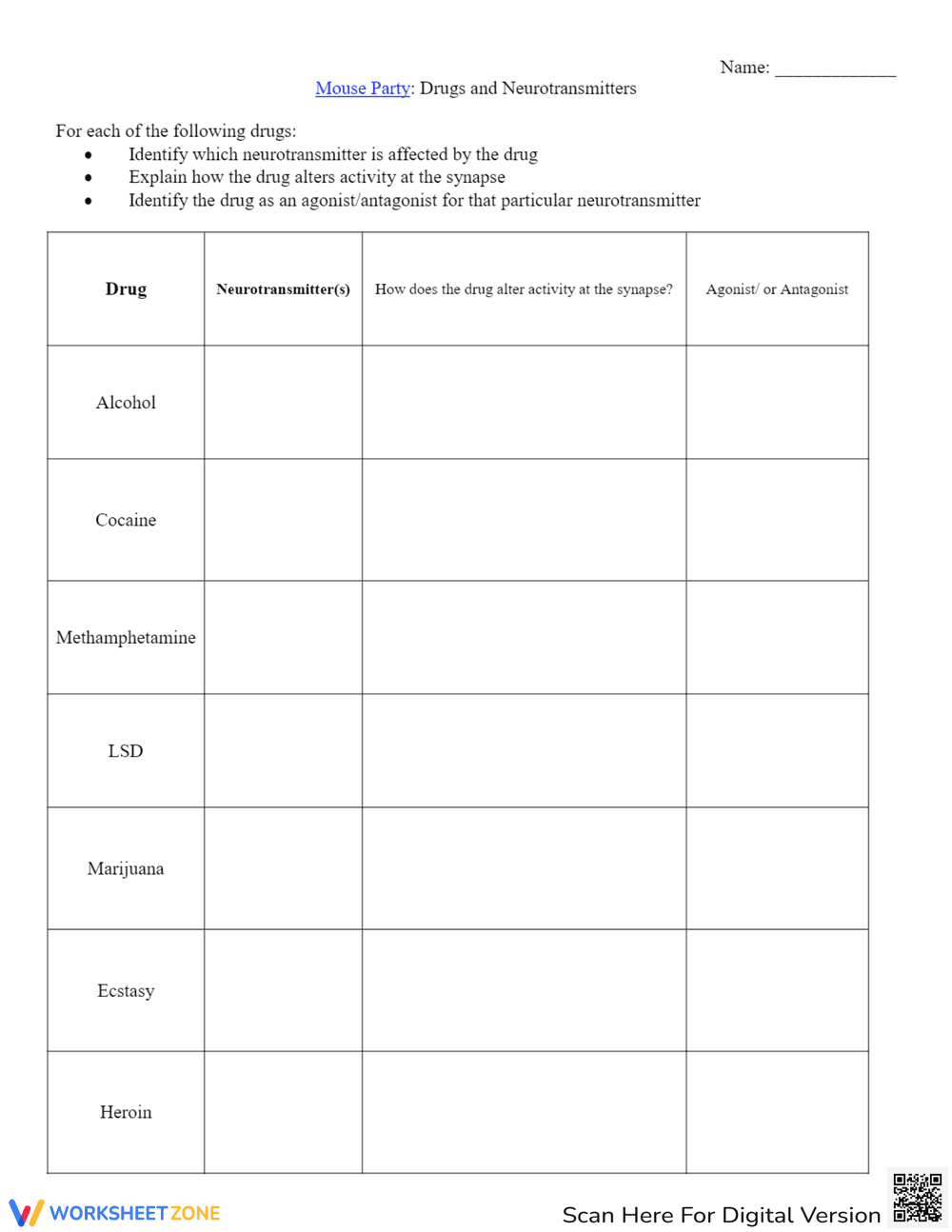
This is an educational worksheet titled 'Mouse Party: Drugs and Neurotransmitters'. It features a table with columns labeled 'Drug', 'Neurotransmitter(s)', 'How does the drug alter activity at the synapse?', and 'Agonist or Antagonist'. The drugs listed in the first column are Alcohol, Cocaine, Methamphetamine, LSD, Marijuana, Ecstasy, and Heroin. The instructions ask students to identify the neurotransmitters affected by each drug, explain how the drug alters activity at the synapse, and identify the drug as an agonist or antagonist for that neurotransmitter.
Grade Level Suitability:
This worksheet is most suitable for high school (Grades 9-12) or introductory college-level biology or psychology courses. The content requires an understanding of neurotransmitters, synapses, and the basic effects of drugs on the nervous system.
Why Use It:
This worksheet helps students learn about the effects of different drugs on the brain and nervous system. It reinforces understanding of neurotransmitter function, synaptic activity, and the concepts of agonists and antagonists. It encourages critical thinking and the application of knowledge to specific examples.
How to Use It:
Students should research each drug listed in the worksheet. For each drug, they should identify the neurotransmitter(s) affected, describe the mechanism of action at the synapse, and determine whether the drug acts as an agonist or antagonist. The answers should be written in the corresponding boxes in the table.
Target Users:
The target users are high school or college students studying biology, psychology, neuroscience, or related fields. It's appropriate for students learning about the nervous system, neurotransmitters, and the effects of drugs on the brain.
This is an educational worksheet titled 'Mouse Party: Drugs and Neurotransmitters'. It features a table with columns labeled 'Drug', 'Neurotransmitter(s)', 'How does the drug alter activity at the synapse?', and 'Agonist or Antagonist'. The drugs listed in the first column are Alcohol, Cocaine, Methamphetamine, LSD, Marijuana, Ecstasy, and Heroin. The instructions ask students to identify the neurotransmitters affected by each drug, explain how the drug alters activity at the synapse, and identify the drug as an agonist or antagonist for that neurotransmitter.
Grade Level Suitability:
This worksheet is most suitable for high school (Grades 9-12) or introductory college-level biology or psychology courses. The content requires an understanding of neurotransmitters, synapses, and the basic effects of drugs on the nervous system.
Why Use It:
This worksheet helps students learn about the effects of different drugs on the brain and nervous system. It reinforces understanding of neurotransmitter function, synaptic activity, and the concepts of agonists and antagonists. It encourages critical thinking and the application of knowledge to specific examples.
How to Use It:
Students should research each drug listed in the worksheet. For each drug, they should identify the neurotransmitter(s) affected, describe the mechanism of action at the synapse, and determine whether the drug acts as an agonist or antagonist. The answers should be written in the corresponding boxes in the table.
Target Users:
The target users are high school or college students studying biology, psychology, neuroscience, or related fields. It's appropriate for students learning about the nervous system, neurotransmitters, and the effects of drugs on the brain.


