


























1 / 5
0
Views
0
Downloads



0.0
0
0 Likes
Naming Chemical Compounds Practice
0 Views
0 Downloads
Paste this activity's link or code into your existing LMS (Google Classroom, Canvas, Teams, Schoology, Moodle, etc.).
Students can open and work on the activity right away, with no student login required.
You'll still be able to track student progress and results from your teacher account.
Information
Description
What It Is:
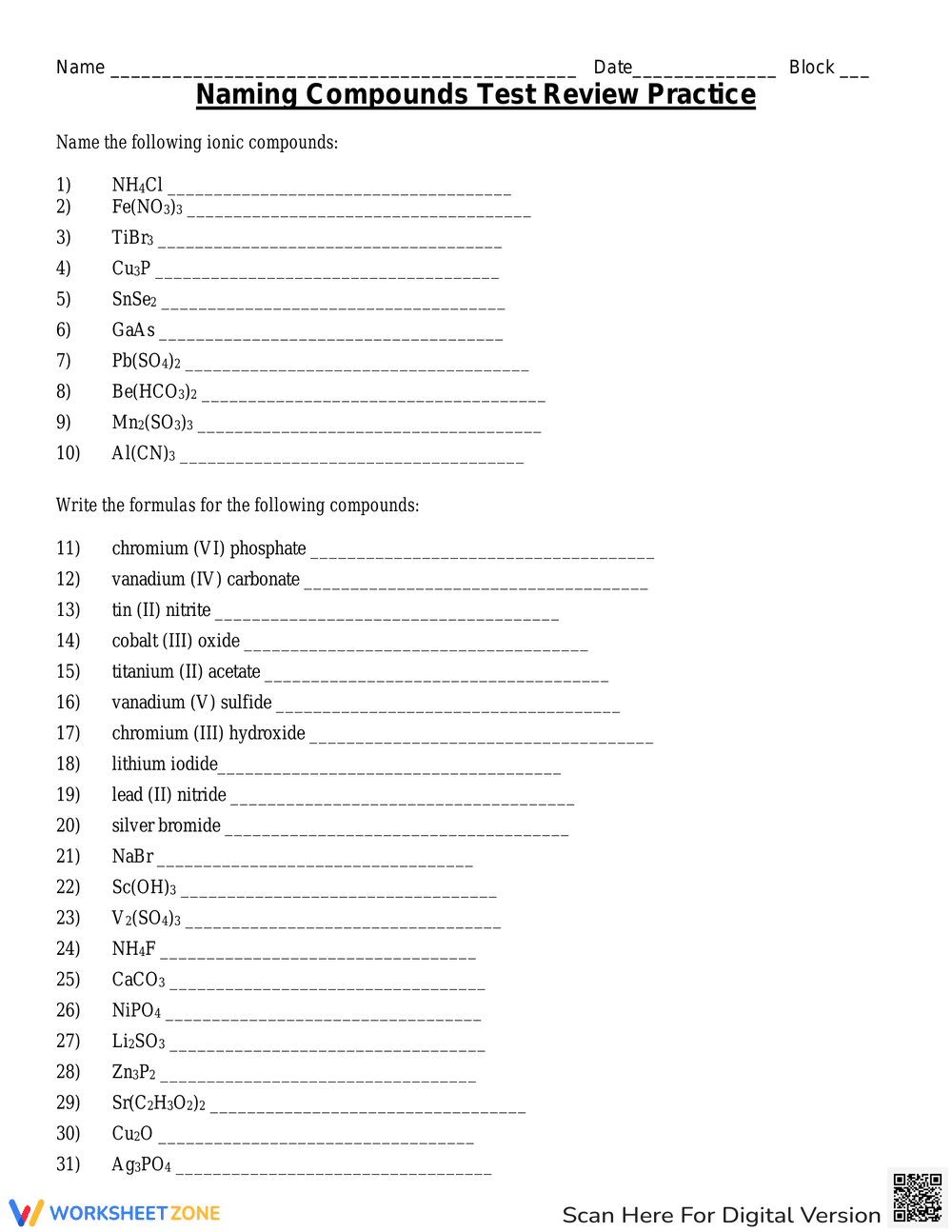
This is a chemistry worksheet titled 'Naming Compounds Test Review Practice'. It includes two sections: one asks students to name ionic compounds given their chemical formulas (e.g., NH4Cl, Fe(NO3)2), and the other asks students to write the chemical formulas for ionic compounds given their names (e.g., chromium (VI) phosphate, vanadium (IV) carbonate). The worksheet includes a variety of ionic compounds with different cations and anions.
Grade Level Suitability:
This worksheet is most suitable for high school chemistry students (Grades 9-12). The content requires knowledge of ionic bonding, nomenclature rules for naming ionic compounds, and the ability to determine charges of ions.
Why Use It:
This worksheet helps students practice and reinforce their understanding of naming and writing formulas for ionic compounds. It can be used as a test review, homework assignment, or in-class activity to assess student understanding of chemical nomenclature. It helps students develop skills in translating between chemical names and formulas.
How to Use It:
Students should use their knowledge of ionic compound nomenclature to either write the name of the compound given the formula, or write the formula given the name. They should use the periodic table and rules for determining ion charges to accurately write the formulas. The worksheet can be completed individually or in pairs.
Target Users:
The target users are high school chemistry students who are learning about ionic compounds and chemical nomenclature. Chemistry teachers can use this as a practice or assessment tool.
This is a chemistry worksheet titled 'Naming Compounds Test Review Practice'. It includes two sections: one asks students to name ionic compounds given their chemical formulas (e.g., NH4Cl, Fe(NO3)2), and the other asks students to write the chemical formulas for ionic compounds given their names (e.g., chromium (VI) phosphate, vanadium (IV) carbonate). The worksheet includes a variety of ionic compounds with different cations and anions.
Grade Level Suitability:
This worksheet is most suitable for high school chemistry students (Grades 9-12). The content requires knowledge of ionic bonding, nomenclature rules for naming ionic compounds, and the ability to determine charges of ions.
Why Use It:
This worksheet helps students practice and reinforce their understanding of naming and writing formulas for ionic compounds. It can be used as a test review, homework assignment, or in-class activity to assess student understanding of chemical nomenclature. It helps students develop skills in translating between chemical names and formulas.
How to Use It:
Students should use their knowledge of ionic compound nomenclature to either write the name of the compound given the formula, or write the formula given the name. They should use the periodic table and rules for determining ion charges to accurately write the formulas. The worksheet can be completed individually or in pairs.
Target Users:
The target users are high school chemistry students who are learning about ionic compounds and chemical nomenclature. Chemistry teachers can use this as a practice or assessment tool.


