


























1 / 2
0
Views
0
Downloads


0 Likes
Naming Type III Covalent Compounds
0 Views
0 Downloads
Paste this activity's link or code into your existing LMS (Google Classroom, Canvas, Teams, Schoology, Moodle, etc.).
Students can open and work on the activity right away, with no student login required.
You'll still be able to track student progress and results from your teacher account.
Information
Description
What It Is:
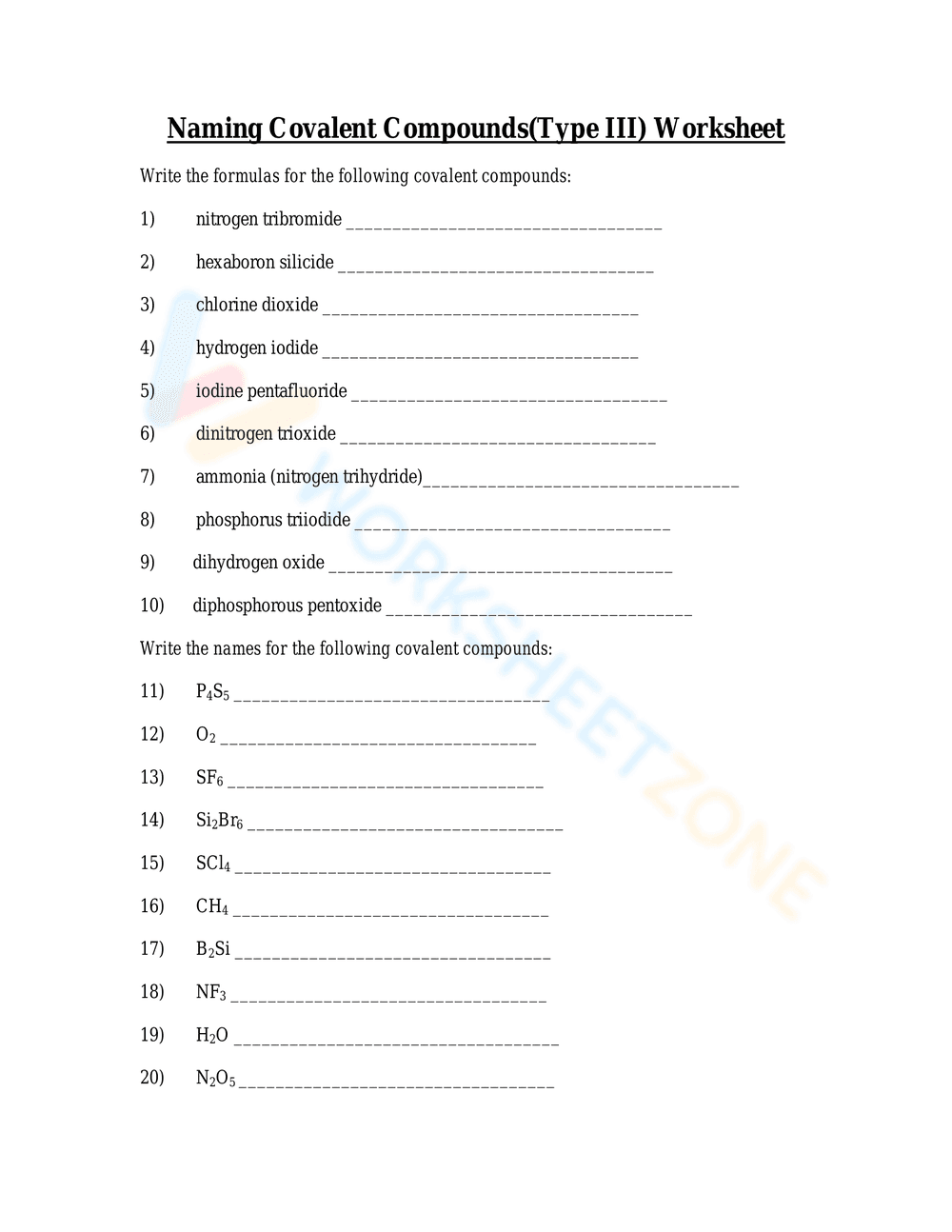
This is a chemistry worksheet focused on naming covalent compounds (Type III). The worksheet contains two sections. The first section provides the names of ten covalent compounds (e.g., nitrogen tribromide, hexaboron silicide) and asks the student to write the corresponding chemical formulas. The second section lists ten chemical formulas of covalent compounds (e.g., P₂S₅, O₂) and asks the student to write the names of the compounds.
Grade Level Suitability:
This worksheet is suitable for high school chemistry students, typically grades 9-12. It assumes a basic understanding of chemical nomenclature and formula writing, which is usually covered in introductory chemistry courses.
Why Use It:
This worksheet reinforces the rules for naming and writing formulas for covalent compounds. It helps students practice converting between chemical names and formulas, which is a fundamental skill in chemistry. It also tests their understanding of prefixes used to indicate the number of atoms of each element in the compound.
How to Use It:
Students should use their knowledge of chemical nomenclature rules to complete the worksheet. For the first section, they need to write the chemical formula based on the given name. For the second section, they need to write the name of the compound based on its chemical formula. Students may need access to a periodic table to identify the elements.
Target Users:
The target users are high school chemistry students who are learning or reviewing the nomenclature of covalent compounds. It can also be used as a practice or review activity for students preparing for chemistry exams.
This is a chemistry worksheet focused on naming covalent compounds (Type III). The worksheet contains two sections. The first section provides the names of ten covalent compounds (e.g., nitrogen tribromide, hexaboron silicide) and asks the student to write the corresponding chemical formulas. The second section lists ten chemical formulas of covalent compounds (e.g., P₂S₅, O₂) and asks the student to write the names of the compounds.
Grade Level Suitability:
This worksheet is suitable for high school chemistry students, typically grades 9-12. It assumes a basic understanding of chemical nomenclature and formula writing, which is usually covered in introductory chemistry courses.
Why Use It:
This worksheet reinforces the rules for naming and writing formulas for covalent compounds. It helps students practice converting between chemical names and formulas, which is a fundamental skill in chemistry. It also tests their understanding of prefixes used to indicate the number of atoms of each element in the compound.
How to Use It:
Students should use their knowledge of chemical nomenclature rules to complete the worksheet. For the first section, they need to write the chemical formula based on the given name. For the second section, they need to write the name of the compound based on its chemical formula. Students may need access to a periodic table to identify the elements.
Target Users:
The target users are high school chemistry students who are learning or reviewing the nomenclature of covalent compounds. It can also be used as a practice or review activity for students preparing for chemistry exams.


