


























1 / 3
0
Views
0
Downloads


0 Likes
Understand Net Ionic Equations
0 Views
0 Downloads
Paste this activity's link or code into your existing LMS (Google Classroom, Canvas, Teams, Schoology, Moodle, etc.).
Students can open and work on the activity right away, with no student login required.
You'll still be able to track student progress and results from your teacher account.
Information
Description
What It Is:
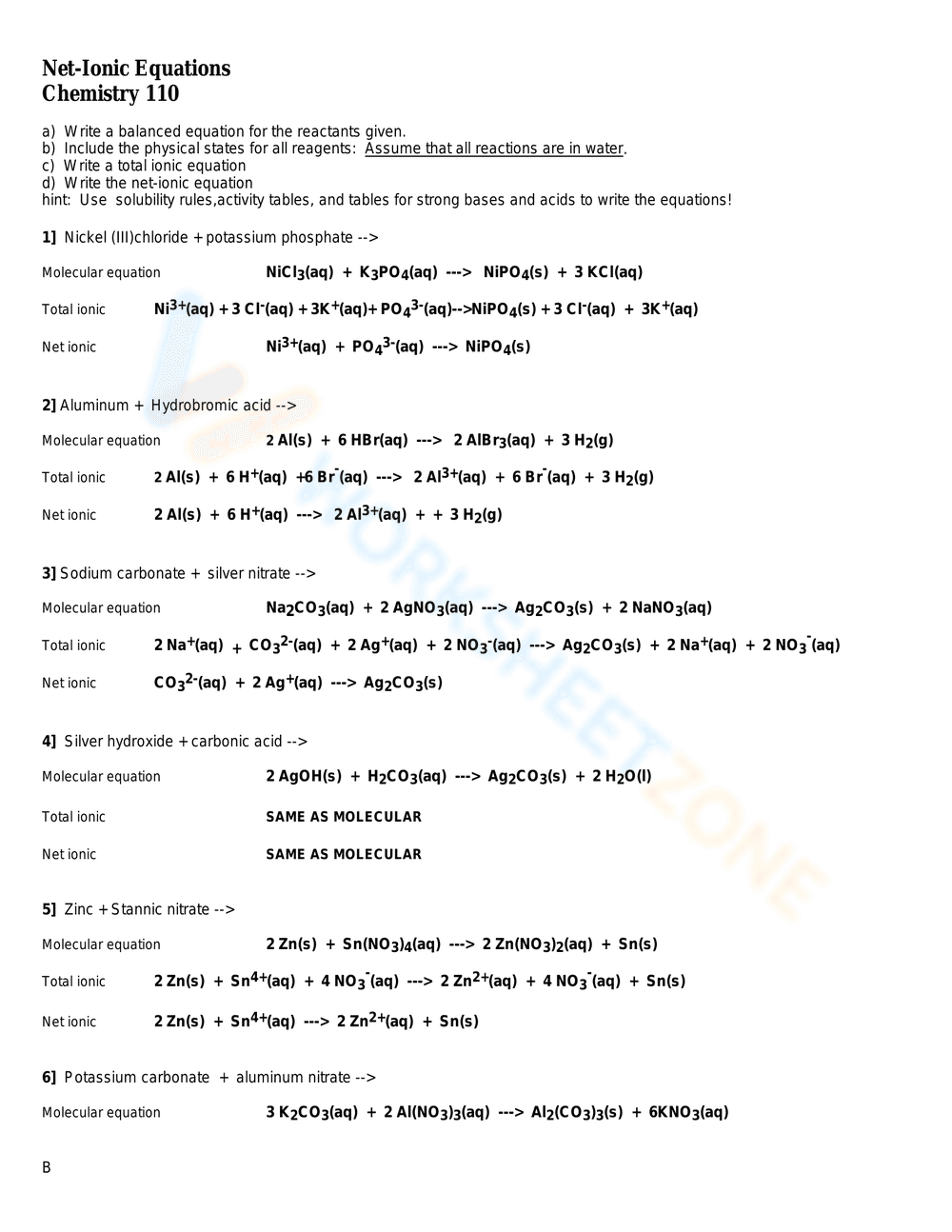
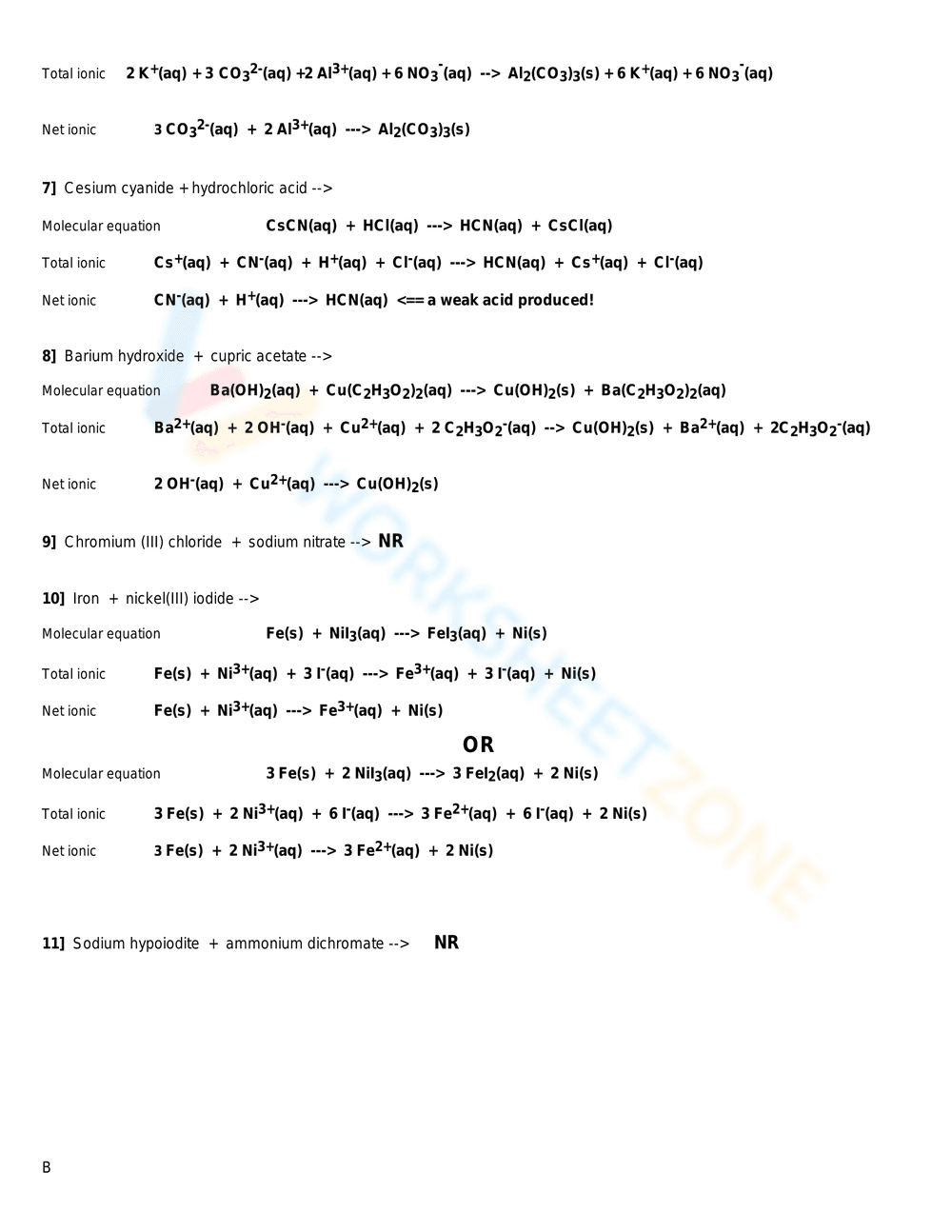
This is a chemistry worksheet focused on writing net-ionic equations. It presents six different chemical reactions, requiring students to write the balanced molecular equation, the total ionic equation, and the net ionic equation for each. The worksheet includes reactions such as Nickel (II) chloride + potassium phosphate, Aluminum + Hydrobromic acid, Sodium carbonate + silver nitrate, Silver hydroxide + carbonic acid, Zinc + Stannic nitrate, and Potassium carbonate + aluminum nitrate. The instructions at the top indicate students should include physical states for all reagents, assuming all reactions are in water, and use solubility rules and activity tables to write the equations.
Grade Level Suitability:
This worksheet is suitable for high school (Grades 11-12) or introductory college chemistry courses. The concepts of balancing equations, understanding ionic compounds, and applying solubility rules are typically taught at these levels.
Why Use It:
This worksheet helps students develop a strong understanding of chemical reactions in aqueous solutions. It reinforces the concepts of balancing equations, identifying spectator ions, and writing net ionic equations, which are essential skills for understanding chemical reactivity and stoichiometry.
How to Use It:
Students should first write the balanced molecular equation for each reaction, including the physical states (s, l, g, aq) of each reactant and product. Next, they should write the total ionic equation, showing all soluble ionic compounds as separate ions. Finally, they should identify and cancel out the spectator ions (ions that appear on both sides of the equation) to arrive at the net ionic equation.
Target Users:
The target users are high school chemistry students, college students taking introductory chemistry courses, and anyone studying chemical reactions and stoichiometry. It's also useful for teachers looking for practice problems on net ionic equations.
This is a chemistry worksheet focused on writing net-ionic equations. It presents six different chemical reactions, requiring students to write the balanced molecular equation, the total ionic equation, and the net ionic equation for each. The worksheet includes reactions such as Nickel (II) chloride + potassium phosphate, Aluminum + Hydrobromic acid, Sodium carbonate + silver nitrate, Silver hydroxide + carbonic acid, Zinc + Stannic nitrate, and Potassium carbonate + aluminum nitrate. The instructions at the top indicate students should include physical states for all reagents, assuming all reactions are in water, and use solubility rules and activity tables to write the equations.
Grade Level Suitability:
This worksheet is suitable for high school (Grades 11-12) or introductory college chemistry courses. The concepts of balancing equations, understanding ionic compounds, and applying solubility rules are typically taught at these levels.
Why Use It:
This worksheet helps students develop a strong understanding of chemical reactions in aqueous solutions. It reinforces the concepts of balancing equations, identifying spectator ions, and writing net ionic equations, which are essential skills for understanding chemical reactivity and stoichiometry.
How to Use It:
Students should first write the balanced molecular equation for each reaction, including the physical states (s, l, g, aq) of each reactant and product. Next, they should write the total ionic equation, showing all soluble ionic compounds as separate ions. Finally, they should identify and cancel out the spectator ions (ions that appear on both sides of the equation) to arrive at the net ionic equation.
Target Users:
The target users are high school chemistry students, college students taking introductory chemistry courses, and anyone studying chemical reactions and stoichiometry. It's also useful for teachers looking for practice problems on net ionic equations.


